We are accustomed to a universe defined by light. When we look up at night, we see a glittering tapestry of stars, planets, and galaxies. Light is our cosmic shorthand for existence.
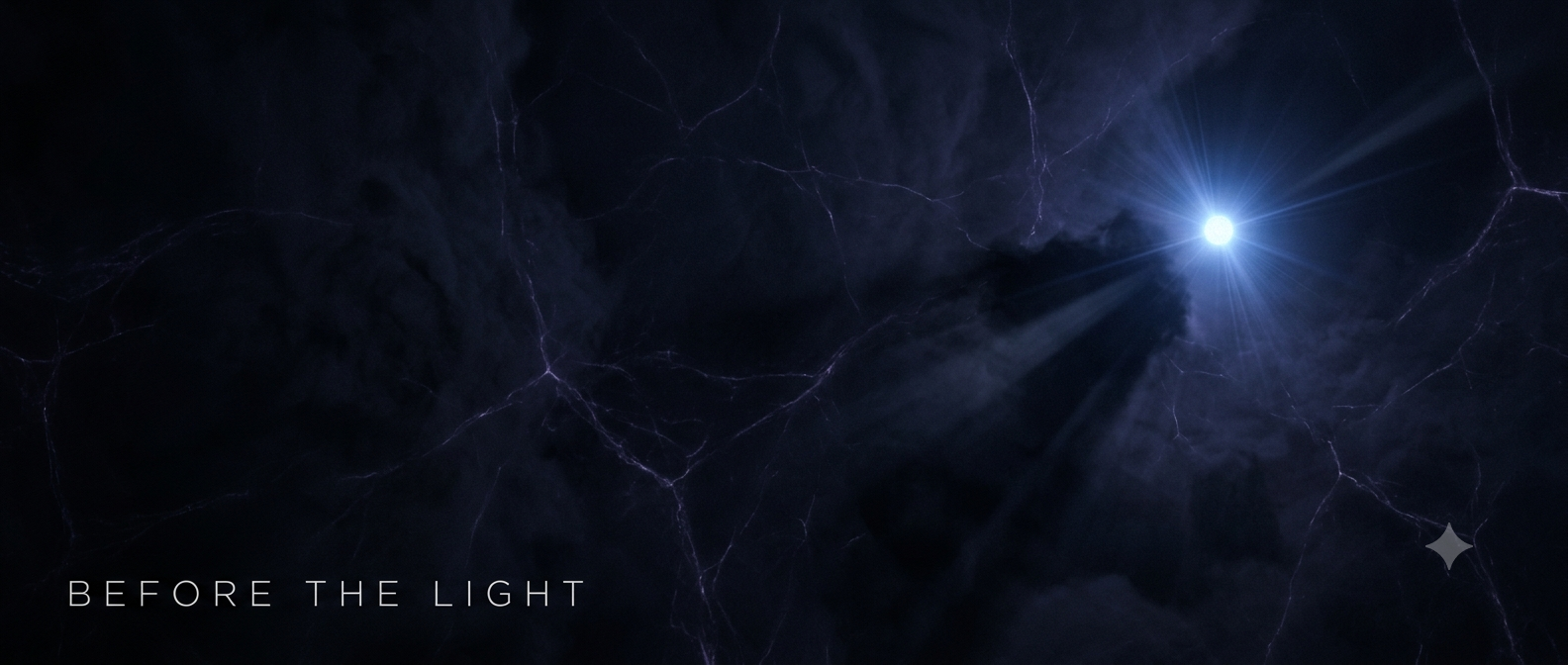
Yet, there was a time when the universe was completely, utterly blind.
Immediately following the violent, blinding flash of the Big Bang, the universe plunged into an era known to cosmologists as the Cosmic Dark Ages. For roughly 100 million to 200 million years, not a single star shone. There were no galaxies, no black holes, no planets, and no light. The cosmos was a cold, silent, and expanding ocean of primordial gas.
Understanding this mysterious blank page in cosmic history has become one of modern astronomy’s greatest challenges. With the help of deep-space observatories like the James Webb Space Telescope (JWST) and upcoming radio arrays, scientists are finally beginning to read the secrets written in the absolute dark.
The Architecture of the Void
The Dark Ages began roughly 380,000 years after the Big Bang. Before this point, the universe was a superheated, dense plasma soup where light was trapped, continually bouncing off free electrons.
But as the universe expanded, it cooled. Eventually, temperatures dropped enough for protons and electrons to combine into the very first neutral atoms—primarily hydrogen, with a small dash of helium. This monumental event is called Recombination.
The moment neutral hydrogen formed, space suddenly became transparent. The trapped primordial light was unleashed all at once, traveling freely across space. Today, we detect the stretched-out remains of that first flash as the Cosmic Microwave Background (CMB).
But once that initial flash faded into the infrared spectrum due to the expansion of space, absolute darkness set in. The universe had entered the Dark Ages. If you were floating in space during this epoch, you would see nothing but pitch-black emptiness stretching uniformly in every direction.
The Invisible Sculptor: Gravity and Dark Matter
Though the universe was dark and quiet on the outside, a monumental structural revolution was taking place beneath the shadows.
The primordial hydrogen gas was not perfectly distributed. Infinitesimal ripples in density—clumps where gas was just a fraction of a percent thicker than elsewhere—began to exert a tiny gravitational pull.
But hydrogen gas alone didn’t have enough mass to pull itself together quickly. The real heavy lifting was done by Dark Matter—the mysterious, invisible substance that interacts only via gravity.
During the Dark Ages, dark matter began to clump together into massive, invisible spheres called “halos.” These dark matter halos acted like cosmic gravity wells. Like water flowing down a funnel, the surrounding primordial hydrogen gas was dragged into these invisible wells, pooling into increasingly dense, superheated clouds at the center of the halos.
Without the invisible framework built by dark matter during the century of darkness, the gas would have drifted apart, and the universe might have remained a stagnant cloud forever.
The Dawn of Reality: Breaking the Dark
The Cosmic Dark Ages did not end with a sudden, synchronized explosion of light. Instead, it was broken by a scattered, violent awakening known as the Cosmic Dawn.
Deep inside the densest gas pockets within the dark matter halos, the gravity became overwhelming. The hydrogen gas was packed so tightly that temperatures skyrocketed to millions of degrees.
Once the core pressure crossed a critical threshold, nuclear fusion ignited. The very first stars—known as Population III stars—burst into existence.
These firstborn stars were monsters. Unlike our modest Sun, Population III stars were made purely of pristine hydrogen and helium, making them hundreds of times more massive and millions of times brighter than any stars alive today. They burned incredibly hot, shining with a brilliant, fierce blue-white light.
These stellar giants emitted torrential floods of high-energy ultraviolet radiation. This light sliced through the cold fog of the Dark Ages, ionizing the surrounding hydrogen gas and rendering space transparent once again in a process called Reionization.
The 100-million-year night was over. The cosmic dark had given birth to the foundations of the stars, heavy elements, and galaxies that would eventually build our world. By studying this period of total isolation, scientists aren’t just learning how the first stars turned on—they are discovering how the universe learned to create.
700 701 702 703 704 705 706 707 708 709 710 711 712 713 714 715 716 717 718 719 720 721 722 723 724 725 726 727 728 729 730 731 732 733 734 735 736 737 738 739 740 741 742 743 744 745 746 747 748 749 750 751 752 753 754 755 756 757 758 759 760 761 762 763 764 765 766 767 768 769 770 771 772 773 774 775 776 777 778 779 780 781 782 783 784 785 786 787 788 789 790 791 792 793 794 795 796 797 798 799 800 801 802 803 804 805 806 807 808 809 810 811 812 813 814 815 816 817 818 819 820 821 822