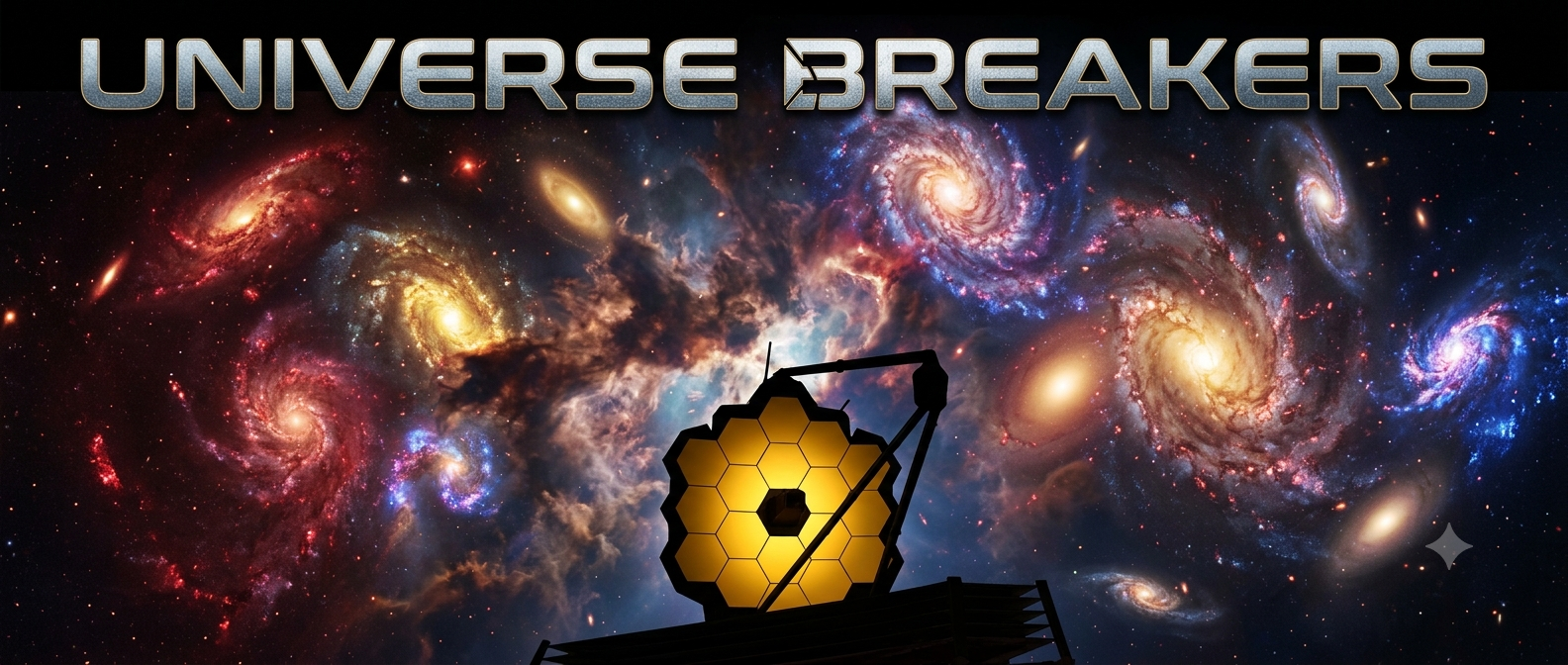
When the James Webb Space Telescope (JWST) unfolded its golden mirrors in the freezing depths of space, astrophysicists knew they were about to see the universe in a way humanity never had before. Designed to peer through thick clouds of cosmic dust and capture the ancient, stretched infrared light from the dawn of time, the JWST was built to answer a fundamental question: What did the very first galaxies look like?
According to our standard model of cosmology, the answer was supposed to be simple. The first galaxies should have been chaotic, fragile, and incredibly small—infant clusters of stars slowly pulling themselves together over billions of years.
Instead, the JWST looked into the deepest recesses of the ancient universe and found monsters.
Gazing back over 13 billion years—to a time when the universe was only 500 to 700 million years old, a mere 3% of its current age—astronomers spotted massive, fully formed galaxies. They are bursting with mature red stars and boasting masses comparable to our own Milky Way. There is only one problem: according to everything we know about physics and cosmic evolution, these structures simply should not exist.
The “Universe Breakers”
To understand why this discovery has sent shockwaves through the astrophysics community, we must look at how galaxies are traditionally understood to grow.
In the standard model of cosmology, known as Lambda-CDM, the early universe was a dark, expanding soup of hydrogen, helium, and dark matter. Slowly, dark matter clumped together, creating gravitational wells that pulled in standard gas. This gas eventually ignited to form the first stars, which eventually grouped together into the first dwarf galaxies. Growing a massive, structured galaxy like the Milky Way is a painstaking, step-by-step process requiring billions of years of mergers and gas accretion.
Yet, the JWST’s deep-field observations revealed a half-dozen “candidate” galaxies from the cosmic dawn that are overwhelmingly massive.
A Defiance of Time: Finding these colossal structures so soon after the Big Bang is akin to excavating a prehistoric archaeological site and finding a fully assembled, modern skyscraper buried among stone tools. The timeline simply does not allow for it.
Because these galaxies are so wildly out of sync with our timeline of the cosmos, astronomers quickly dubbed them “Universe Breakers.”
Did We Get the Big Bang Wrong?
The discovery of these impossible early galaxies has sparked a fierce debate among astrophysicists. If the observations are correct—and the masses and distances of these galaxies are accurately measured—it means our understanding of the universe’s infancy is fundamentally flawed.
Scientists are currently wrestling with a few mind-bending possibilities:
-
Star Formation was Hyper-Accelerated: In the dense, hot environment of the early universe, stars might have formed in a radically different, wildly more efficient manner than they do today. Instead of a slow burn, the early universe might have been an explosive engine of star creation, bypassing the slow, clumpy growth we previously modeled.
-
The Nature of Dark Matter: Dark matter, the invisible scaffolding of the cosmos, might behave differently than we think. If dark matter clumped together much faster in the early universe, it could have provided the rapid gravitational blueprints needed to build these massive galaxies.
-
Black Hole Trickery: Some scientists suggest that the extreme brightness of these ancient objects might not be entirely from stars. Supermassive black holes actively consuming gas at the centers of these galaxies could be producing immense amounts of light, making the galaxies appear much more massive and star-filled than they actually are.
The Next Frontier in Cosmology
The JWST has not just opened a new window into space; it has held a mirror up to the gaps in our own scientific models. The “Universe Breakers” are forcing physicists to rethink the fundamental laws that govern the assembly of the cosmos.
As the telescope continues its observations, capturing spectroscopic data to confirm the exact masses and chemical makeups of these ancient titans, one thing is already clear. The early universe was not a quiet, slow-moving nursery. It was a turbulent, fiercely active forge that produced cosmic behemoths long before we thought it was possible—proving, once again, that the cosmos is vastly stranger than we can imagine.
700 701 702 703 704 705 706 707 708 709 710 711 712 713 714 715 716 717 718 719 720 721 722 723 724 725 726 727 728 729 730 731 732 733 734 735 736 737 738 739 740 741 742 743 744 745 746 747 748 749 750 751 752 753 754 755 756 757 758 759 760 761 762 763 764 765 766 767 768 769 770 771 772 773 774 775 776 777 778 779 780 781 782 783 784 785 786 787 788 789 790 791 792 793 794 795 796 797 798 799 800 801 802 803 804 805 806 807 808 809 810 811 812 813 814 815 816 817 818 819 820 821 822