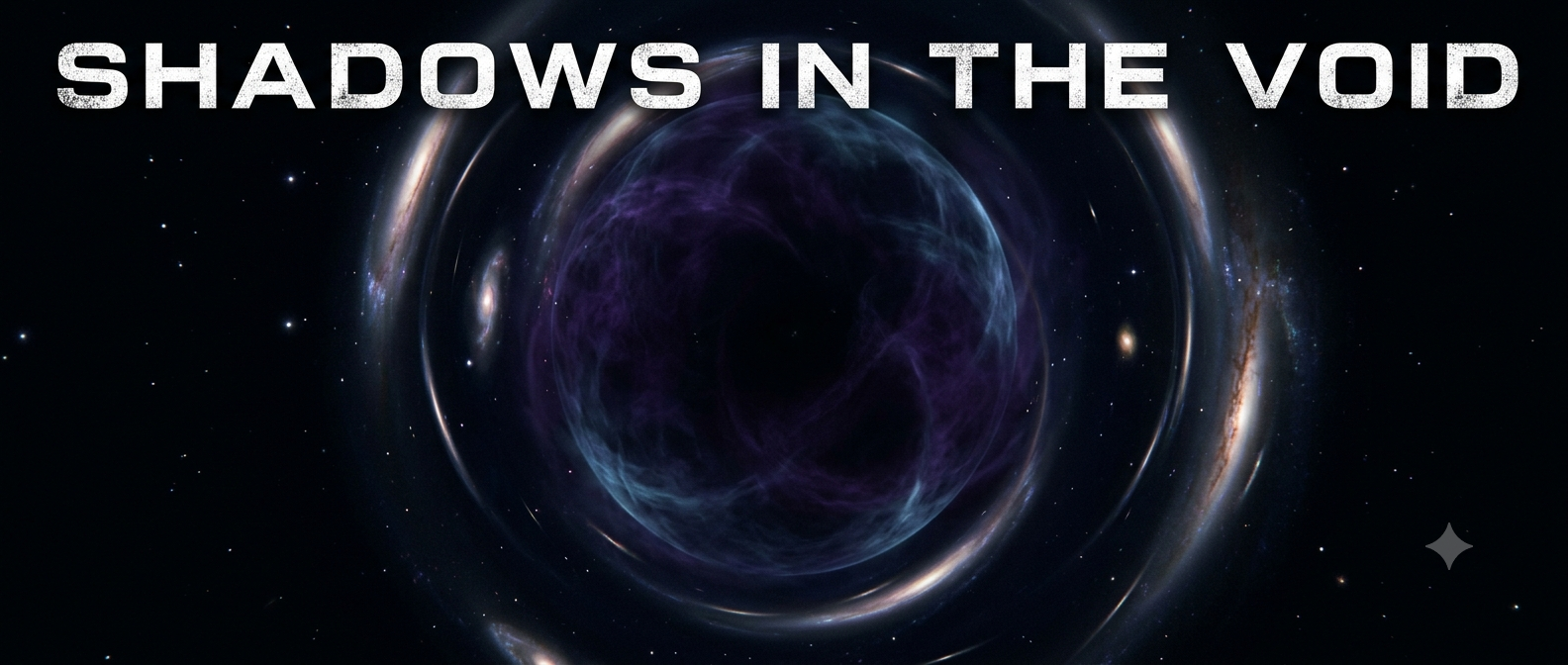
When we picture a galaxy, we envision a blindingly radiant metropolis of light. Structures like our own Milky Way or the neighboring Andromeda galaxy are defined by their brilliance, illuminated by the thermonuclear fires of hundreds of billions of stars, wrapped in glowing nebulae, and anchored by supermassive black holes.
But what if you removed the stars? What if a galaxy possessed the immense gravitational mass of the Milky Way, yet emitted almost no light at all?
For decades, such an idea was purely theoretical. Then, astronomers peered into the Coma Cluster—a massive grouping of galaxies roughly 320 million light-years from Earth—and discovered an astrophysical nightmare. They found a phantom. It is called Dragonfly 44, and it is one of the most unsettling structures in the known universe: a “ghost galaxy” made almost entirely of invisible dark matter.
The Phantom Behemoth
At first glance, Dragonfly 44 doesn’t look like a galaxy at all. Through a telescope, it appears as nothing more than a faint, barely perceptible smudge against the inky blackness of deep space. It lacks the majestic spiral arms, the dense central bulge, and the glittering star fields that characterize normal galaxies.
Yet, when scientists measured the velocity of the few stars that do exist within this faint smudge, they realized something impossible was happening.
The stars were moving far too fast. In astrophysics, the speed at which stars orbit the center of a galaxy is directly tied to the galaxy’s total mass. If Dragonfly 44 only contained the mass of its visible stars, it should have ripped itself apart eons ago; there simply wasn’t enough visible gravity to hold the structure together.
Calculations revealed that Dragonfly 44 is roughly a trillion times more massive than our Sun—putting it in the exact same weight class as the Milky Way. But while the Milky Way boasts up to 400 billion stars, Dragonfly 44 has less than one percent of that.
It is a galactic heavyweight completely stripped of its flesh, leaving only an invisible skeleton.
The 99.9% Mystery
To understand how a ghost galaxy can exist, we must look to the most elusive substance in the cosmos: dark matter.
Dark matter does not emit, reflect, or absorb light. It is completely invisible to the electromagnetic spectrum. We only know it exists because of its gravitational effect on the visible universe. In a standard galaxy, dark matter acts as the cosmic scaffolding, outnumbering normal, visible matter by a ratio of about five to one.
Dragonfly 44 shatters that ratio.
Observations suggest that this ghost galaxy is composed of 99.99% dark matter. The normal matter—the stuff that makes up stars, planets, dust, and humans—accounts for a mere one-hundredth of one percent of its total mass.
A Realm of Shadows: If you were to travel to Dragonfly 44, the sky would be an abyss. Without the dense concentration of starlight we are accustomed to, the space within this galaxy would be overwhelmingly cold, dark, and empty. You would be standing in the middle of a massive gravitational vortex, surrounded by the crushing weight of a trillion suns, without being able to see a single thing.
A Cosmic Graveyard or a New Paradigm?
How does a galaxy become a ghost? Astrophysicists are currently divided, but the prevailing theories point toward violent, cosmic disruption.
One hypothesis is that ghost galaxies like Dragonfly 44 are “failed galaxies.” Billions of years ago, when the universe was young, this massive halo of dark matter may have begun to pull in normal hydrogen gas to form stars. But something stopped it. Perhaps an onslaught of intense radiation from a neighboring galaxy blew the star-forming gas away, or perhaps the galaxy expanded too rapidly, dispersing the gas before it could ignite into stars.
Instead of blossoming into a vibrant spiral of light, the galaxy was prematurely quenched. It became a cosmic graveyard before it was ever truly born.
The discovery of Dragonfly 44 has profoundly disturbed our understanding of galactic evolution. It proves that the universe does not strictly require stars, gas, or light to build a galaxy. It only requires gravity.
As our telescopes become more advanced, astronomers are beginning to find more of these ultra-diffuse, dark matter-dominated structures drifting through the void. They serve as a chilling reminder of how little we truly see. We are surrounded by a universe of light, completely oblivious to the massive, invisible ghosts silently moving in the dark.
700 701 702 703 704 705 706 707 708 709 710 711 712 713 714 715 716 717 718 719 720 721 722 723 724 725 726 727 728 729 730 731 732 733 734 735 736 737 738 739 740 741 742 743 744 745 746 747 748 749 750 751 752 753 754 755 756 757 758 759 760 761 762 763 764 765 766 767 768 769 770 771 772 773 774 775 776 777 778 779 780 781 782 783 784 785 786 787 788 789 790 791 792 793 794 795 796 797 798 799 800 801 802 803 804 805 806 807 808 809 810 811 812 813 814 815 816 817 818 819 820 821 822