For decades, humanity’s search for extraterrestrial life has been fixated on the red deserts of Mars. We have scanned its rusted sands for microscopic fossils and chased the ghost of water that dried up billions of years ago.
But a growing contingent of astrobiologists believes we have been looking in the wrong direction.
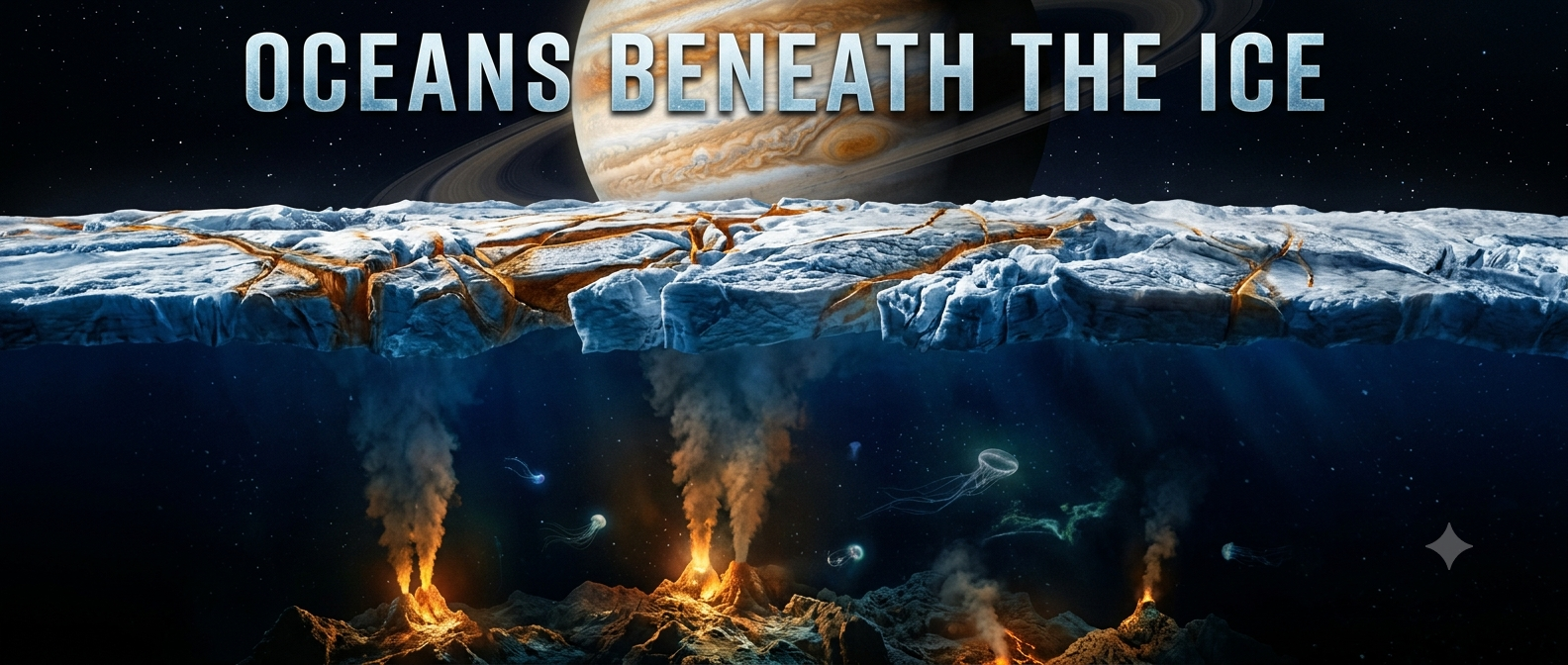
Instead of a dry planet close to home, the most promising sanctuary for alien life in our solar system may be a frozen, cracked cue ball of a moon orbiting nearly 500 million miles away in the radiation-choked domain of Jupiter. This is Europa. Beneath its blinding, hyper-reflective shell of solid ice lies a global, pitch-black ocean that contains more liquid water than all of Earth’s oceans combined—and it might just possess everything required to spark biology.
The Planetary Engine: Tidal Flexing
At first glance, Europa seems like an impossible place for liquid water. Its surface temperature never rises above -225°F (-143°C), freezing its outer crust into a shell of water ice estimated to be 10 to 15 miles thick.
However, Europa is caught in a violent gravitational tug-of-war. As it orbits Jupiter, it is relentlessly pulled by the immense gravity of the gas giant on one side and its sibling moons, Io and Ganymede, on the other. This cosmic stretching and squeezing is a phenomenon known as tidal flexing.
[Jupiter's Gravity] ⟲ [Europa's Core: Friction & Heat] ⟳ [Neighboring Moons]
This constant physical distortion creates immense internal friction, warming Europa’s rocky interior from the inside out. This geothermal engine melts the underside of the icy crust, maintaining a spectacular, global subsurface ocean that could be up to 60 to 100 miles deep. While Earth’s oceans are a mere film on our planet’s surface, Europa’s hidden sea is a colossal, abyssal realm of unfathomable proportions.
The Three Pillars of Habitability
To sustain life as we know it, an environment requires three core ingredients: liquid water, essential chemical elements (like carbon, hydrogen, nitrogen, and oxygen), and an energy source. Europa checks every single box.
-
Abundant Water: As a global liquid matrix, Europa’s ocean provides the ultimate medium for chemical reactions and biological mobility.
-
Chemical Delivery: The chaotic fractures scarring Europa’s surface—known as lineae—suggest the icy shell is dynamic. Heavy radiation from Jupiter strikes the surface ice, breaking molecules apart to create oxidants. Through tectonic churning and cryovolcanic upwelling, these life-supporting chemicals are dragged down into the dark waters below.
-
An Energy Source: Because sunlight cannot penetrate the miles-thick ice sheet, photosynthesis is impossible. Instead, life on Europa would rely on chemosynthesis. Scientists hypothesize that the moon’s geothermally heated seafloor is littered with hydrothermal vents. On Earth, such vents are teeming with bizarre ecosystems—shrimp, tube worms, and extreme bacteria—that thrive entirely independent of sunlight, feeding on the rich chemical soup spewing from the planet’s core.
The Deep-Sea Analogy: If life can flourish in the pitch-black, crushing pressures of Earth’s Mariana Trench using nothing but geothermal energy, there is no physical reason it cannot do the exact same thing in the abyssal depths of Europa.
Piercing the Frozen Shield
Humanity is finally moving past theory and entering the era of direct exploration. NASA’s Europa Clipper mission is currently journeying through deep space, packed with advanced ice-penetrating radar, magnetometers, and thermal imagers. It aims to map the moon’s icy shell and determine precisely how habitable this hidden ocean truly is.
We no longer have to dream of finding life around distant stars light-years away. The ultimate breakthrough in human history may be waiting for us right inside our own solar system, swimming in the warm, dark, volcanic depths of an icy moon. If life can take hold in the subterranean darkness of Europa, it means the universe isn’t a barren desert—it is an ocean teeming with possibilities.
700 701 702 703 704 705 706 707 708 709 710 711 712 713 714 715 716 717 718 719 720 721 722 723 724 725 726 727 728 729 730 731 732 733 734 735 736 737 738 739 740 741 742 743 744 745 746 747 748 749 750 751 752 753 754 755 756 757 758 759 760 761 762 763 764 765 766 767 768 769 770 771 772 773 774 775 776 777 778 779 780 781 782 783 784 785 786 787 788 789 790 791 792 793 794 795 796 797 798 799 800 801 802 803 804 805 806 807 808 809 810 811 812 813 814 815 816 817 818 819 820 821 822