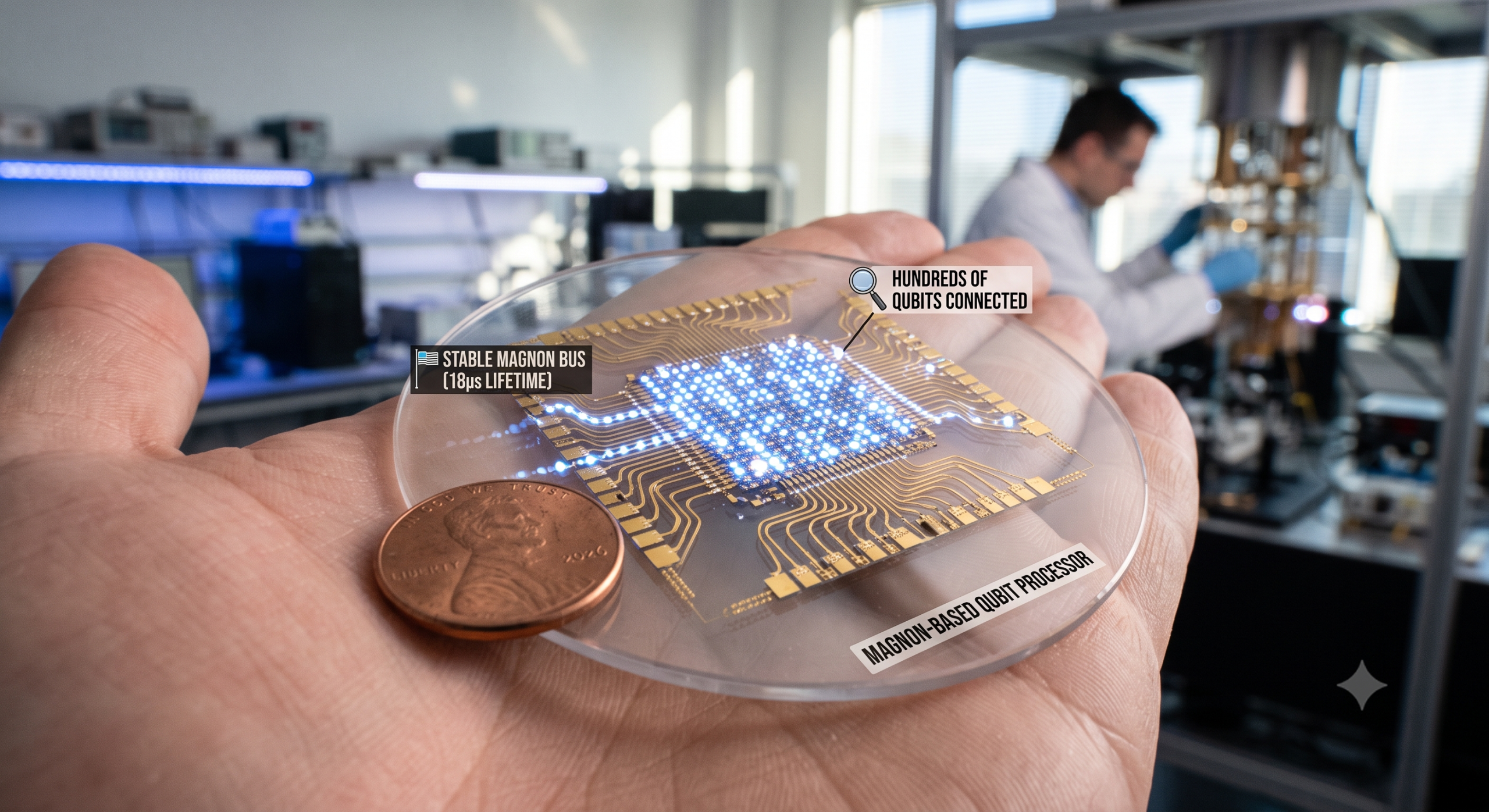
The long-standing joke in advanced physics labs has always been that practical, large-scale quantum computing is forever twenty years away. However, a major breakthrough has turned that timeline on its head, shifting the focus from abstract theoretical physics to immediate materials science. A team of researchers has successfully transformed fleeting magnetic waves into highly stable carriers of quantum information, potentially clearing the path for powerful quantum computers no larger than a standard penny.
The study centers around subatomic particles known as magnons, which are collective, wave-like excitations of electron spins inside a magnetic structure. For decades, physicists viewed magnons as highly promising candidates for quantum processing because they naturally interact with many different quantum systems and can act as universal translators between conflicting hardware architectures.
The fatal flaw, however, was their lifespan. Typically, a magnon would disintegrate within a few hundred nanoseconds, a window far too brief to reliably store, manipulate, or route information through a processor.
Extending the Quantum Clock
The breakthrough came when a research team successfully extended the operational lifetime of these fragile magnetic waves by nearly 100 times, pushing their survival threshold up to 18 microseconds. This lifespan suddenly elevates magnons into the same operational performance tier as the ultra-expensive, superconducting qubits currently championed by tech giants like IBM and Google.
Even more surprising was what the scientists discovered when troubleshooting the limits of the particles. By testing multiple crystalline spheres of Yttrium Iron Garnet (YIG) with varying degrees of structural integrity, the researchers determined that the primary bottleneck limiting magnon survival is not a fixed, unyielding law of quantum mechanics. Instead, it is simply a manufacturing limitation regarding the physical purity of the hosting crystal.
This realization shifts the engineering burden completely. Future optimization does not require an entirely new discovery in physics; rather, it requires better manufacturing pipelines capable of producing hyper-pure materials.
Building the First Miniature Quantum Bus
The ability to keep magnons stable for microseconds unlocks several immediate technological advantages:
-
The Scale Problem: Traditional quantum computing rigs require massive, room-sized dilution refrigerators that keep superconducting qubits cooled to temperatures colder than deep space to prevent environmental interference. Because magnons pack quantum information tightly into localized microscopic magnetic waves, they could allow hundreds of qubits to connect through a shared tiny pathway. This creates a dense “quantum bus” that cuts down physical space requirements drastically.
-
The Encryption Dilemma: This hardware leap arrives precisely as the wider cybersecurity industry braces for the eventual arrival of code-breaking quantum systems. Financial institutions and blockchain networks are already accelerating their defense frameworks due to separate 2026 mathematical models that slashed the theoretical resource gap needed to break traditional encryption protocols by twenty-fold.
By turning what was once a fleeting subatomic vibration into a resilient, long-lasting digital asset, materials scientists are quietly building the physical bridge needed to drag quantum computing out of highly specialized laboratories and into the commercial grid.
To better understand how these hardware innovations are transitioning from theoretical physics experiments into real-world manufacturing pipelines, watch this deep dive on Quantum Computing in 2026. This video breaks down the specific technical shifts occurring this year as global tech leaders race to move fragile qubits across silicon chips without breaking their quantum states.
700 701 702 703 704 705 706 707 708 709 710 711 712 713 714 715 716 717 718 719 720 721 722 723 724 725 726 727 728 729 730 731 732 733 734 735 736 737 738 739 740 741 742 743 744 745 746 747 748 749 750 751 752 753 754 755 756 757 758 759 760 761 762 763 764 765 766 767 768 769 770 771 772 773 774 775 776 777 778 779 780 781 782 783 784 785 786 787 788 789 790 791 792 793 794 795 796 797 798 799 800 801 802 803 804 805 806 807 808 809 810 811 812 813 814 815 816 817 818 819 820 821 822