NASA’s premier astrobiology mission is coming home—but only long enough to catch its breath and steal a little momentum.
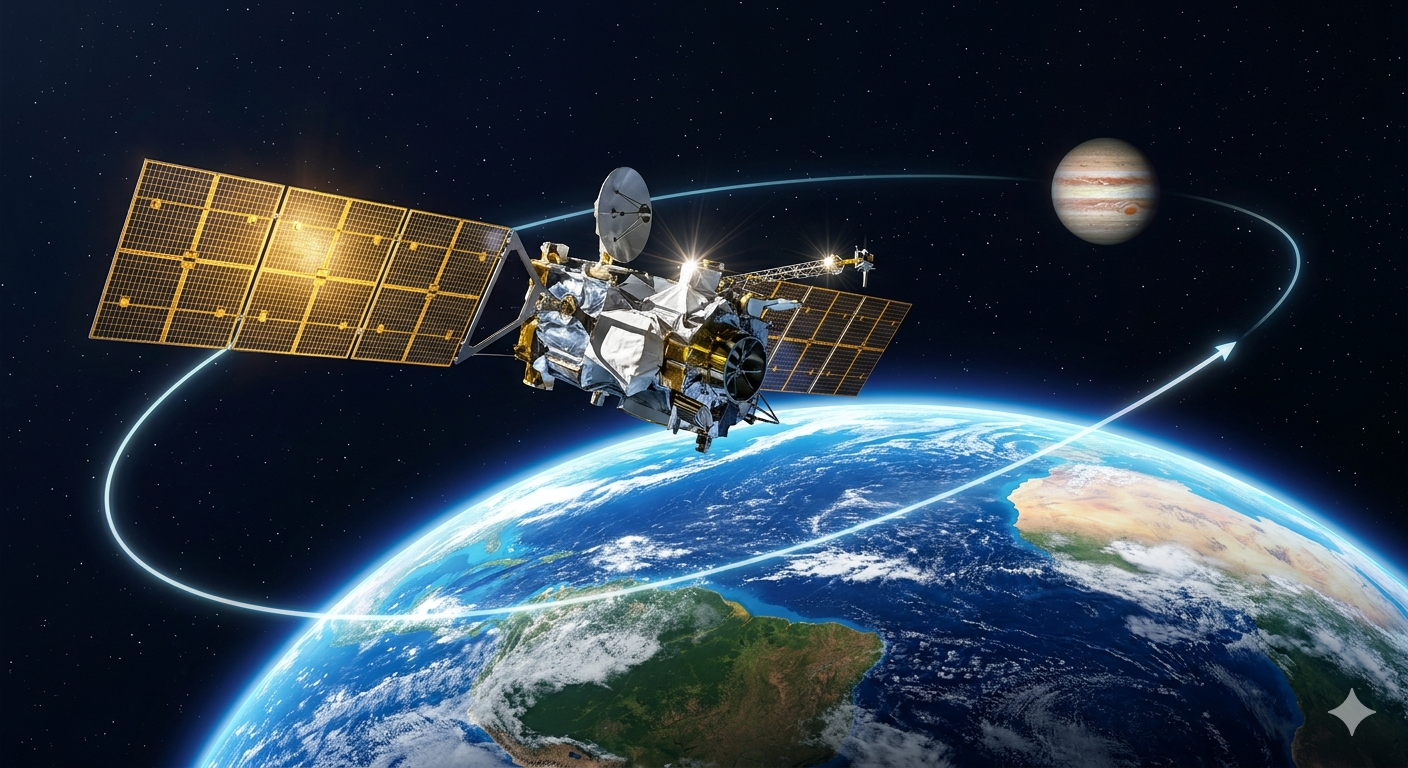
On December 3, 2026, the Europa Clipper spacecraft is scheduled to pull off a daring, ultra-close flyby of Earth. Hurtling through deep space on its multi-year journey to investigate Jupiter’s icy moon, the probe will dive to a microscopic altitude of just 3,200 kilometers above our planet’s surface. By skimming the upper boundaries of Earth’s gravitational well, the spacecraft will execute a textbook gravity-assist maneuver, effectively slingshotting itself outward toward the harsh environments of the outer solar system.
The Mechanics of the “MEGA” Trajectory
To reach a destination as distant as Jupiter without equipping an impossibly heavy and expensive amount of rocket fuel, space agencies rely on orbital billiards. Europa Clipper’s current route is known to flight navigators as a Mars-Earth Gravity Assist (MEGA) trajectory.
The spacecraft originally blasted off from Florida in October 2024. In March 2025, it performed its first gravity-assist maneuver by swinging past Mars, which reshaped its orbit around the Sun and threw it back toward its home planet. This December’s encounter with Earth is the final, definitive speed boost the probe needs to line up a straight, high-speed sprint across the asteroid belt.
Flyby At-A-Glance
| Flight Metric / Objective | Mission Parameters |
| Flyby Date | December 3, 2026 |
| Closest Approach Altitude | ~3,200 kilometers above the surface |
| Trajectory Type | Mars-Earth Gravity Assist (MEGA) |
| Key Instrument Goals | Calibration of the ECM Magnetometer and PIMS instruments |
| Jovian System Arrival | April 11, 2030 |
A Golden Opportunity for Science Calibrations
While flight engineers at NASA’s Jet Propulsion Laboratory (JPL) are primarily focused on the critical steering and velocity gains of the flyby, planetary scientists are eager to treat the temporary homecoming as a vital checkout phase.
Because Earth possesses a robust and highly mapped magnetic field, passing so close offers the mission team a pristine baseline environment. Scientists intend to use the planet’s magnetosphere to perform the only post-launch absolute calibration of the Europa Clipper Magnetometer (ECM).
“This Earth flyby is arguably our most important operational milestone of the entire cruise phase,” notes the engineering team’s planning brief. “By testing our suite of sensitive instruments against the known environments of Earth, we ensure every sensor is perfectly tuned and ready for the extreme radiation and magnetic fields of Jupiter.”
Additionally, the close proximity will allow operators to cross-calibrate the Plasma Instrument for Magnetic Sounding (PIMS) against data from nearby Earth-orbiting science satellites, verifying that the hardware behaves exactly as it did during laboratory assembly.
Destination: An Ocean World
Once Europa Clipper clears Earth’s shadow on December 3, it will leave its home world behind for the final time. The velocity gained during this maneuver will lock the probe onto a path toward its ultimate arrival in the Jovian system on April 11, 2030.
Once nestled into an elliptical orbit around Jupiter, Europa Clipper will conduct nearly 50 low-altitude flybys of the moon Europa. The goal is to peer beneath the moon’s heavily fractured, frozen crust to study its massive subsurface liquid ocean, determining whether the chemical conditions beneath the ice could support extraterrestrial microbial life.
1 2 3 4 5 6 7 8 9 10 11 12 13 14 15 16 17 18 19 20 21 22 23 24 25 26 27 28 29 30 31 32 33 34 35 36 37 38
700 701 702 703 704 705 706 707 708 709 710 711 712 713 714 715 716 717 718 719 720 721 722 723 724 725 726 727 728 729 730 731 732 733 734 735 736 737 738 739 740 741 742 743 744 745 746 747 748 749 750 751 752 753 754 755 756 757 758 759 760 761 762 763 764 765 766 767 768 769 770 771 772 773 774 775 776 777 778 779 780 781 782 783 784 785 786 787 788 789 790 791 792 793 794 795 796 797 798 799 800 801 802 803 804 805 806 807 808 809 810 811 812 813 814 815 816 817 818 819 820 821 822