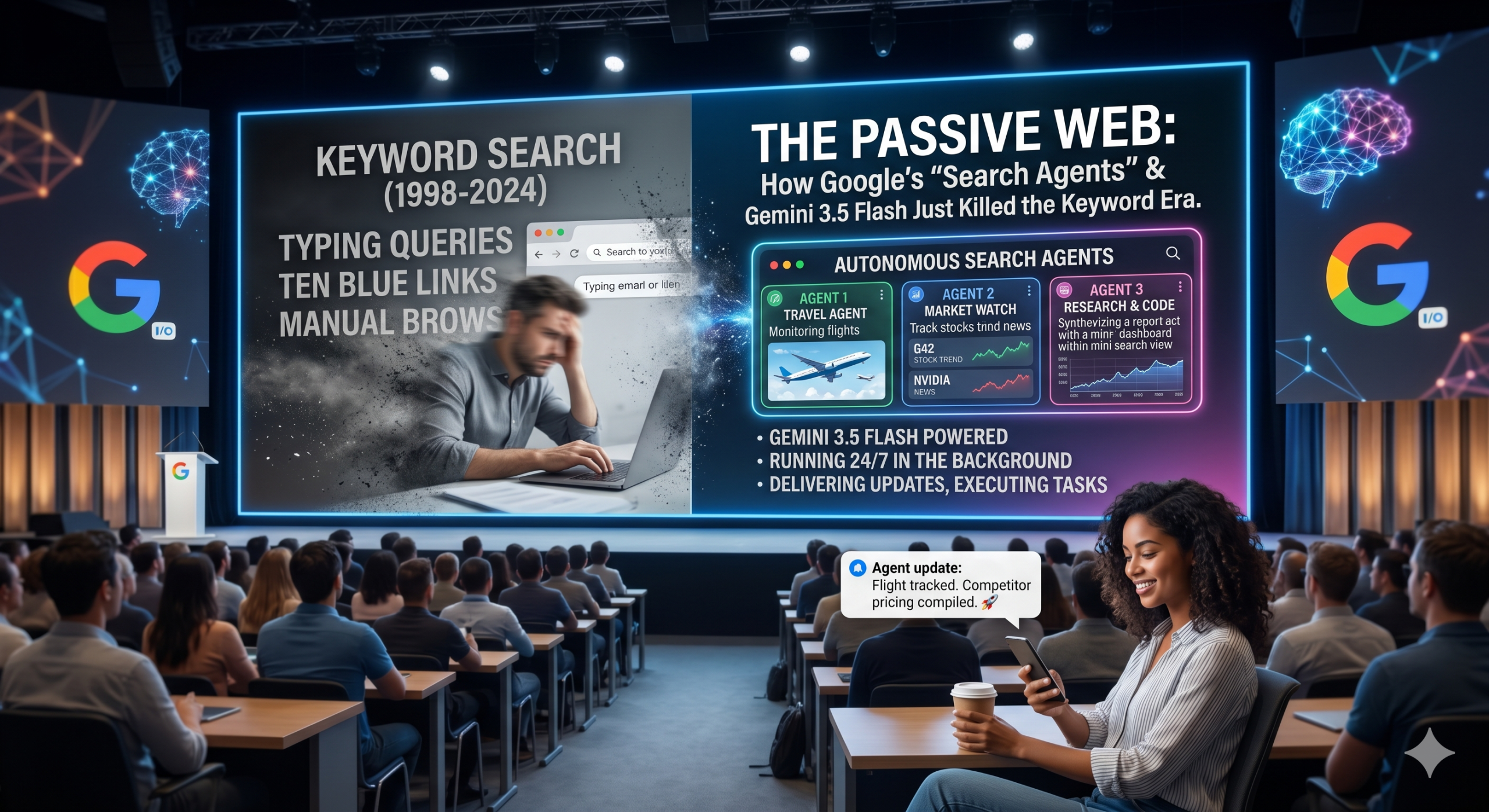
MOUNTAIN VIEW, CA — For over two decades, the internet economy has operated on a simple, foundational contract: a user types keywords into a blank box, and a search engine returns a list of links. At Google I/O, the tech giant officially tore up that contract, unveiling a structural paradigm shift from manual query-based search to autonomous, background “Search Agents” powered by the newly minted Gemini 3.5 Flash model.
The announcement marks the widest scale deployment of “agentic” AI to date. Rather than simply answering a single question, Google is transitioning its massive search infrastructure—which recently crossed 1 billion monthly active users in its unified AI Mode—into a platform where users delegate open-ended, complex tasks to digital entities that execute them over hours, days, or weeks.
Gemini 3.5 Flash: The Engine of the Agentic Era
At the core of this transformation is Gemini 3.5 Flash, Google’s latest multimodal reasoning model. Architected specifically for the rapid, iterative loops required by autonomous software, Gemini 3.5 Flash delivers near-Pro-level intelligence with massive parallel execution capabilities.
Crucially, the model brings advanced coding proficiency directly into the browser. Combined with Google’s internal “Antigravity” system, Search can now deploy agentic coding on the fly. When a user asks a complex, multi-part question, the underlying model doesn’t just pull data—it dynamically programs a custom user interface, building tailored trackers, comparison tables, or mini-dashboards right inside the search results to fit the user’s exact intent.
Meet Your 24/7 Information Agents
The most disruptive feature showcased at I/O is the introduction of “Information Agents,” rolling out to Google AI Pro and Ultra subscribers. These are personalized AI assistants that run continuously in the background of a user’s Google account, removing the need to ever initiate a manual search for ongoing tasks.
Instead of repeatedly checking websites for real-time updates, users can brief an Information Agent once. For instance, a small business owner can task an agent with monitoring market competitor pricing, tracking real-time material supply listings, or watching for changes in complex regulatory filings. The agent works around the clock, continuously reasoning across news sites, blogs, and unstructured web data. Once it synthesizes a critical update or discovers an optimal deal, it sends a comprehensive recommendation directly to the user via the Google App.
A Seismic Shock to the Open Web
While the feature promises unprecedented convenience for consumers and small businesses, it introduces a profound shift for search engine optimization (SEO) and digital brands.
As Information Agents move users into a passive state of discovery, the traditional consumer journey—clicking through “ten blue links” to browse multiple websites—is being bypassed. Because these background agents read raw site data and interact with APIs, web ecosystems will be forced to transition away from traditional keyword targeting. To survive in an ecosystem driven by autonomous agents, brands will need to ensure their data is highly structured, actionable, and refreshed in real time, adapting to a world where machines, not humans, do the shopping.
Google’s background agents are scheduled for a phased global rollout, signaling a future where the best way to search the web is to let an agent do it for you.
700 701 702 703 704 705 706 707 708 709 710 711 712 713 714 715 716 717 718 719 720 721 722 723 724 725 726 727 728 729 730 731 732 733 734 735 736 737 738 739 740 741 742 743 744 745 746 747 748 749 750 751 752 753 754 755 756 757 758 759 760 761 762 763 764 765 766 767 768 769 770 771 772 773 774 775 776 777 778 779 780 781 782 783 784 785 786 787 788 789 790 791 792 793 794 795 796 797 798 799 800 801 802 803 804 805 806 807 808 809 810 811 812 813 814 815 816 817 818 819 820 821 822