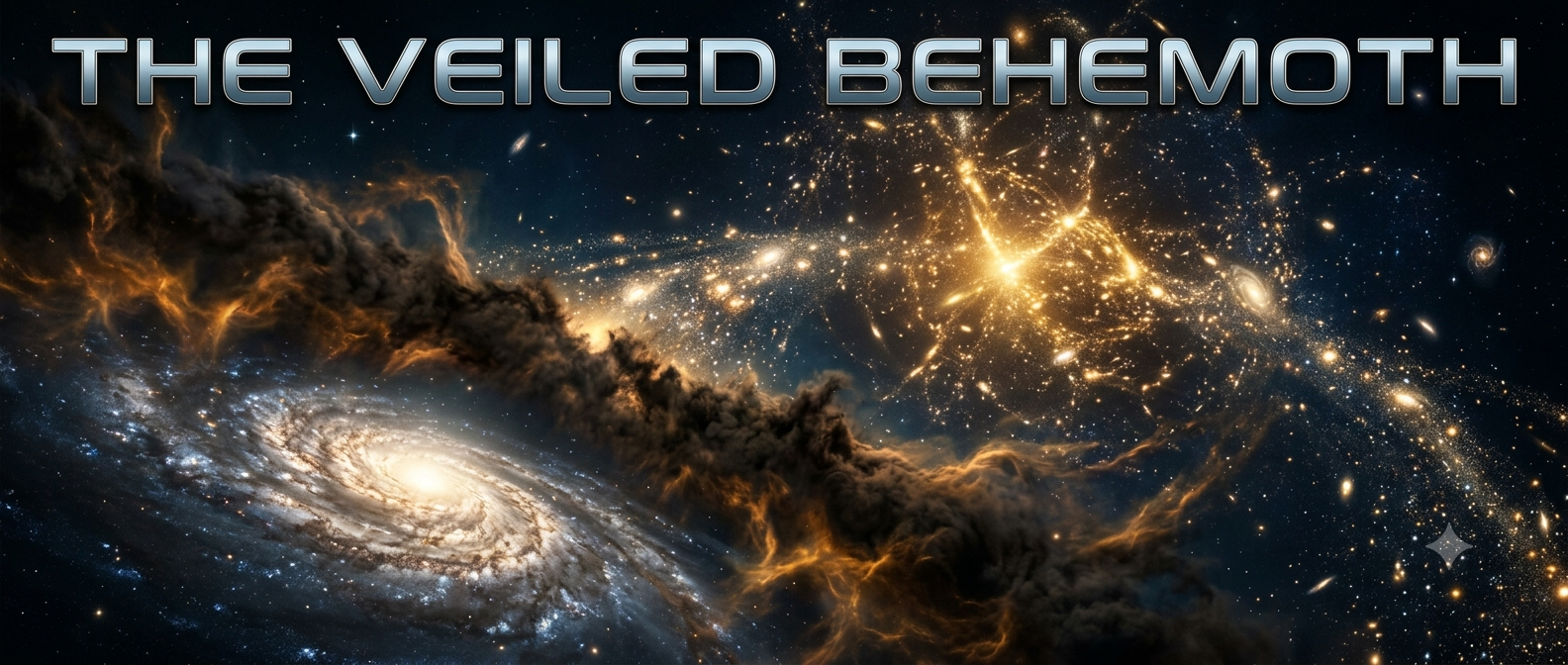
On Earth, it is easy to feel stationary. Yet, at this very moment, our planet is spinning, orbiting a star that is hurtling around the center of the Milky Way. But the movement does not stop there. The Milky Way itself, along with our neighboring neighbor Andromeda and the entire Local Group of galaxies, is rushing through the universe at a staggering speed of 1.3 million miles per hour.
We are being pulled.
The source of this immense gravitational tug is a colossal accumulation of mass located hundreds of millions of light-years away. It is an astrophysical titan wielding so much gravity that it dictates the cosmic flow of hundreds of thousands of galaxies. Scientists call it The Great Attractor.
Yet, despite its overwhelming influence on our corner of the universe, we cannot fully see it.
The Zone of Avoidance
The problem with trying to observe the Great Attractor is a matter of incredibly bad galactic placement.
To look toward this gravitational behemoth, astronomers must peer directly through the center of our own Milky Way galaxy. This region of the sky is packed with billions of stars, thick clouds of interstellar gas, and dense bands of cosmic dust. In astronomical terms, this obscuring band is ominously known as the Zone of Avoidance.
The Cosmic Blindfold: Imagine trying to look at a distant mountain range while standing in the middle of a dense, swirling blizzard. The sheer volume of light, dust, and matter in our own galactic disk completely blocks visible light from the universe beyond, leaving a massive blind spot in our map of the cosmos.
For decades, this blind spot kept the Great Attractor a complete secret. It wasn’t until the 1970s and 1980s, when astronomers began using radio, infrared, and X-ray telescopes—which can penetrate the Milky Way’s dust—that the terrifying scale of our cosmic migration became apparent.
A River of Galaxies
By measuring the redshift of galaxies across the observable universe, astrophysicists realized that the expansion of the universe isn’t entirely uniform. Galaxies aren’t just moving apart; they are flowing in specific directions, much like water pooling into an ocean.
Our entire local supercluster, a vast web containing the Milky Way, the Virgo Cluster, and tens of thousands of other galaxies, is streaming toward a specific convergence point located in the direction of the constellation Centaurus.
When astronomers finally managed to peek through the Zone of Avoidance using X-ray satellites, they discovered what was anchoring this flow: the Norma Cluster. This is a massively dense cluster of galaxies, but even it was not massive enough to account for the sheer velocity of the Milky Way’s movement.
The Great Attractor, it turns out, is not a single object. It is the gravitational epicenter of a much larger, mind-bending structure.
Laniakea: Our Immeasurable Heaven
In 2014, scientists successfully mapped the cosmic web surrounding us, revealing that the Great Attractor is actually the dense gravitational heart of a supercluster called Laniakea (Hawaiian for “immense heaven”).
Laniakea spans 520 million light-years and contains the mass of a hundred million billion suns. The Great Attractor is the deepest valley in this vast gravitational landscape. Every galaxy within Laniakea—including our own—is inexorably sliding down the slopes of spacetime toward this central basin.
What makes the Great Attractor truly unsettling is the role of dark matter. Visible galaxies alone do not possess enough mass to generate such a devastating pull. The vast majority of the Great Attractor’s weight comes from immense, unseen webs of dark matter that bind the supercluster together.
A Journey Without an End
Will the Milky Way eventually crash into the Great Attractor?
Despite rushing toward it at over a million miles per hour, we will never actually reach it. Because of dark energy, the mysterious force driving the accelerated expansion of the universe, the space between our local group and the Great Attractor is stretching faster than we are moving through it. Eventually, dark energy will overpower the gravitational grip of the Great Attractor, tearing the Laniakea supercluster apart and leaving us adrift in an increasingly cold, isolated universe.
Until then, the Great Attractor remains a humbling reminder of our place in the cosmos. We are caught in a cosmic tide, pulled blindly through the dark by a phantom giant we can barely even see.
700 701 702 703 704 705 706 707 708 709 710 711 712 713 714 715 716 717 718 719 720 721 722 723 724 725 726 727 728 729 730 731 732 733 734 735 736 737 738 739 740 741 742 743 744 745 746 747 748 749 750 751 752 753 754 755 756 757 758 759 760 761 762 763 764 765 766 767 768 769 770 771 772 773 774 775 776 777 778 779 780 781 782 783 784 785 786 787 788 789 790 791 792 793 794 795 796 797 798 799 800 801 802 803 804 805 806 807 808 809 810 811 812 813 814 815 816 817 818 819 820 821 822