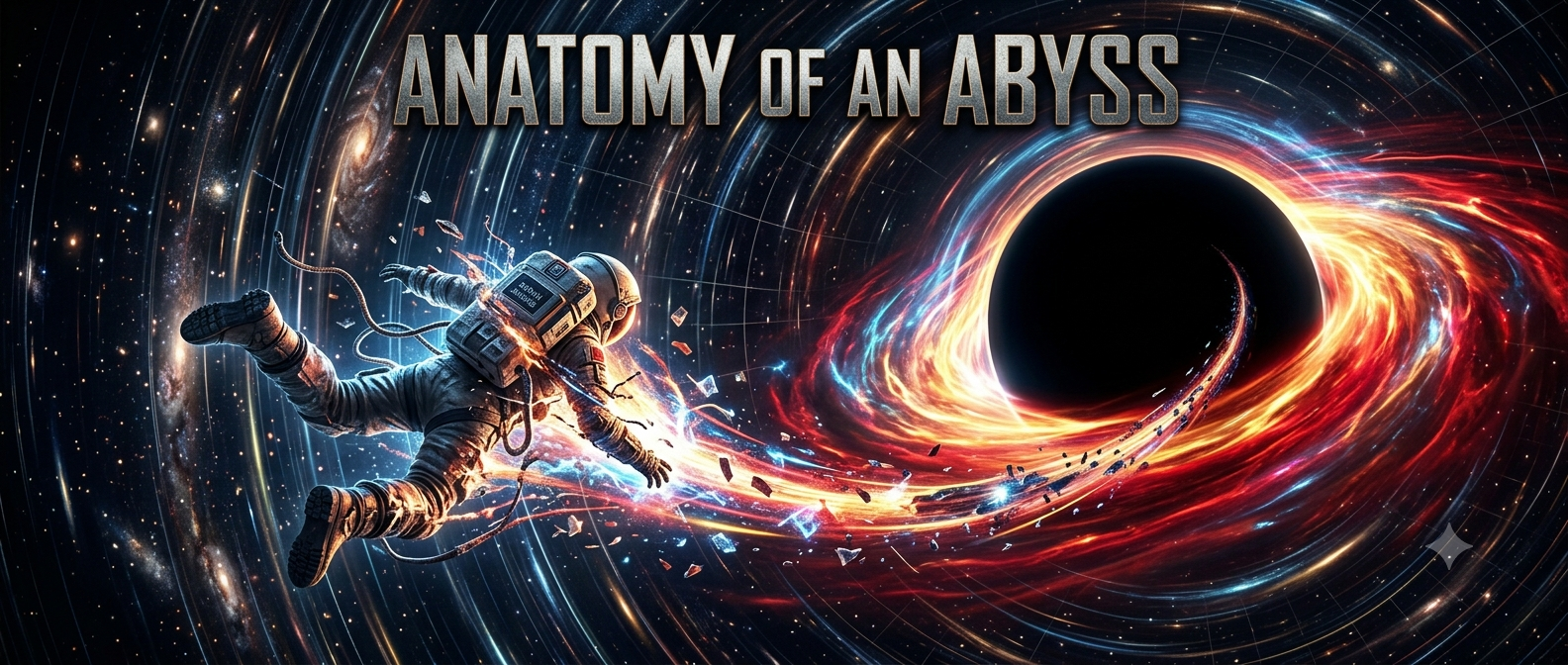
Of all the extreme environments in the cosmos, none captivate and terrify the human imagination quite like the black hole. They are the universe’s ultimate apex predators—regions of space where matter has collapsed so densely into itself that the gravitational pull becomes infinite.
But what actually happens if you were to fall into one?
Crossing the threshold of a black hole is not simply a matter of being crushed. It is a one-way journey that systematically dismantles the foundational laws of reality, warping time, bending space, and subjecting the human body to a biomechanical nightmare known by the deceptively whimsical term: spaghettification.
The Approach: The Illusion of Frozen Time
The strange physics of your demise begin long before you reach the black hole itself. As you drift closer to the abyss, you become a living demonstration of Einstein’s General Theory of Relativity.
Because immense gravity curves the very fabric of spacetime, time behaves differently depending on where you are.
To an outside observer watching you from a safe distance, your descent appears agonizingly slow. As you approach the black hole, the light reflecting off you takes longer and longer to escape the immense gravity well. To your friends, you appear to decelerate, your movements freezing, while your image slowly stretches into the red spectrum—a process called gravitational redshift. Eventually, your frozen image fades to black. To the outside universe, you never actually cross the threshold.
But from your perspective inside the spacesuit, time flows perfectly normally. However, if you look back at the universe behind you, you will see a breathtaking and terrifying sight: as your time slows down relative to the cosmos, you will watch the rest of the universe’s history play out in fast-forward, witnessing the birth and death of stars in a matter of seconds.
The Event Horizon: The Point of No Return
Eventually, you will cross the Event Horizon.
This is not a physical surface you can touch; it is a mathematical boundary. It is the exact threshold where the escape velocity required to leave the black hole exceeds the speed of light—186,000 miles per second. Because nothing in the universe can travel faster than light, nothing that crosses this boundary can ever return.
[Safe Space] ➔ [Time Dilation Zone] ➔ [Event Horizon (c > escape velocity)] ➔ [The Singularity]
Surprisingly, if you were falling into a supermassive black hole—like the one at the center of our Milky Way—crossing the event horizon would be entirely unremarkable. The gravitational gradient of a supermassive black hole is so gentle at its edge that you wouldn’t feel a thing. You would drift across the point of no return in blissful, floating ignorance.
But if you fall into a stellar-mass black hole (one only a few times heavier than our Sun), your journey ends violently.
Spaghettification: The Cosmic Meat Grinder
Once inside the gravitational grip of a stellar black hole, you encounter extreme tidal forces.
Tidal forces occur when gravity pulls harder on one side of an object than the other. On Earth, this difference is negligible. But near a dense black hole, the gravitational gradient is so unimaginably steep that the pull on your feet (if you are falling feet-first) becomes millions of times stronger than the pull on your head, even though they are only a few feet apart.
The Physics of the Stretch: As you fall, this massive discrepancy in gravity begins to pull your feet away from your torso, and your torso away from your head. Simultaneously, the geometry of spacetime is funneling inward toward a single point. This means that while you are being violently stretched vertically, you are also being crushed horizontally.
Astrophysicists call this process spaghettification.
First, your spacesuit would rip. Then, your bones, muscles, and tissues would snap under the tension. Within milliseconds, your body would be drawn out into a long, microscopic stream of subatomic particles, resembling a strand of cosmic spaghetti. You are completely disassembled on a molecular level, joining a swirling, superheated accretion disk of torn-apart matter.
The Singularity: Where Physics Dies
Whatever remains of your atoms is forcefully dragged toward the absolute center: the Singularity.
Here, all the mass of the black hole is crushed into an infinitely small, infinitely dense point. At the singularity, space and time as we understand them cease to exist. All paths, all directions, and all futures point inextricably inward. The mathematical equations of both quantum mechanics and general relativity completely break down, yielding only infinities and impossible calculations.
We do not know what happens to matter once it joins the singularity. It may be destroyed, it may be translated into pure data, or, as some exotic theories suggest, it may be funneled through a wormhole to another universe.
Ultimately, black holes serve as the greatest locked doors in astrophysics. They invite us in with awe-inspiring gravity, but demand our total physical destruction as the price of admission to their secrets.
700 701 702 703 704 705 706 707 708 709 710 711 712 713 714 715 716 717 718 719 720 721 722 723 724 725 726 727 728 729 730 731 732 733 734 735 736 737 738 739 740 741 742 743 744 745 746 747 748 749 750 751 752 753 754 755 756 757 758 759 760 761 762 763 764 765 766 767 768 769 770 771 772 773 774 775 776 777 778 779 780 781 782 783 784 785 786 787 788 789 790 791 792 793 794 795 796 797 798 799 800 801 802 803 804 805 806 807 808 809 810 811 812 813 814 815 816 817 818 819 820 821 822