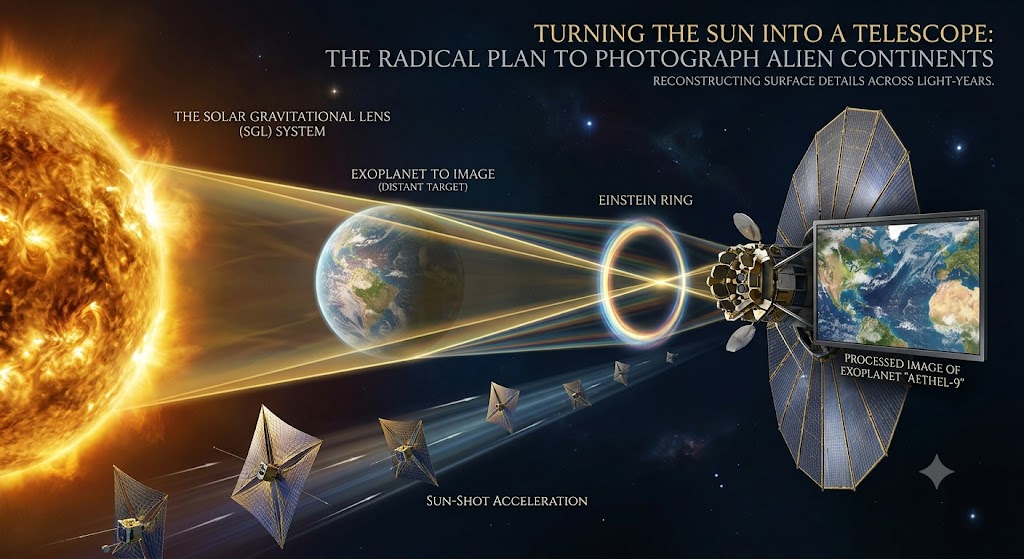
For decades, space telescopes have shared a frustrating limitation: no matter how large or advanced they are, a distant, Earth-like exoplanet will only ever look like a single, blurry pixel of light. We can analyze its atmosphere, but we cannot see its surface.
That reality could soon change. A visionary concept backed by NASA’s Jet Propulsion Laboratory (JPL) aims to bypass the physical limits of traditional glass and mirrors by using the largest object in our solar system as a natural magnifying glass: the Sun.
Known as the Solar Gravitational Lens (SGL) mission, this project proposes sending a fleet of small, autonomous satellites into deep space to turn Einstein’s theories into the ultimate planet-hunting tool.
The Physics: Albert Einstein’s Giant Magnifying Glass
The foundation of the SGL is a phenomenon known as gravitational lensing, predicted by Albert Einstein’s theory of general relativity. Gravity warps the fabric of space-time. When light from a distant exoplanet passes by the edge of the Sun, the Sun’s immense mass acts as a cosmic lens, bending and concentrating the faint light rays toward a single focal line in deep space.
By placing a modest, one-meter telescope along this line, the Sun’s gravity acts as a natural booster, amplifying the light from the target planet by a factor of up to 100 billion times.
   [ Distant Exoplanet ]
            |
            | (Faint light travel)
            v
       ( \ / )  <-- Light bends around the edges of the Sun
        (Sun)
       ( / \ )
            |
            | (Amplified light focuses into an "Einstein Ring")
            v
    [ SGL Telescope Probe ] (Stationed at 550+ AU)
The Breakthrough: From One Pixel to Continents
While the James Webb Space Telescope looks back at the early universe, it cannot map the geography of an individual alien world. The SGL, however, changes everything.
Rather than a blurry dot, this system is capable of capturing a 1,000×1,000 pixel image of an exoplanet up to 100 light-years away. Computational algorithms then take the distorted ring of light gathered by the probe and reconstruct it into a high-resolution map.
At a surface resolution of roughly 25 kilometers, scientists could easily identify:
-
Distinct continents, island chains, and mountain ranges.
-
Oceans, rivers, and seasonal ice cap fluctuations.
-
Weather patterns, cloud cover, and potentially the massive green footprint of surface plant life.
The Catch: A 50-Billion-Mile Journey
The physics of the universe dictates a steep price for this cosmic shortcut: the Sun’s gravitational focal point doesn’t begin until you are at least 547 Astronomical Units (AU) away from Earth—about 50.8 billion miles out.
To put that distance into perspective, consider the sheer scale of the journey:
| Spacecraft / Boundary | Distance Covered | Journey Time |
| Pluto’s Orbit | ~40 AU | — |
| Voyager 1 (Humanity’s farthest probe) | ~165 AU | ~50 Years |
| SGL Focal Zone (The Finish Line) | 550+ AU | Target: <20 Years |
Using traditional chemical rockets to reach 550 AU would take centuries. To solve this, researchers are developing an innovative swarmsat architecture powered by solar sails.
Instead of a single heavy spacecraft, the mission would deploy a swarm of small, agile smallsats equipped with massive, ultra-lightweight sails. The probes will dive incredibly close to the Sun, catching an extreme gravitational slingshot and a massive blast of solar radiation pressure. This maneuver will propel the swarm to blistering exit speeds of over 150 km/s—fast enough to cross the finish line in less than two decades.
The Long-Term Legacy: Because these probes must travel so far, the scientists who build and launch the mission likely won’t be alive to see the first pictures. It is a multigenerational project designed to pass the torch to the next era of explorers.
The SGL is currently a matured technical concept supported by NASA’s Innovative Advanced Concepts (NIAC) program. With propulsion and autonomous AI systems advancing rapidly, researchers estimate that a target flight demonstration could be underway in the coming decades, finally offering humanity a direct look at a living world beyond our own.
To push a telescope to a staggering 150 km/s (roughly 335,000 mph), traditional rocket fuel is out of the question. The fuel weight alone would make the spacecraft too heavy to accelerate quickly.
Instead, the Solar Gravitational Lens (SGL) mission relies on solar sails—harnessing the literal pressure of sunlight—combined with a high-stakes orbital maneuver known as a perihelion dive.
Here is the step-by-step breakdown of how physicists plan to execute this extreme deep-space sprint.
1. The Physics of Solar Sailing: Riding Photons
Solar sails do not catch the “solar wind” (which is made of physical particles like protons). Instead, they catch photons—particles of light.
Even though photons have no mass, they possess momentum. When a photon hits a highly reflective, mirror-like material, it bounces off. That bounce transfers a tiny, microscopic amount of momentum to the sail. While the push from a single photon is almost imperceptible, billions of trillions of photons hitting a massive sail every second create a continuous, smooth, and infinite acceleration.
The best part? Unlike a rocket engine, a solar sail never runs out of fuel.
2. The Mechanics of the “Perihelion Dive”
To get a spacecraft moving fast enough to reach 550+ AU in less than 20 years, it needs an immense, concentrated blast of photon pressure. The closer you are to the Sun, the denser the photon field. This is where the perihelion dive comes in.
The Engineering Hurdles
While the orbital mechanics work out beautifully on paper, executing a perihelion dive introduces a couple of brutal engineering challenges:
-
Extreme Thermal Management: Flying that close to the Sun will expose the probe to blistering radiation and heat. The sails must be constructed from highly advanced materials—like carbon fiber matting paired with reflective aluminum or beryllium coatings—capable of handling temperatures exceeding 1,000°C without melting or tearing.
-
The “Edge-On” Shielding Technique: To protect the delicate instrument package (the actual telescope payload), the probe must use the sail itself as a sunshield. During the closest approach, the sail is angled slightly edge-on or pitched to deflect the intense heat away from the core electronics until it passes the danger zone and heads for deep space.
Once the solar storm is cleared, the sails are discarded or re-angled, leaving a fleet of hyper-velocity smallsats hurtling into the dark, ready to open humanity’s clearest window into the cosmos.
700 701 702 703 704 705 706 707 708 709 710 711 712 713 714 715 716 717 718 719 720 721 722 723 724 725 726 727 728 729 730 731 732 733 734 735 736 737 738 739 740 741 742 743 744 745 746 747 748 749 750 751 752 753 754 755 756 757 758 759 760 761 762 763 764 765 766 767 768 769 770 771 772 773 774 775 776 777 778 779 780 781 782 783 784 785 786 787 788 789 790 791 792 793 794 795 796 797 798 799 800 801 802 803 804 805 806 807 808 809 810 811 812 813 814 815 816 817 818 819 820 821 822