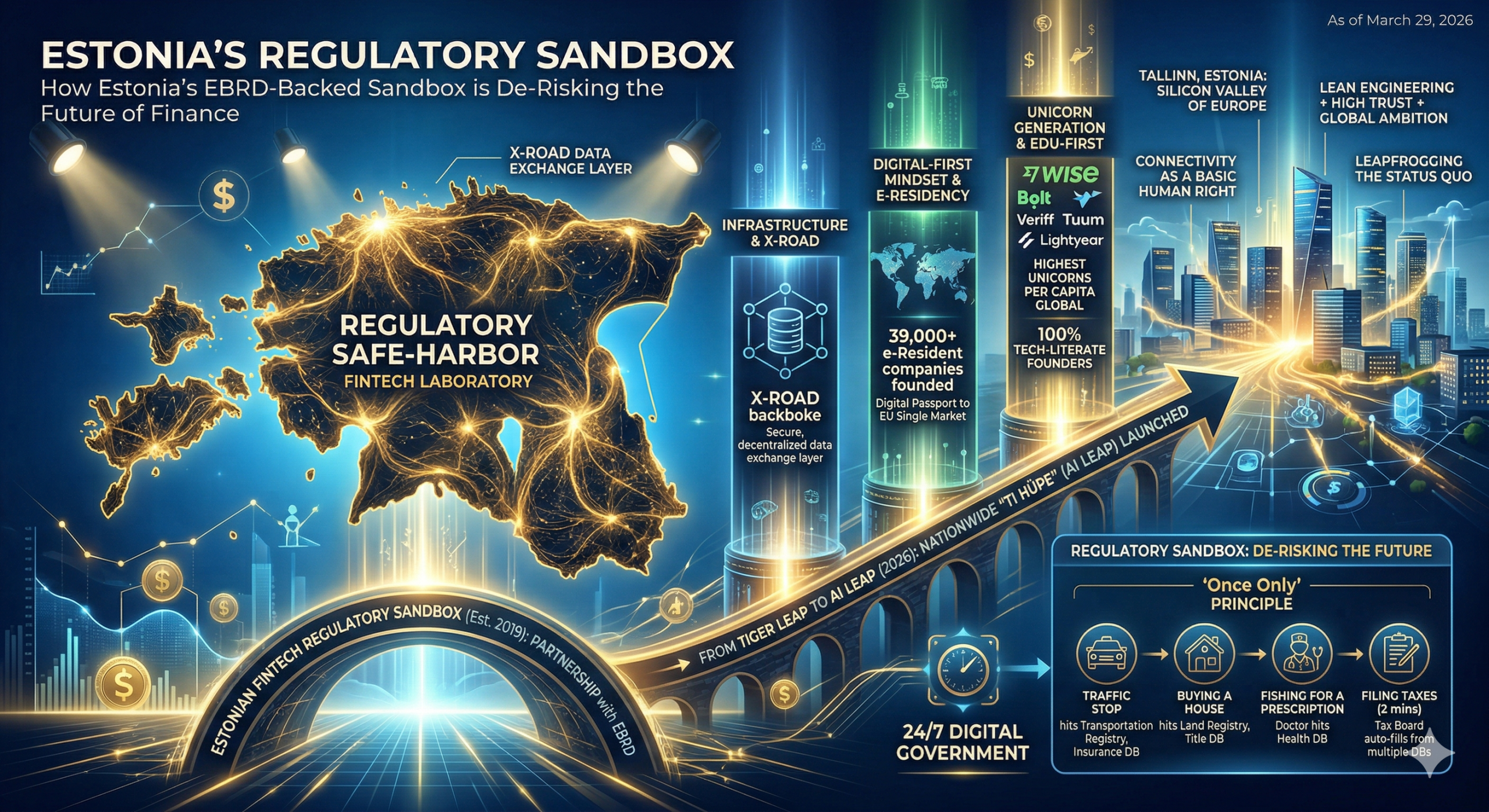
TALLINN, ESTONIA — March 29, 2026 — In the high-stakes world of financial technology, the greatest barrier to innovation isn’t always capital or code—it’s the “compliance cliff.” For years, startups with radical ideas for digital assets or decentralized lending faced a binary choice: launch and risk a regulatory shutdown, or wait years for a license.
To solve this, Estonia launched its Fintech Regulatory Sandbox, a strategic collaboration between the Estonian Ministry of Finance, the Financial Supervision and Resolution Authority (Finantsinspektsioon), and the European Bank for Reconstruction and Development (EBRD). As of March 2026, the sandbox has evolved into a “churning laboratory” where the next generation of financial products is being safely stress-tested before hitting the global market.
🏗️ The Partnership: EBRD’s Institutional Weight
The EBRD’s involvement in 2019 provided more than just funding; it provided a global framework for “Regulatory Technical Assistance.” By benchmarking Estonia against global leaders like the UK and Singapore, the EBRD helped design a system where regulation is treated as a collaborative service rather than a hurdle.
-
Technical Guidance: The EBRD worked with Estonian authorities to create a “digital sandbox” infrastructure that can simulate market conditions without putting real consumer capital at risk.
-
Legal Reform: Data from sandbox trials has directly informed recent amendments to the Securities Market Act (approved in late 2025), which modernized laws around close-out netting and financial collateral—making Estonia one of the most “netting-friendly” jurisdictions in the world.
🧪 How the Sandbox Works: Testing Without Tears
The sandbox is a “controlled, time-bound live testing environment.” For a period of 6 to 12 months, an approved startup can operate under the direct, eyes-on supervision of the regulator.
The Three-Stage Process:
-
Selection: Companies must prove their product is truly innovative (not just a copy of existing tech) and provides a clear benefit to consumers or the financial system.
-
Live Testing: Firms interact with a limited number of real customers or transactions. The regulator monitors data in real-time, looking for “spikes” in risk or security vulnerabilities.
-
The Exit Strategy: Upon completion, the firm receives a detailed report. If successful, they may receive an expedited pathway to a full license or a recommendation for a permanent regulatory waiver.
💎 Success Stories of 2026
The 2026 cohort of the sandbox is focusing heavily on “Deep-RegTech” and “Asset Tokenization.”
| Company | Sandbox Focus | Milestone Achieved |
| Salv (RegTech) | AI-driven AML monitoring | Trialed a cross-border “Financial Crime Data Exchange” that cut fraud detection time by 60%. |
| Depowise | Compliance Automation | Used the sandbox to refine AI oversight for assets totaling over €8 trillion. |
| Onfido (Digital ID) | Biometric Verification | Successfully trialed new facial-recognition protocols that are now being integrated into EU-wide “Digital Wallet” standards. |
🛡️ Balancing Act: Innovation vs. Oversight
The ultimate goal of the sandbox is to solve the “Innovation Paradox”: How do you allow firms to experiment without treating citizens as “unwitting beta-testers”?
-
Staged Permissions: Regulators use “dynamic licensing,” where a firm’s permissions expand only as they hit specific security and volume milestones.
-
Radical Transparency: Every trial must clearly communicate its goals and safeguards to any participant, building a “culture of trust” that is essential for mass adoption.
“A regulatory sandbox isn’t a static testing ground; it’s a conversation,” says a lead specialist at Finantsinspektsioon. “We learn as much from the startups as they learn from us. We are co-creating the rules of 2030.”
Strategic Insight for Your Business
The existence of a “Regulatory Sandbox” is a major reason why Estonian fintechs are so dominant in emerging markets like Kenya. These companies arrive with products that have already been “pre-cleared” by one of the world’s most rigorous regulators.
1 2 3 4 5 6 7 8 9 10 11 12 13 14 15 16 17 18 19 20 21 22 23 24 25 26 27 28 29 30 31 32 33 34 35 36 37 38
700 701 702 703 704 705 706 707 708 709 710 711 712 713 714 715 716 717 718 719 720 721 722 723 724 725 726 727 728 729 730 731 732 733 734 735 736 737 738 739 740 741 742 743 744 745 746 747 748 749 750 751 752 753 754 755 756 757 758 759 760 761 762 763 764 765 766 767 768 769 770 771 772 773 774 775 776 777 778 779 780 781 782 783 784 785 786 787 788 789 790 791 792 793 794 795 796 797 798 799 800 801 802 803 804 805 806 807 808 809 810 811 812 813 814 815 816 817 818 819 820 821 822