A New Industrial Revolution — Green by Design
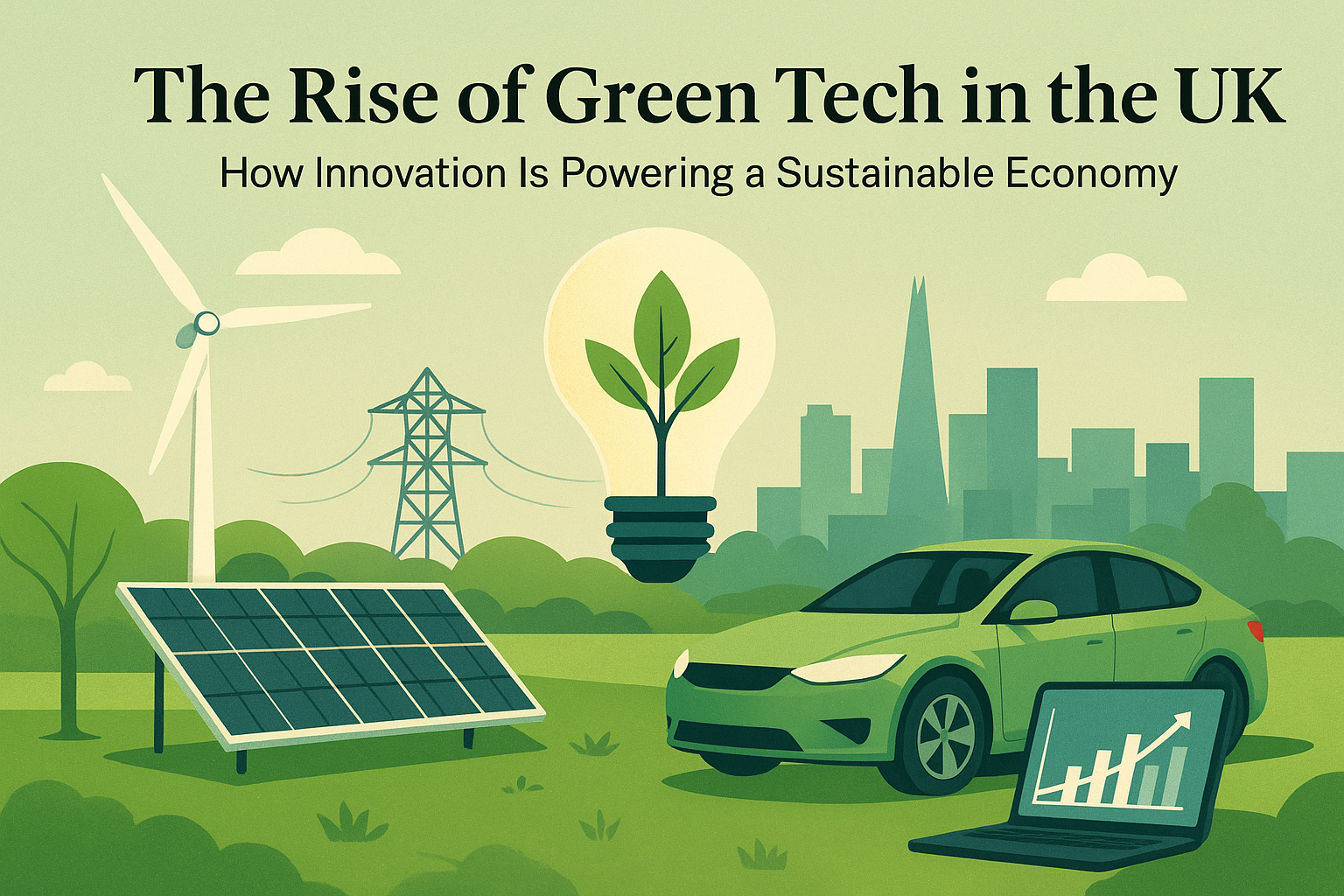
The United Kingdom is in the midst of a quiet revolution — one driven not by steam or steel, but by data, carbon targets, and renewable innovation. Green technology, once a niche segment of environmental activism, has matured into a core driver of Britain’s modern economy.
Across the nation, from the wind farms of the North Sea to electric vehicle (EV) factories in the Midlands, a new generation of businesses is redefining what growth looks like in a carbon-conscious world. The UK’s push toward net zero by 2050 has turned sustainability into both a regulatory mandate and a lucrative business opportunity.
This transformation is not just about cutting emissions; it’s about positioning Britain at the forefront of a global race where clean innovation equals competitive advantage.
Policy as a Catalyst for Change
Government policy has been instrumental in shaping the green tech landscape. The UK Industrial Decarbonisation Strategy and Clean Growth Strategy have provided direction, while the creation of the UK Infrastructure Bank and Green Finance Strategy has unlocked billions in sustainable investment.
London, already one of the world’s leading financial centers, has become a hub for green bonds and ESG (Environmental, Social, and Governance) finance. The City’s institutions are adapting to a new reality in which sustainability is not a side project but a key investment criterion.
However, experts argue that government incentives must go further. The cancellation of certain renewable subsidies and delays in grid connections have slowed momentum. Still, the UK remains one of Europe’s most attractive destinations for green capital, ranking high in renewable investment confidence indexes.
Energy Innovation on the Rise
The energy transition lies at the heart of the green tech boom. Offshore wind has become Britain’s flagship success story — the UK now hosts several of the world’s largest offshore wind farms, including Hornsea Two and Dogger Bank, capable of powering millions of homes.
Solar power, once seen as impractical in the British climate, is experiencing renewed growth thanks to falling costs and improved efficiency. Meanwhile, hydrogen and carbon capture, usage and storage (CCUS) technologies are gaining traction, supported by pilot projects in Teesside and Humberside.
These initiatives not only reduce emissions but also create thousands of skilled jobs in engineering, data science, and logistics. For the UK, green energy is no longer just environmental policy — it’s industrial strategy.
The Role of Technology and Startups
At the heart of the movement lies Britain’s thriving tech ecosystem. Startups in Cambridge, Oxford, and London are developing software and hardware solutions that make energy systems smarter and more efficient.
Companies like Octopus Energy and OVO are revolutionizing how consumers engage with power — using AI, predictive analytics, and smart meters to optimize energy use. Climeworks UK and other climate tech firms are pioneering direct air capture and carbon credit marketplaces.
Venture capital is responding accordingly. Green tech startups received more than £3 billion in private investment in 2024, according to PwC — nearly double the figure from just three years earlier. Investors increasingly see sustainability not as a moral choice, but as a market inevitability.
Transport and the Electrification Wave
Nowhere is Britain’s green transformation more visible than on its roads. The government’s plan to phase out new petrol and diesel car sales by 2035 has ignited massive investment in electric vehicle (EV) infrastructure.
Manufacturers such as Jaguar Land Rover, BMW UK, and Nissan Sunderland are committing billions to EV production. The newly operational Britishvolt gigafactory in Northumberland, despite early setbacks, is seen as a critical step toward domestic battery manufacturing.
Meanwhile, London has emerged as a testing ground for sustainable mobility — with the expansion of electric buses, green taxis, and e-bike-sharing networks. These innovations are not just about emissions; they reflect a broader shift in how cities think about transport, data, and energy integration.
The Data Dimension: AI Meets Sustainability
Artificial intelligence is also finding its place in the UK’s green transition. From predictive maintenance in wind turbines to AI-optimized energy grids, technology is improving both efficiency and reliability.
In the agricultural sector, precision farming and AI-driven soil monitoring are helping reduce waste and improve yields, while in construction, digital twins allow architects to model and minimize carbon footprints before a single brick is laid.
These advancements illustrate a deeper trend: sustainability and technology are no longer separate conversations. The green economy is, in essence, a digital economy.
Challenges Ahead
Despite progress, the UK’s green tech sector faces several headwinds. Inflation and supply chain disruptions have raised costs for renewable projects. Critics warn that without long-term policy consistency, investor confidence could waver.
There’s also a growing debate over energy security. As global tensions reshape supply chains, Britain’s reliance on imported components — from solar panels to EV batteries — poses strategic risks.
Moreover, while urban areas are advancing rapidly, rural regions risk being left behind. Bridging this “green divide” will require coordinated infrastructure investment and targeted support for local innovation.
Green Finance and Global Influence
One of the UK’s most powerful exports is its financial expertise. The growth of green finance — from sustainable bonds to ESG indices — is allowing London to influence global capital flows toward climate-friendly projects.
Major banks and insurers are integrating sustainability metrics into their core business models, while the London Stock Exchange’s Green Economy Mark now highlights firms deriving more than 50% of their revenues from environmental solutions.
Through initiatives such as the Glasgow Financial Alliance for Net Zero (GFANZ), British policymakers and institutions are helping shape the global conversation on how finance can accelerate the energy transition.
The Road to 2050
Looking ahead, the UK’s green tech trajectory will depend on innovation, investment, and inclusion. The path to net zero is not linear — it requires balancing economic growth with environmental stewardship.
Yet, if Britain continues to leverage its scientific talent, financial strength, and policy ambition, it could define the blueprint for sustainable industrialization in the 21st century.
The rise of green tech is more than a trend; it’s a transformation of national identity. Just as the Industrial Revolution once made Britain the world’s workshop, the green revolution may yet make it the world’s laboratory for sustainable progress.
700 701 702 703 704 705 706 707 708 709 710 711 712 713 714 715 716 717 718 719 720 721 722 723 724 725 726 727 728 729 730 731 732 733 734 735 736 737 738 739 740 741 742 743 744 745 746 747 748 749 750 751 752 753 754 755 756 757 758 759 760 761 762 763 764 765 766 767 768 769 770 771 772 773 774 775 776 777 778 779 780 781 782 783 784 785 786 787 788 789 790 791 792 793 794 795 796 797 798 799 800 801 802 803 804 805 806 807 808 809 810 811 812 813 814 815 816 817 818 819 820 821 822