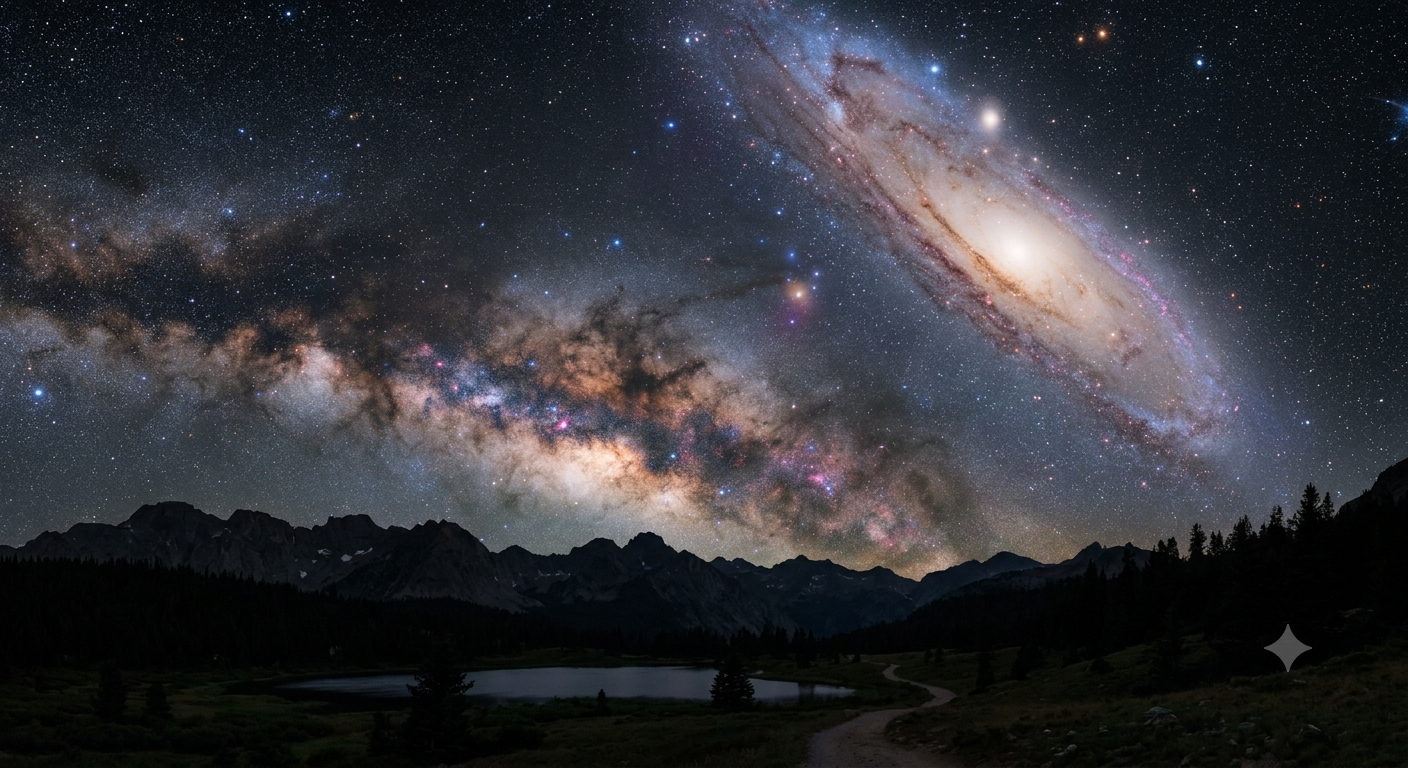
When we hear the word “collision,” our brains naturally picture violence: twisted metal, shattering glass, and explosive energy. It’s only logical to assume that when two colossal galactic empires smash into each other, the result must be a cosmic apocalypse of colliding stars and pulverized planets.
But in the grand, quiet theater of the universe, things rarely play out the way they do in Hollywood.
Right now, the Andromeda galaxy ($M31$)—a massive spiral galaxy slightly larger than our own Milky Way—is hurtling toward us at roughly 250,000 miles per hour. It is a slow-motion cosmic drag race, and the finish line is our back yard.
Yet, astronomers have a comforting, if mind-bending, spoiler for us: when these two titans finally merge, it will be one of the most peaceful events in cosmic history.
The Illusions of Scale: Why Stars Won’t Collide
The Milky Way contains roughly 100 billion to 400 billion stars. Andromeda boasts upwards of one trillion. When these two massive swarms of stars integrate, you might expect celestial bumper cars.
Instead, the chances of even two individual stars physically colliding are practically zero.
To understand why, we have to look at the sheer, mind-boggling emptiness of space. While stars seem tightly packed on a galactic map, they are actually separated by terrifying abysses of nothingness.
The Quarter Analogy: If we scaled our Sun down to the size of a standard quarter coin, the closest star to us (Proxima Centauri) would be sitting roughly 470 miles away.
Because of these vast, yawning chasms of empty space between stars, galaxies are less like solid rocks smashing together and more like two gentle puffs of smoke passing through one another. The stars will simply slide past each other, guided only by the invisible, swirling hands of gravity.
A Timeline of the Night Sky: What Earth Will See
While the stars themselves will remain safe, the night sky over Earth will undergo a multi-billion-year visual transformation. If humans (or our evolutionary descendants) are still around to look up, they will witness the greatest light show in terrestrial history.
Here is what the celestial sky-show will look like across the eons:
Phase 1: The Approaching Giant (In 2 to 3 Billion Years)
Andromeda is currently a faint, smudge-like blur in the night sky. But as the eons tick by, it will grow larger and more distinct. Eventually, its brilliant, glowing core and sprawling spiral arms will dominate the night, dwarfing our own moon and casting a soft, ethereal glow over the Earth.
Phase 2: The First Close Pass (In 3.75 Billion Years)
The outer edges of both galaxies will begin to intermingle. The intense gravitational tug-of-war will compress vast clouds of interstellar gas and dust. This compression will trigger a massive baby boom of star formation, lighting up the sky with brilliant, short-lived blue giant stars and glowing pink nebulae.
Phase 3: The Gravitational Waltz (In 4 to 5 Billion Years)
After the first pass, Andromeda will overshoot us, pull to a stop under the grip of gravity, and swing back for the final merger. The sky will become a chaotic, beautiful masterpiece of stretched-out stellar streams, warped galactic arms, and two bright galactic nuclei competing for dominance overhead.
Phase 4: The Birth of “Milkomeda” (In 6 Billion Years)
The two galaxies will finally settle down, organizing into a single, massive, smoothly blended elliptical galaxy. Astronomers have already dubbed this future super-galaxy Milkomeda. The distinctive, band-like arc of our Milky Way will be gone, replaced by a smooth, bright, dome-like glow of trillions of aging stars stretching from horizon to horizon.
What Happens to Our Solar System?
If the stars aren’t crashing, what about us? Will the Sun and its planets survive the merger?
In all likelihood, yes. Our solar system will act like a passenger on a very smooth cruise ship. While gravity will certainly alter our orbit—likely flinging our Sun much further out into the newly formed galactic suburbs of Milkomeda—the planets themselves will remain locked in their tight, orderly orbits around the Sun.
There is, however, a catch. Long before Milkomeda is fully born, our Sun will grow naturally hotter and brighter as it ages. By the time the galaxies first touch, Earth’s oceans will have likely boiled away, rendering our planet a dry, barren desert.
But if humanity has managed to migrate to the frozen, outer moons of the solar system, or bypassed the solar system entirely, we will have front-row seats to a silent, stunning, and completely harmless cosmic rebirth.
1 2 3 4 5 6 7 8 9 10 11 12 13 14 15 16 17 18 19 20 21 22 23 24 25 26 27 28 29 30 31 32 33 34 35 36 37 38
700 701 702 703 704 705 706 707 708 709 710 711 712 713 714 715 716 717 718 719 720 721 722 723 724 725 726 727 728 729 730 731 732 733 734 735 736 737 738 739 740 741 742 743 744 745 746 747 748 749 750 751 752 753 754 755 756 757 758 759 760 761 762 763 764 765 766 767 768 769 770 771 772 773 774 775 776 777 778 779 780 781 782 783 784 785 786 787 788 789 790 791 792 793 794 795 796 797 798 799 800 801 802 803 804 805 806 807 808 809 810 811 812 813 814 815 816 817 818 819 820 821 822