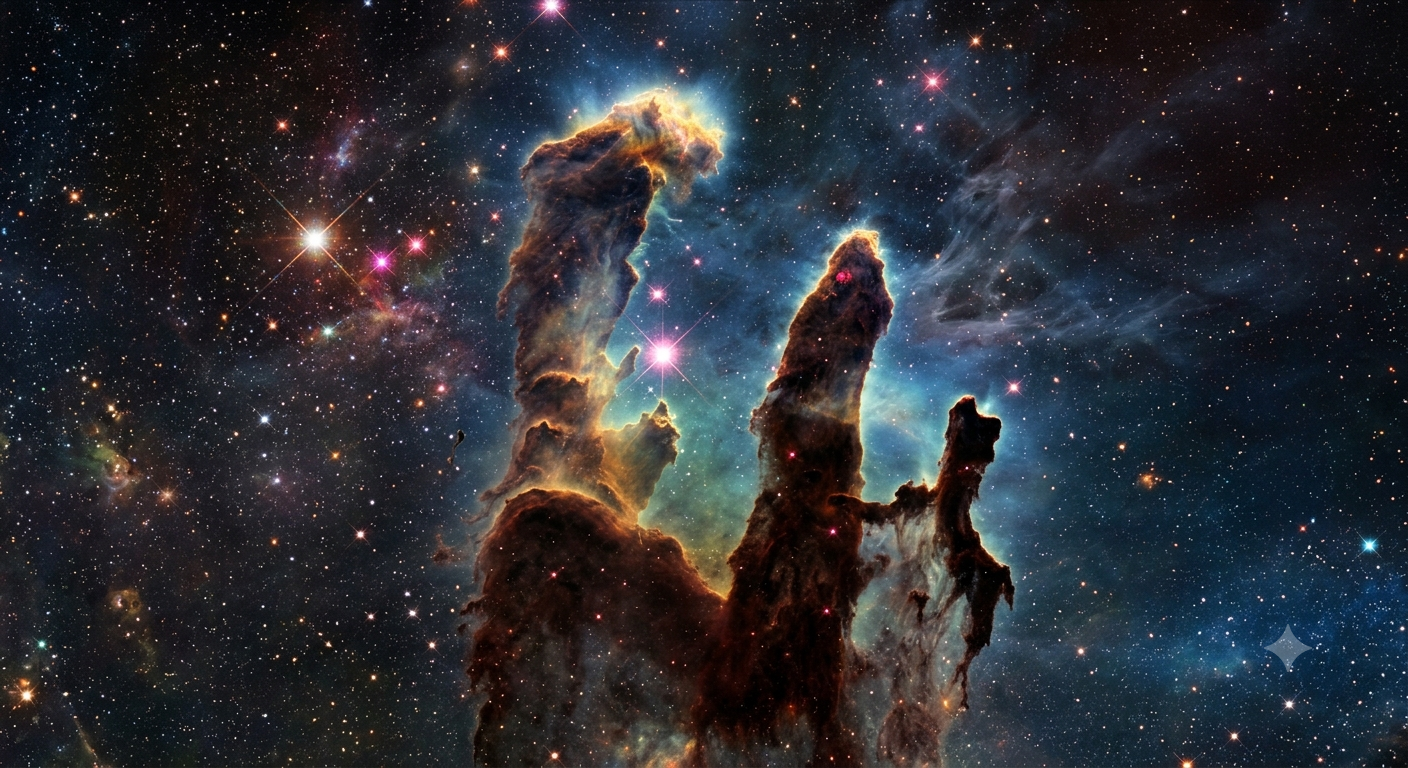
Few images of the cosmos have captured the human imagination quite like the Pillars of Creation. First made famous by the Hubble Space Telescope in 1995 and recently re-mapped in piercing, translucent infrared detail by the James Webb Space Telescope, these towering columns look like majestic, solid rock formations rising out of a celestial desert.
In reality, they are anything but static.
Located roughly 6,500 light-years away in the heart of the Eagle Nebula ($M16$), the Pillars of Creation are colossal, fluid structures of cold interstellar gas and cosmic dust. Stretching between four to five light-years tall—a distance so vast it would take a beam of light half a decade to travel from their base to their tips—these columns serve as the ultimate cosmic foundries. They are places of extreme, chaotic duality, where stars are violently brought to life and systematically destroyed at the exact same time.
The Crucible of Birth: How Cosmic Nurseries Ignite
At their core, the pillars are stellar nurseries, and their primary raw material is molecular hydrogen. The process of creation within these giant structures is entirely driven by an invisible master architect: gravity.
The columns are not uniform; they are filled with turbulent, churning pockets of varying density. The cycle of birth unfolds in a series of violent stages:
-
The Gravitational Collapse: Over millennia, random ripples or shockwaves cause dense knots of gas and dust to clump together within the pillars. As a knot gains mass, its gravitational pull grows exponentially stronger, dragging in surrounding material from the pillar.
-
The Heat of Compression: As the cloud collapses inward under its own crushing weight, the material at the center is packed so tightly that its kinetic energy skyrockets. The core transforms into a superheated, spinning ball of matter known as a protostar.
-
The Spark of Fusion: Once the core temperature reaches a staggering threshold, hydrogen atoms are forced to smash together, igniting nuclear fusion. The star “turns on,” blasting powerful jets of energy and stellar winds outward, clearing away its leftover umbilical cord of dust and stepping onto the cosmic stage.
The Flash of Annihilation: Sculpted by Destruction
While the interior of the pillars works to build new stars, the exterior is locked in a desperate battle against absolute annihilation. The very birth of stars in this region triggers the inevitable doom of the pillars themselves.
Just outside the frame of the iconic photographs lies a cluster of brilliant, massive, ultra-hot newborn stars. These stellar giants release a continuous, torrential flood of fierce stellar winds and searing ultraviolet (UV) radiation.
This triggers a destructive process known as photoevaporation.
The intense UV radiation acts like a blowtorch against an ice sculpture, cooking the outer layers of the pillars and ionizing the gas. The fierce stellar winds then strip this heated gas away, blowing it out into the empty interstellar medium like smoke caught in a gale-force wind. The ghostly, frayed edges and “lava-like” fringes visible at the tips of the pillars are actually the visual evidence of the structures being actively vaporized.
The pillars only exist because their dense dust cores act like cosmic umbrellas, shielding the gas directly behind them from the radiation. But this shield is failing. Astronomers estimate that the columns are eroding so rapidly that they will completely vanish into nothingness within the next hundred thousand years.
Looking at a Cosmic Ghost
There is a final, mind-bending twist to the story of the Pillars of Creation: they may already be gone.
Because the Eagle Nebula is 6,500 light-years away, the light hitting our telescope mirrors today has been traveling through the void since the dawn of human civilization. We are looking at a snapshot of the deep past.
Data from older space telescopes suggested that a shockwave from a nearby supernova—a dying star’s catastrophic explosion—may have ripped through the Eagle Nebula roughly 6,000 years ago, toppling the pillars like a house of cards. If that theory holds true, the pillars were destroyed before the pyramids of Egypt were ever built.
Because of the cosmic speed limit of light, humanity is trapped in a beautiful illusion. We will have to wait another 500 to 1,000 years for the light of that destruction to reach Earth, meaning we will spend the next several centuries admiring a majestic, glowing ghost.
700 701 702 703 704 705 706 707 708 709 710 711 712 713 714 715 716 717 718 719 720 721 722 723 724 725 726 727 728 729 730 731 732 733 734 735 736 737 738 739 740 741 742 743 744 745 746 747 748 749 750 751 752 753 754 755 756 757 758 759 760 761 762 763 764 765 766 767 768 769 770 771 772 773 774 775 776 777 778 779 780 781 782 783 784 785 786 787 788 789 790 791 792 793 794 795 796 797 798 799 800 801 802 803 804 805 806 807 808 809 810 811 812 813 814 815 816 817 818 819 820 821 822