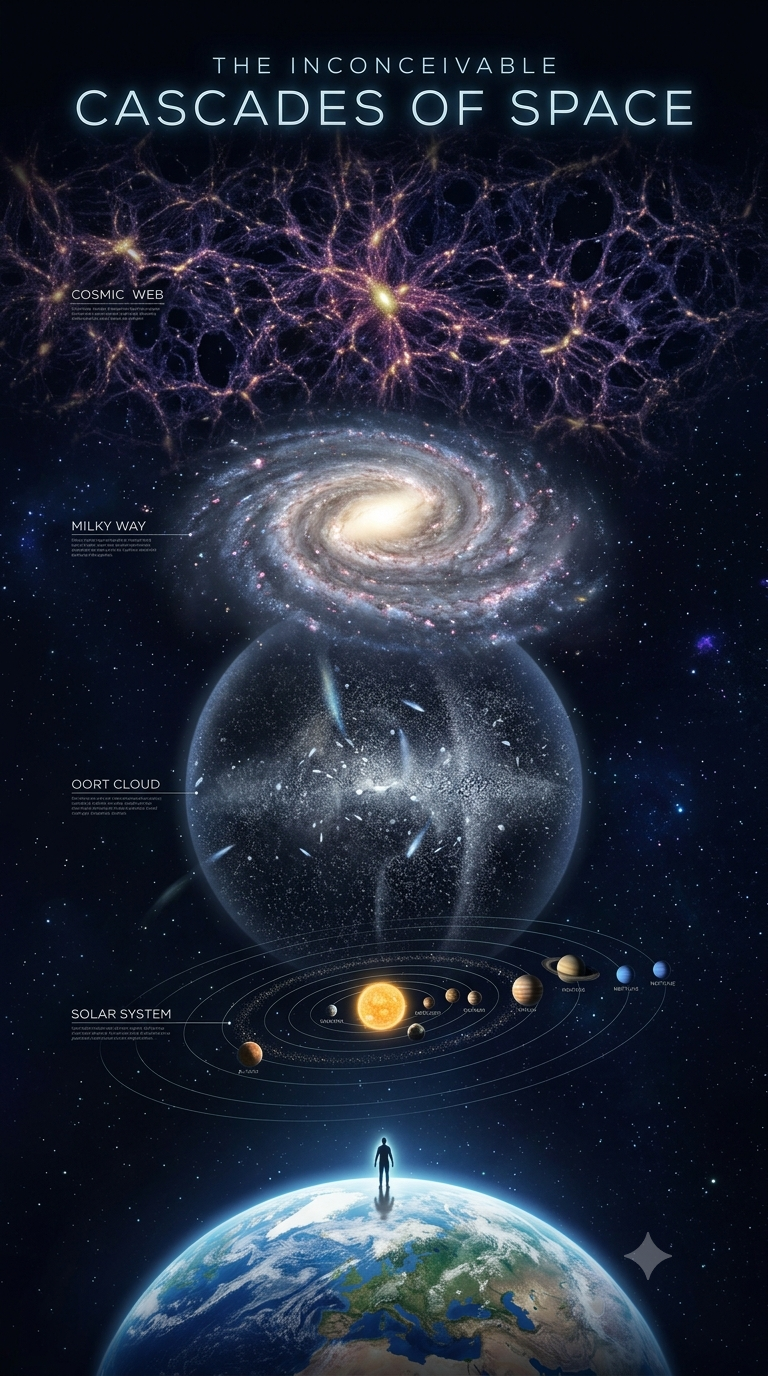
Human brains are not wired to understand the true scale of the universe. We evolved to comprehend distances we could walk, heights we could climb, and objects we could hold. To us, a ten-hour flight across the Atlantic Ocean feels like a massive journey.
But when we step outside our thin blanket of atmosphere, our intuitive sense of distance doesn’t just fail—it shatters. Recent standard cosmological mappings from instruments like the James Webb Space Telescope (JWST) and the Euclid satellite continue to reinforce a haunting truth: we live on a microscopic speck hidden inside a nearly infinite Russian nesting doll of space.
To try and comprehend the incomprehensible, let us take a mind-melting step-by-step journey upward, climbing the ladders of cosmic scale.
Step 1: The Human Scale to Planet Earth
Our journey begins with you. An average human stands roughly 1.7 meters tall.
If we scale the Earth down to something we can grasp—say, a tiny grain of sand just 1 millimeter in diameter—the human scale becomes completely invisible, existing at the microscopic subatomic level. On this same scale, where the entire planet Earth is a single grain of sand, the distance to the Moon is about 3 centimeters away, and the Sun is a beach-ball-sized object sitting 12 meters down the road.
Step 2: The Solar System to the Oort Cloud
Leaving Earth behind, we enter the domain of the Solar System. The distance from the Earth to the Sun is roughly 150 million kilometers—a distance astronomers call an Astronomical Unit (AU).
To cross the entire planetary solar system out to Neptune takes about 30 AU. But the planets are just the sun’s immediate front yard. Far beyond Neptune lies the Oort Cloud, a colossal, spherical shell of billions of icy comets enveloping our solar system.
The Oort Cloud is so vast that its inner edge begins at 2,000 AU, and its outer boundary stretches up to 100,000 AU—nearly halfway to the next neighboring star. If our planetary solar system out to Neptune were the size of a standard US quarter coin, the Oort Cloud would wrap around it with a diameter stretching across an entire professional football stadium.
Step 3: The Interstellar Neighborhood to the Galactic Scale
Once we cross the Oort Cloud, measuring distances in kilometers or AU becomes utterly useless. We must switch to light-years—the distance light travels in a single Earth year (about 9.46 trillion kilometers).
Our Sun is just one of roughly 100 billion to 400 billion stars bound together in the swirling spiral arms of the Milky Way galaxy. The Milky Way is massive, spanning roughly 100,000 light-years from edge to edge.
To visualize this leap: if the entire Oort Cloud from our previous step were shrunk down to the size of a single cell in the human body, the Milky Way galaxy would be the size of the entire North American continent.
Step 4: The Local Group and Cosmic Voids
Galaxies do not just drift alone in the dark; they congregate in galactic neighborhoods. The Milky Way belongs to the Local Group, a cluster of about 80 galaxies spanning roughly 10 million light-years across. Our closest large neighbor, the Andromeda Galaxy, is currently hurtling toward us from 2.5 million light-years away.
When we zoom out further, the scale alters again. The Local Group is merely a tiny twig on a massive branch called the Laniakea Supercluster, which contains 100,000 galaxies.
At this scale, the universe looks like a vast, sponge-like “cosmic web.” Long, glowing filaments made of billions of galaxies are threaded around unimaginable, empty black pockets known as cosmic voids—such as the famous Boötes Void, a terrifying expanse of nothingness up to 330 million light-years across where practically no galaxies exist.
Step 5: The Edge of the Observable Universe
Finally, we reach the ultimate boundary: the Observable Universe. Because the universe is roughly 13.8 billion years old, and light takes time to travel, there is a strict limit to how far we can see.
However, because space itself has been expanding since the Big Bang, the objects that emitted that early light have drifted much further away. Today, the comoving diameter of the observable universe is a staggering 93 billion light-years.
[Human: 1.7 Meters]
   ➔ [Earth: 12,742 Kilometers]
      ➔ [Oort Cloud: 2 Light-Years Across]
         ➔ [Milky Way: 100,000 Light-Years Across]
            ➔ [Observable Universe: 93 Billion Light-Years Across]
The Ultimate Perspective
If we take one final look at the math, the reality is humbling. If you were to shrink the entire 93-billion-light-year observable universe down to the size of the Earth, our entire Milky Way galaxy would become so small it could fit comfortably on a regular sheet of paper.
And planet Earth? Earth would be billions of times smaller than a single atom—an untraceable, subatomic point hidden somewhere in the static.
We may feel isolated or insignificant in the face of such crushing, ungraspable scale. Yet, there is a profound flip side to the coin: we are the microscopic pieces of the universe that built telescopes, solved the equations, and figured out how to map the whole magnificent thing.
For a beautifully animated, fluid breakdown of how these scales transition continuously into one another, you can explore The true Scale of the Universe – How Big is the Universe?, a documentary that journeys visually from quantum particles up to the largest structures in the cosmic web.
700 701 702 703 704 705 706 707 708 709 710 711 712 713 714 715 716 717 718 719 720 721 722 723 724 725 726 727 728 729 730 731 732 733 734 735 736 737 738 739 740 741 742 743 744 745 746 747 748 749 750 751 752 753 754 755 756 757 758 759 760 761 762 763 764 765 766 767 768 769 770 771 772 773 774 775 776 777 778 779 780 781 782 783 784 785 786 787 788 789 790 791 792 793 794 795 796 797 798 799 800 801 802 803 804 805 806 807 808 809 810 811 812 813 814 815 816 817 818 819 820 821 822