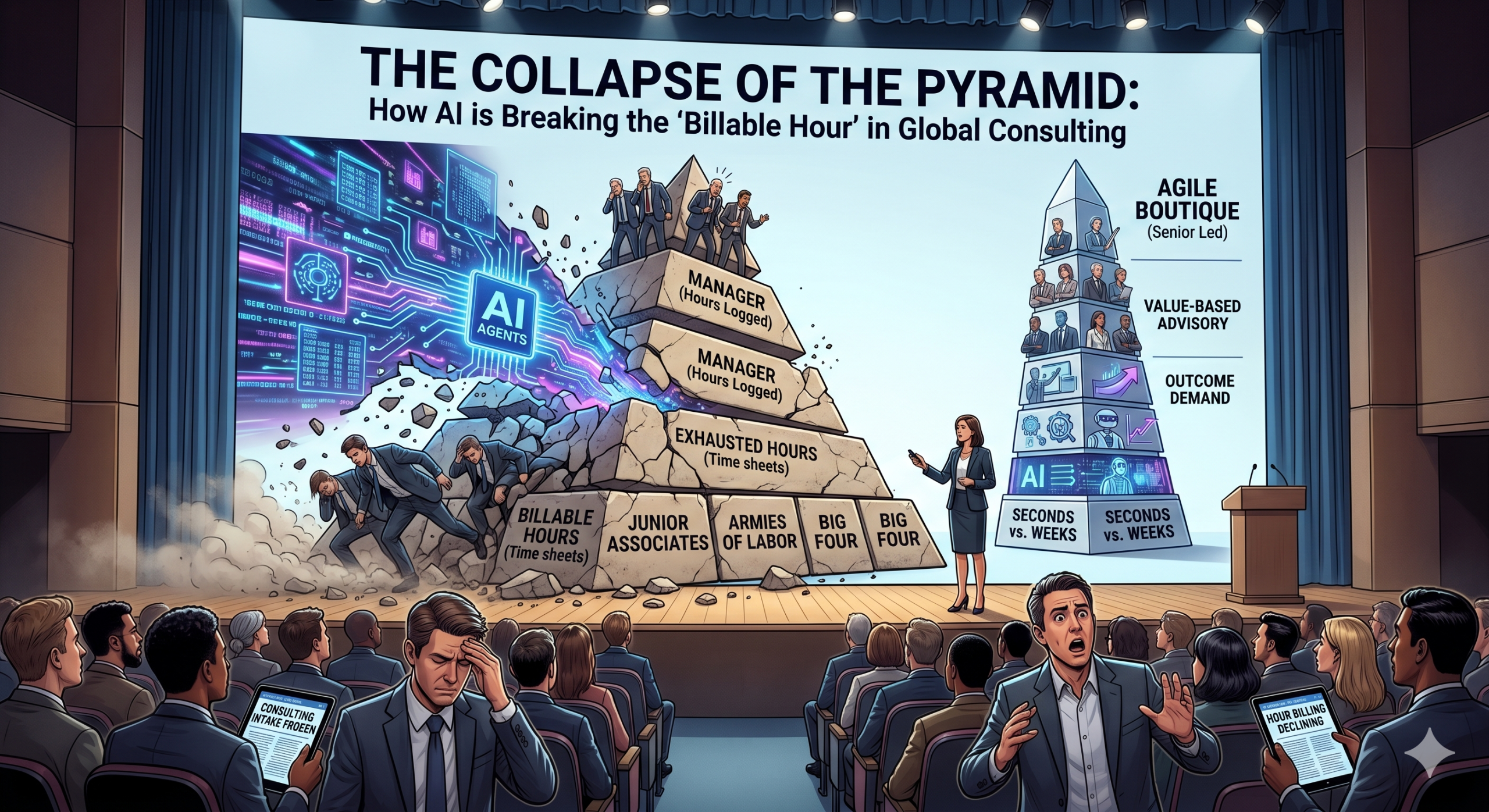
For nearly half a century, the economic engine of elite corporate consulting has relied on a brutal, elegant math known as the “pyramid structure.” At the wide base of this pyramid sat armies of fresh graduate analysts and junior associates. Their job was to log grueling 80-hour workweeks manually combing through data, auditing legal frameworks, and building presentation slides. The firm billed clients by the hour for this labor, generating massive margins that funneled straight up to a lean apex of senior partners.
In 2026, that multi-billion-dollar machine is fracturing. The rapid evolution of autonomous AI agents has triggered severe industry anxiety across the “Big Four” (Deloitte, EY, KPMG, and PwC) and the “Big Three” strategy giants (McKinsey, BCG, and Bain), directly threatening both their structural hierarchies and their sacred “billing by time” business models.
When Speed Destroys the Time Sheet
The core issue facing these legacy institutions is that artificial intelligence has decoupled time from value. When a domain-specific AI agent can ingest, audit, and cross-reference thousands of pages of corporate tax documents or legal contracts in seconds—identifying liabilities that would take a human team weeks to find—the logic of charging by the hour completely implodes.
“AI is fundamentally challenging the billable hour model that these firms were built upon,” warn sector analysts. If a boutique competitor utilizes an advanced agentic framework to complete a month-long audit in a single afternoon, charging by time becomes a competitive disadvantage. Charging an hourly rate either forces the firm to absorb a massive revenue hit or exposes them as highly inefficient compared to AI-native alternatives.
In response, major firms are scrambling to rewrite their fee structures. McKinsey & Company has quietly spent the last two years overhauling its partner compensation models, with roughly a third of its global engagements now anchored to value- and performance-based outcomes rather than hours clocked.
The Rise of the Agile Boutique
This erosion of the scale advantage has opened a massive vulnerability that smaller, hyper-agile boutique consulting firms are actively exploiting.
Historically, small firms were locked out of massive enterprise projects because they simply didn’t have the headcount to process the raw volume of data. Today, AI acts as a massive force multiplier. Armed with custom execution layers running over open-weight models, a lean team of three or four senior consultants can achieve the same analytical output as a traditional platoon of fifty on-site junior associates.
These AI-native boutiques are operating with a heavy bias toward senior-led advisory, completely bypassing the need to recruit, train, and maintain thousands of entry-level employees. They can underbid the Big Four by massive margins while delivering highly accurate strategic insights in a fraction of the time.
From Pyramid to Obelisk: A Narrower Talent Pipeline
As a result, the physical shape of consulting firms is physically altering. Industry specialists report a structural transition toward what they call the “Consulting Obelisk” or “Diamond” model—a tall, narrow corporate structure with a severely pinched base.
The demand for raw junior analytical labor has fallen so dramatically that major consulting leaders have begun freezing early-career intake and freezing entry-level salaries. PwC’s global headcount contracted significantly over the past year, and firms across the UK and US are actively scaling back graduate recruitment programs.
This creates a secondary, long-term crisis: if AI automates the “grunt work” traditionally handled by first- and second-year associates, how do firms train the next generation of senior partners?
While the Big Four still retain massive advantages in the form of deep institutional trust, immense capital reserves, and vast global networks, their reliance on sheer human scale is no longer an impenetrable moat. As corporate clients increasingly demand to pay for actual outcomes rather than the time it takes humans to reach them, the traditional consulting pyramid isn’t just evolving—it is being flattened by automation.
700 701 702 703 704 705 706 707 708 709 710 711 712 713 714 715 716 717 718 719 720 721 722 723 724 725 726 727 728 729 730 731 732 733 734 735 736 737 738 739 740 741 742 743 744 745 746 747 748 749 750 751 752 753 754 755 756 757 758 759 760 761 762 763 764 765 766 767 768 769 770 771 772 773 774 775 776 777 778 779 780 781 782 783 784 785 786 787 788 789 790 791 792 793 794 795 796 797 798 799 800 801 802 803 804 805 806 807 808 809 810 811 812 813 814 815 816 817 818 819 820 821 822