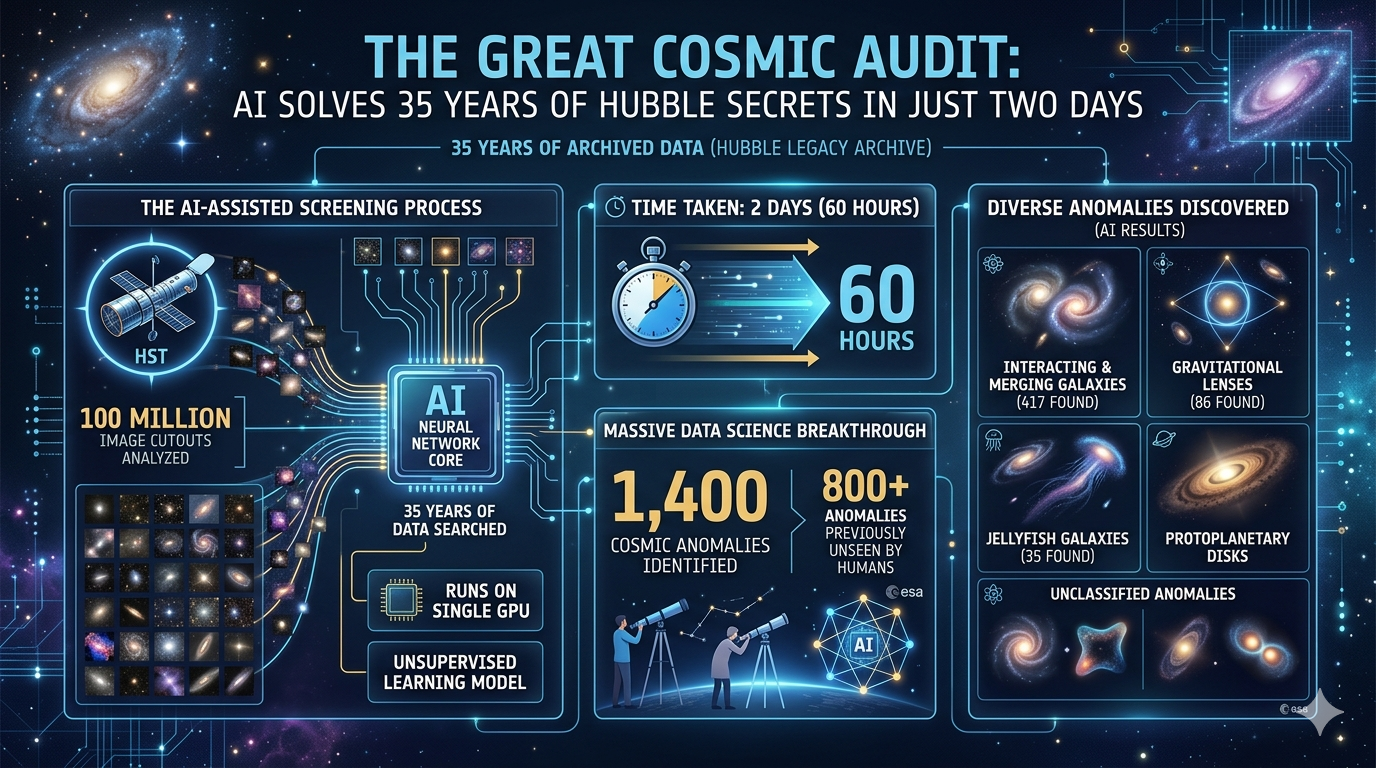
Modern astronomy is facing a data crisis. With advanced space telescopes generating vast streams of imagery daily, the volume of raw information has far outpaced the processing power of organic human brains. To address this cosmic information overload, researchers have turned to artificial intelligence—resulting in a staggering breakthrough.
In a massive demonstration of modern data science, astronomers David O’Ryan and Pablo Gómez from the European Space Agency (ESA) deployed a newly developed AI tool to comb through the Hubble Legacy Archive. In a blistering 60-hour marathon, the neural network analyzed nearly 100 million image cutouts, successfully flagging roughly 1,400 anomalous space objects. Upon manual human verification, over 1,300 were confirmed as genuine astrophysical anomalies—more than 800 of which had completely escaped human notice in previous studies.
Flipping the Script on Machine Learning
Traditionally, computer vision models used in astronomy rely on supervised learning. Humans must painstakingly label millions of images so the AI knows what a standard spiral galaxy or a quasar looks like. While highly accurate, this method is slow and inherently biased toward known cosmic categories.
The team’s newly introduced framework, named AnomalyMatch, takes the opposite approach by using unsupervised machine learning.
“Instead of teaching the AI what to look for, we trained it to understand what is statistically ‘normal’ in astronomical images,” explained lead author David O’Ryan. “Once the model established a baseline for normality, we cut it loose to flag anything that deviated from the norm. It isn’t looking for what it already knows; it’s looking for the unexplained.”
Running on a single graphics processing unit (GPU), AnomalyMatch tore through decades of historical data spanning Hubble’s 35-year operational lifetime in just two and a half days.
Inside the Cosmic Bargain Bin
When human experts stepped in to evaluate the AI’s top-rated anomalies, they discovered an incredible variety of rare, structurally warped, and dramatic phenomena. The identified anomalies offer a diverse cross-section of cosmic evolution and extreme environments:
| Anomaly Classification | Quantity Uncovered | Scientific Significance |
| Interacting & Merging Galaxies | 417 | Natural laboratories for studying large-scale gravitational dynamics and structural collapse. |
| Gravitational Lenses | 86 | Distortions in spacetime that magnify deep-space objects, crucial for measuring cosmic expansion and dark matter. |
| Jellyfish Galaxies | 35 | Rare galaxies with trailing “gaseous tentacles” sculpted by extreme intergalactic pressure. |
| Protoplanetary Disks | Multiple | Dusty, planet-forming disks observed edge-on, frequently resembling cosmic “hamburgers.” |
| Unclassified Anomalies | Several Dozen | Mysterious objects with unique shapes—such as dual-lobed swirling cores—that completely defy existing classification schemes. |
The Future of Autonomous Discovery
The success of the AnomalyMatch trial marks a profound shift in how archival data will be managed moving forward. Old data is no longer dead data; instead, it is a treasure trove waiting for a fresh algorithm to unlock its secrets.
As next-generation hardware like the James Webb Space Telescope and the Euclid Space Telescope continue to flood servers with hundreds of gigabytes of new data every day, cognitive filters like AI will become mandatory tools for researchers. By outsourcing the initial digital triage to neural networks, astronomers can bypass the tedious task of searching for cosmic needles, allowing them to focus entirely on studying the anomalies once they are found.
700 701 702 703 704 705 706 707 708 709 710 711 712 713 714 715 716 717 718 719 720 721 722 723 724 725 726 727 728 729 730 731 732 733 734 735 736 737 738 739 740 741 742 743 744 745 746 747 748 749 750 751 752 753 754 755 756 757 758 759 760 761 762 763 764 765 766 767 768 769 770 771 772 773 774 775 776 777 778 779 780 781 782 783 784 785 786 787 788 789 790 791 792 793 794 795 796 797 798 799 800 801 802 803 804 805 806 807 808 809 810 811 812 813 814 815 816 817 818 819 820 821 822