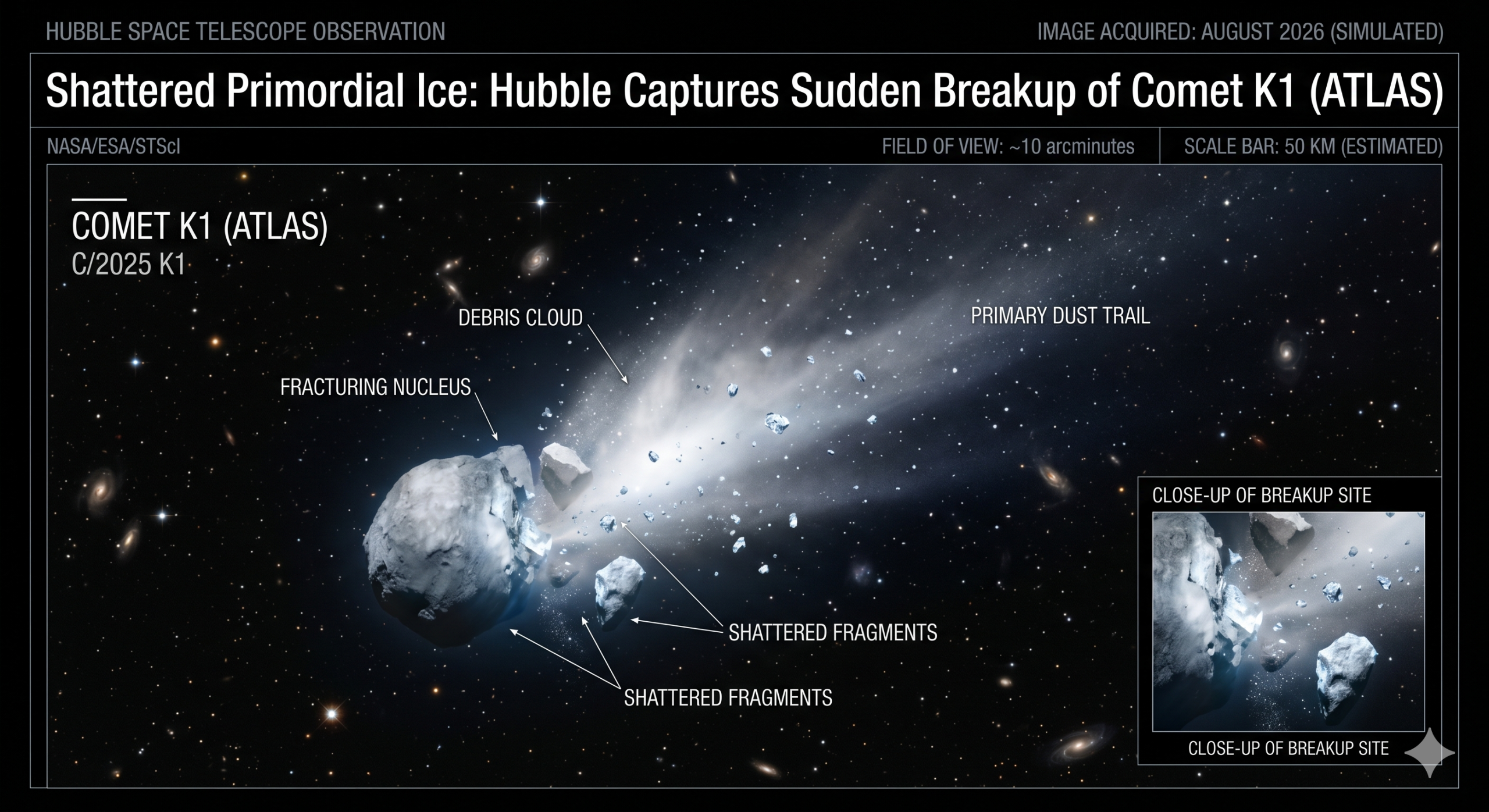
The global astronomical community has been treated to a front-row seat for a rare and dramatic deep-space disaster. NASA’s Hubble Space Telescope has captured highly detailed imagery of Comet C/2025 K1 (ATLAS) unexpectedly disintegrating in real-time.
Just days after surviving its closest approach to the Sun, the pristine visitor from the outermost edges of our solar system fractured into at least four distinct pieces. The violent breakup occurred just as the comet began its long, lonely journey back into deep space, providing scientists with an unprecedented look at the volatile mechanics of cometary death.
Surviving the Solar Gauntlet
Comet K1 (ATLAS) originated in the Oort Cloud—a vast, icy repository of primordial debris surrounding our solar system. Traveling for millennia toward the inner solar system, the comet made its closest approach to the Sun (perihelion), diving deep inside the orbit of Mercury.
During this close pass, the comet experienced intense gravitational tidal forces and blistering thermal radiation. While many astronomers initially feared it would vaporize during perihelion, K1 initially appeared to survive the encounter. However, the extreme structural stress proved to be a delayed death sentence. As the icy nucleus began moving away from the Sun, the built-in pressures caused the comet to structurally fail and tear itself apart.
A Serendipitous Masterpiece by Hubble
The capture of this fragmentation event was an extraordinary stroke of luck for researchers. Astronomers were targeting a completely different cosmic object when unexpected technical constraints forced them to shift Hubble’s gaze to Comet K1 as a backup option.
When the telescope’s high-resolution data came through, scientists were stunned to find a cosmic crime scene. Instead of a single, solid nucleus, Hubble clearly resolved at least four separate, major fragments drifting away from each other in a diagonal line.
Remarkably, Hubble’s sharp optics showed that each individual piece had already developed its own “coma”—the fuzzy, glowing envelope of gas and dust that forms when fresh ice is exposed to space and sublimates. While ground-based observatories could only see a blurry, indistinct blob of light, Hubble’s view provided the clearest timeline of a cometary breakup ever recorded so early in the process.
Clues to the Early Solar System
Because comets like K1 have been frozen in the deep freeze of outer space since the birth of our solar system roughly 4.6 billion years ago, they act as time capsules. Studying how they fracture gives scientists a rare peek beneath their weathered surfaces into the pristine, ancient material hidden inside.
The unexpected fragmentation has also introduced a compelling mystery. Ground-based observers noticed a slight delay between when the physical breakup occurred and when the fragments experienced bright outbursts of light. Planetary scientists are currently analyzing data from Hubble’s spectrometers to determine why the freshly exposed ice didn’t instantly vaporize, a finding that could rewrite our understanding of cometary surface physics.
For now, the remnants of Comet K1 continue to drift further apart, transforming a once-promising solo traveler into a spectacular, expanding graveyard of icy rubble leaving our solar system forever.
700 701 702 703 704 705 706 707 708 709 710 711 712 713 714 715 716 717 718 719 720 721 722 723 724 725 726 727 728 729 730 731 732 733 734 735 736 737 738 739 740 741 742 743 744 745 746 747 748 749 750 751 752 753 754 755 756 757 758 759 760 761 762 763 764 765 766 767 768 769 770 771 772 773 774 775 776 777 778 779 780 781 782 783 784 785 786 787 788 789 790 791 792 793 794 795 796 797 798 799 800 801 802 803 804 805 806 807 808 809 810 811 812 813 814 815 816 817 818 819 820 821 822