Suspended in the cosmic dark some 64 light-years away in the constellation Vulpecula, there hangs a world of deceptive, breathtaking beauty.
To the human eye, HD 189733b looks like a tranquil sanctuary—a rich, deep-blue marble reminiscent of Earth’s pristine oceans as seen from orbit. But this cosmic gem is an optical illusion of the most violent order.
HD 189733b is a “Hot Jupiter,” a massive gas giant locked in a scorching, hyper-proximate orbit around its parent star. It is a world where the weather is weaponized, where planetary physics are pushed to terrifying extremes, and where the tranquil blue sky hides a perpetual nightmare of roaring winds and flying liquid shards.
The Illusion of Azure
When astronomers first determined the color of HD 189733b using the Hubble Space Telescope, it was a historic milestone: the first time the true visible color of an exoplanet had ever been directly measured.
However, its striking cerulean hue does not come from vast, life-giving oceans or a serene nitrogen-oxygen atmosphere. Instead, it is the product of a hellish atmospheric cocktail.
The planet’s atmosphere is packed with high, hazy clouds laced with silicates—the primary component of rocks and sand. The scorching heat of the nearby star keeps these minerals suspended in a hazy shroud. When the star’s brilliant light hits these upper atmospheric layers, the microscopic silicate particles scatter blue light far more efficiently than red light, giving the exoplanet its signature, serene appearance.
Atmospheric Fury: Winds at Mach 7
The true horror of HD 189733b lies just beneath its beautiful blue exterior, driven by a planetary engine of unimaginable violence.
Because the planet sits incredibly close to its host star, it experiences extreme tidal locking, pinning one side in perpetual, blinding daylight while the other faces everlasting night. This creates a staggering temperature differential: the dayside bakes at a crushing 1,700°F (930°C), while the nightside drops significantly cooler.
[Day Side: 1,700°F Silicate Vapor] ➔ [Equatorial Jet Streams] ➔ [Night Side: Condensation & Cooling]
Nature abhors such an extreme imbalance. In a frantic cosmic attempt to equalize this heat, the planet generates planetary-scale jet streams of unfathomable power. Winds on HD 189733b howl across the equator at speeds clocking in at 5,400 mph (8,700 km/h). This is more than seven times the speed of sound—far faster than any storm ever recorded in our solar system, and easily capable of tearing an Earth-sized atmosphere to shreds.
A Torrent of Horizontal Shards
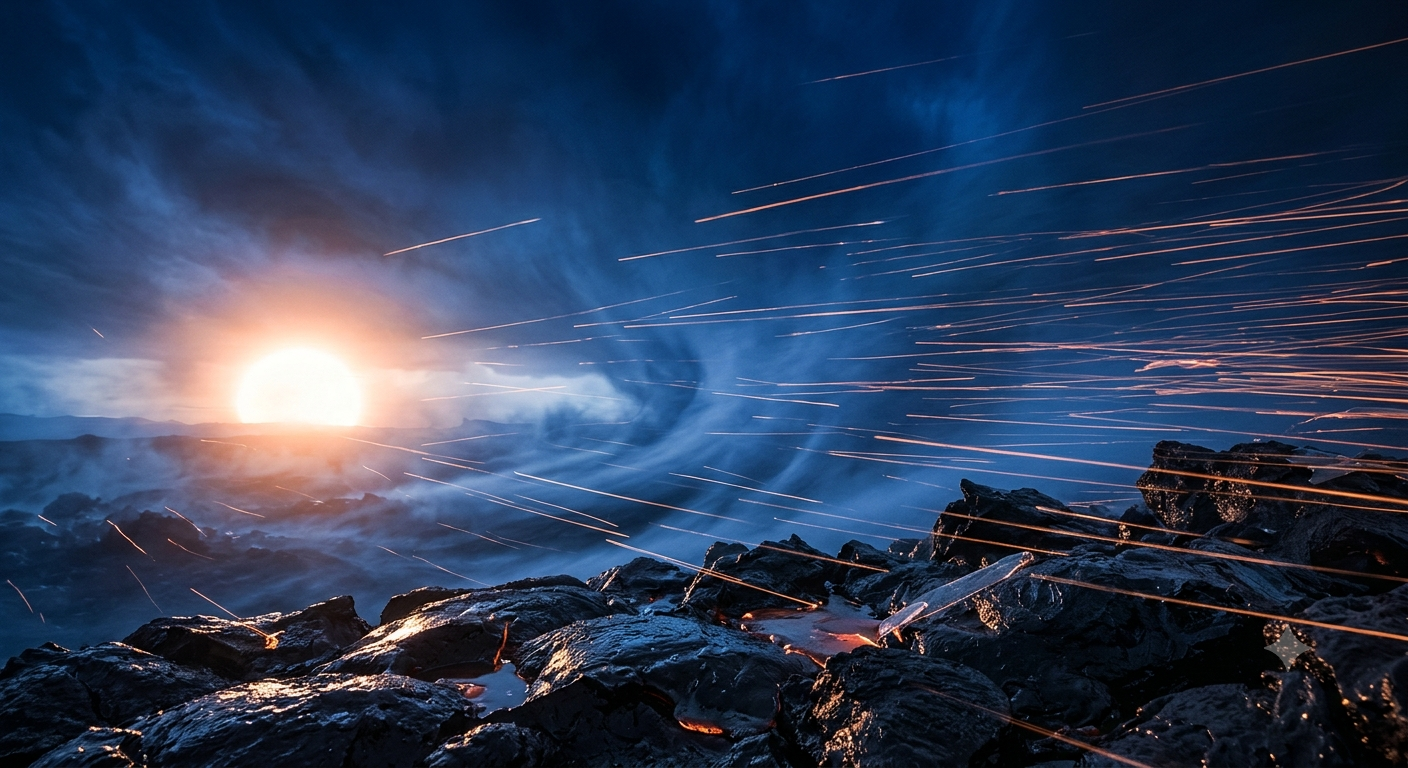
It is the combination of this blistering heat, the silicate chemistry, and the supersonic winds that gives rise to the planet’s most famous, terrifying phenomenon: sideways glass rain.
As the airborne silicates cycle through the atmosphere, the intense heat causes them to condense into microscopic droplets of actual liquid glass. On a calmer world, this molten glass would simply fall toward the planetary core as a scorching rain.
The Physics of the Storm: Because the atmospheric winds travel at a staggering 5,400 mph, the falling liquid glass is instantly caught in the crosswinds. Instead of falling downward, the molten shards are whipped into a horizontal frenzy, raining sideways across the planet’s face.
Anyone or anything caught in this atmospheric current would not merely be melted; they would be instantly shredded by billions of flying, razor-sharp liquid needles moving at supersonic speeds. It is a literal rain of a thousand cuts, sweeping across a vast, deep-blue void.
HD 189733b stands as a powerful testament to the sheer diversity and hostility of the wider universe. It serves as a stark reminder to astronomers that in the vast theater of deep space, the most beautiful, inviting faces often mask the most volatile and dangerous realities.
700 701 702 703 704 705 706 707 708 709 710 711 712 713 714 715 716 717 718 719 720 721 722 723 724 725 726 727 728 729 730 731 732 733 734 735 736 737 738 739 740 741 742 743 744 745 746 747 748 749 750 751 752 753 754 755 756 757 758 759 760 761 762 763 764 765 766 767 768 769 770 771 772 773 774 775 776 777 778 779 780 781 782 783 784 785 786 787 788 789 790 791 792 793 794 795 796 797 798 799 800 801 802 803 804 805 806 807 808 809 810 811 812 813 814 815 816 817 818 819 820 821 822