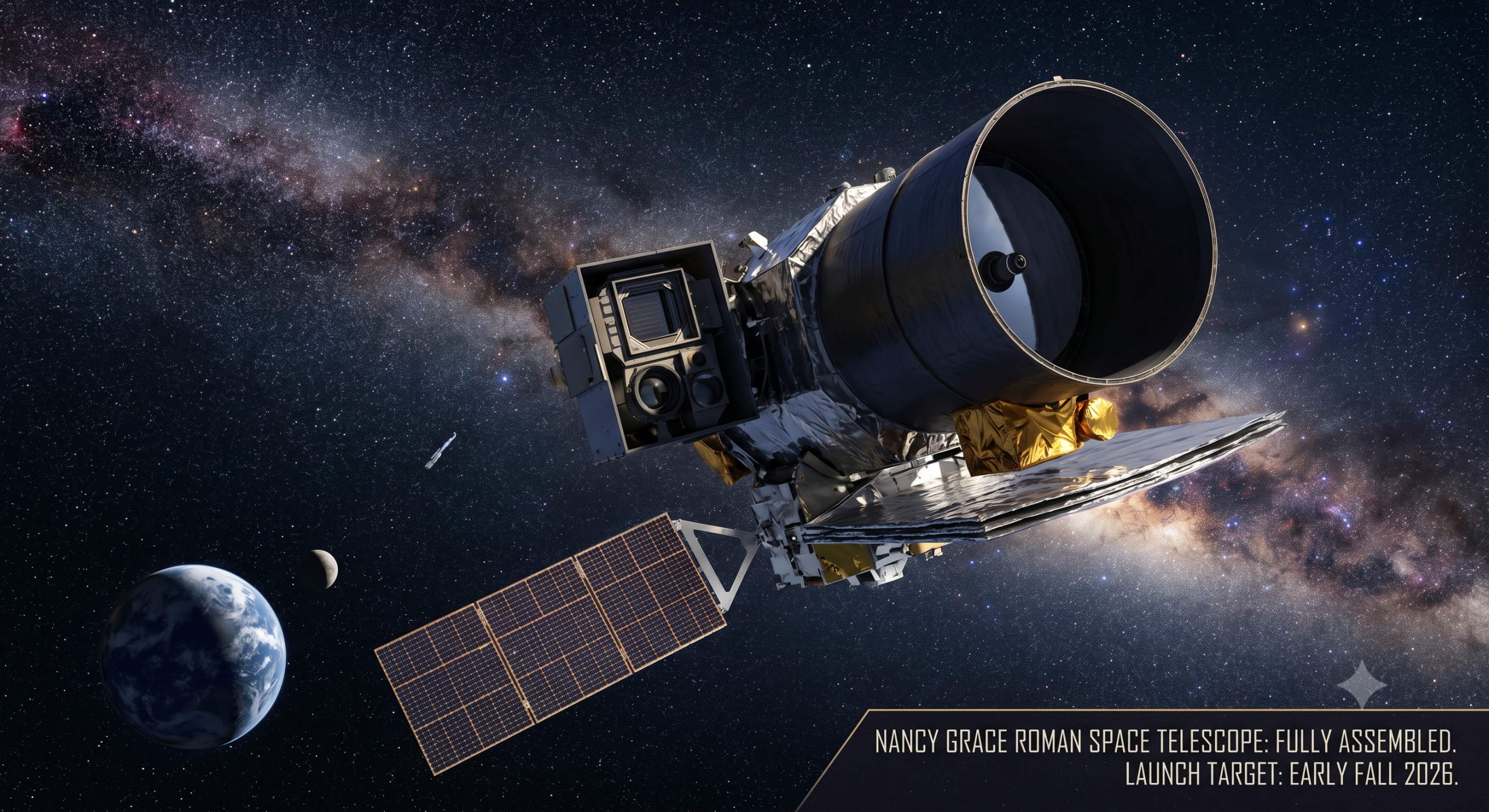
GREENBELT, Md. — In a major milestone for deep-space exploration, NASA has officially completed the final integration and assembly of its next flagship observatory, the Nancy Grace Roman Space Telescope.
Engineers and technicians at the Goddard Space Flight Center successfully joined the telescope’s primary segments in the facility’s massive clean room. Originally committed to a launch no later than May 2027, the project is moving ahead of schedule and under budget, with NASA now targeting an accelerated launch window as early as September 2026.
The observatory is slated to roll out to NASA’s Kennedy Space Center in Florida for final launch preparations aboard a SpaceX Falcon Heavy rocket. It will ultimately travel to the second Sun-Earth Lagrange point ($L_2$), a gravitationally stable orbit located roughly one million miles from Earth, where it will work alongside the James Webb Space Telescope (JWST).
100 Times the View of Hubble
Named in honor of Dr. Nancy Grace Roman, NASA’s first chief astronomer and the “mother of the Hubble Space Telescope,” the Roman Space Telescope is engineered to deliver a panoramic revolution to astrophysics.
While Roman features a 2.4-meter (7.9-foot) primary mirror—the exact same size as Hubble’s—its core instrument, the Wide Field Instrument (WFI), tells a completely different story. The 300.8-megapixel visible and near-infrared camera boasts a field of view 100 times larger than Hubble’s imaging cameras.
“The images it captures will be so large there is not a screen in existence large enough to show them,” NASA officials noted.
Where JWST is designed to peer deeply into narrow, highly specific pinpricks of the early universe, Roman’s strength is massive, ultra-detailed cosmic surveys. Over its 35 years of service, Hubble has generated roughly 400 terabytes of data; once operational, Roman is expected to generate 500 terabytes of data every single year.
Mapping the Dark Universe and Hunting Rogue Worlds
Astronomers intend to leverage Roman’s massive data stream to tackle some of the most fundamental mysteries of the cosmos across three primary areas:
-
Dark Energy & Dark Matter: By conducting cosmic surveys across billions of galaxies, Roman will trace the large-scale structure of the universe to map out dark matter. It will also utilize independent techniques—including tracking distant supernovae and weak gravitational lensing—to examine dark energy, the mysterious force causing the expansion of the universe to accelerate.
-
The Galactic Exoplanet Census: Roman is projected to completely rewrite our understanding of planetary demographics. Using a technique called gravitational microlensing—which observes how the gravity of a foreground star warps and magnifies the light of a background star—Roman is expected to discover roughly 100,000 new transiting planets.
-
Rogue Planets: Beyond worlds tied to parent stars, Roman is uniquely positioned to map out a population of “rogue worlds”—isolated planets drifting through the galaxy without a star to orbit. Scientists estimate the mission will detect hundreds of Earth-mass rogue planets, turning what is currently a handful of cosmic anomalies into a robust statistical population census.
Next-Generation Starlight Blocking
Alongside its wide-field survey capabilities, Roman carries a secondary, high-tech technology demonstration: the Coronagraph Instrument.
Directly imaging an exoplanet is traditionally compared to trying to photograph a firefly floating next to a coastal lighthouse. Roman’s active coronagraph system will use a complex arrangement of masks, filters, and self-flexing mirrors to block out the blinding glare of distant host stars. This will allow the telescope to capture the direct light and atmospheric spectra of Jupiter-sized planets around neighboring stars, proving the critical engineering required for future missions aimed at finding habitable, Earth-sized worlds.
Following a rigorous battery of environmental tests—where the observatory was blasted with extreme acoustic vibrations, shaking, and thermal vacuums—the completed hardware is standing ready. If the current timeline holds, Roman will lift off this autumn to begin its primary five-year mission, offering humanity its widest, clearest look yet at the evolution of the universe.
700 701 702 703 704 705 706 707 708 709 710 711 712 713 714 715 716 717 718 719 720 721 722 723 724 725 726 727 728 729 730 731 732 733 734 735 736 737 738 739 740 741 742 743 744 745 746 747 748 749 750 751 752 753 754 755 756 757 758 759 760 761 762 763 764 765 766 767 768 769 770 771 772 773 774 775 776 777 778 779 780 781 782 783 784 785 786 787 788 789 790 791 792 793 794 795 796 797 798 799 800 801 802 803 804 805 806 807 808 809 810 811 812 813 814 815 816 817 818 819 820 821 822