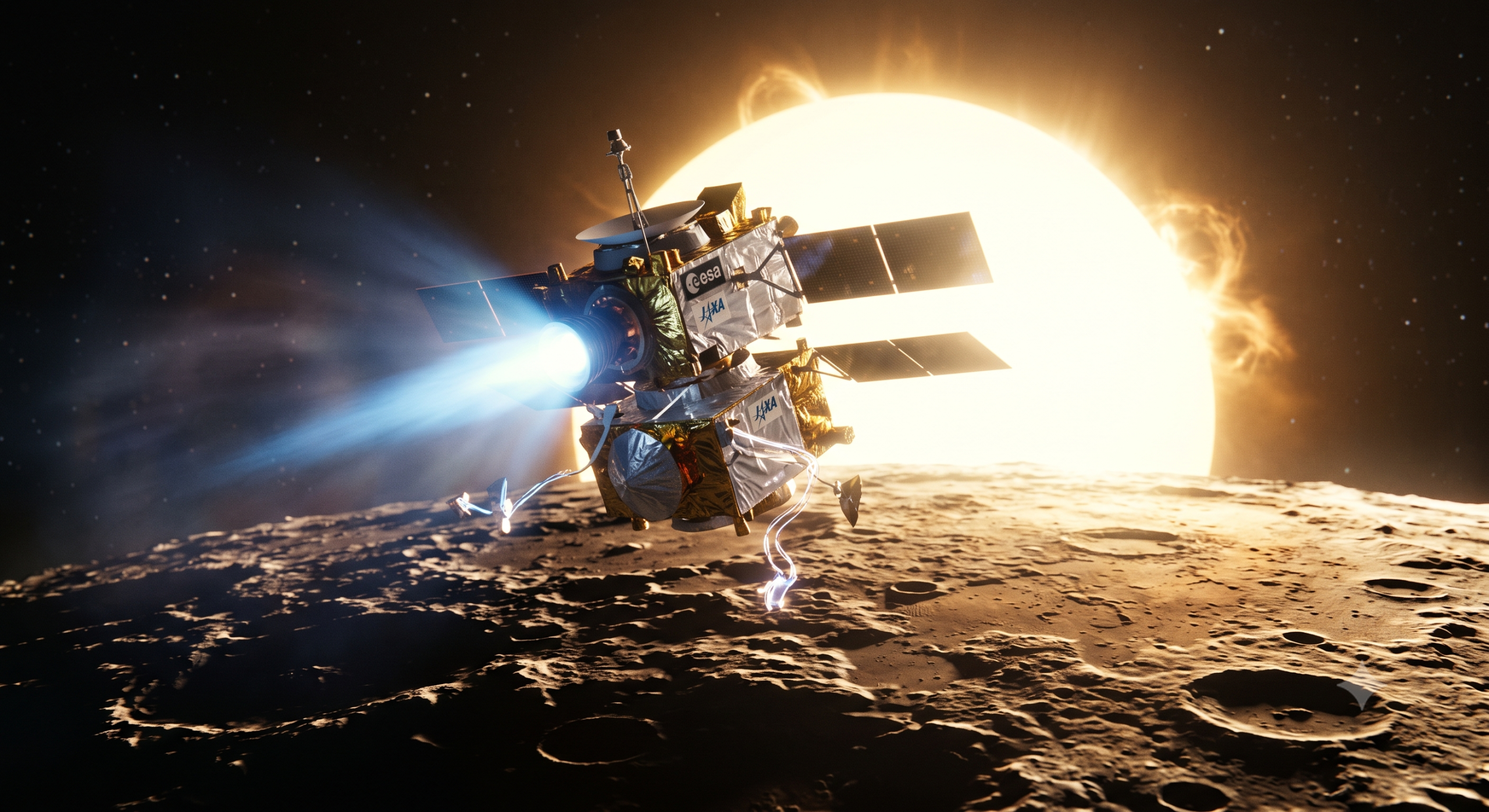
Following an intricate, multi-billion-kilometer trek spanning nearly eight years through the inner solar system, the collaborative ESA-JAXA BepiColombo mission is successfully transitioning into its final arrival sequence at Mercury. Having shut down its main solar electric propulsion system for the last time, the spacecraft is locked onto a precise ballistic trajectory that will culminate in its high-stakes orbit insertion.
Getting into orbit around the solar system’s innermost planet presents an extreme challenge in astrodynamics. Because Mercury sits so close to the Sun, any incoming spacecraft faces a massive gravitational pull that continuously accelerates its speed. To counteract this immense solar drag without exhausting immense amounts of fuel, BepiColombo completed an elaborate series of nine planetary gravity assists, using the orbital energy of Earth, Venus, and Mercury itself as a natural cosmic brake.
Splitting the Stack at the Innermost Planet
The mission architecture stands out due to its multi-vehicle design. BepiColombo has traversed the void as a single stacked unit pushed forward by a dedicated transfer module. Upon reaching the target zone, this transport system will be discarded, allowing two independent scientific orbiters to separate and establish their own specialized flight paths around the scorched world.
The two probes are custom-built to survive the planet’s intense environment, where temperatures oscillate wildly between extreme day-side heat and freezing night-side shadows.
-
The Mercury Planetary Orbiter (MPO): Developed by the European Space Agency, this component will drop into a low polar orbit. It carries highly sensitive instrumentation designed to peer downward to analyze Mercury’s geological history, internal core composition, and volcanic plains.
-
Mio (The Mercury Magnetospheric Orbiter): Engineered by the Japan Aerospace Exploration Agency, this vehicle will follow a wider, highly elliptical path. Rather than studying the crust, Mio’s instruments will monitor the space surrounding the planet, tracking how its volatile magnetosphere interacts with the relentless stream of solar wind.
A Dual-Perspective Science Phase
This simultaneous two-pronged strategy marks a significant upgrade over previous exploration efforts, which only utilized solitary spacecraft. By taking measurements from two different altitudes at the exact same moment, scientists can differentiate between shifting variations in the solar wind and permanent features within Mercury’s own unique magnetic field.
Following the final series of delicate braking maneuvers, the official science phase is expected to commence, opening up a brand-new window into how rocky planets evolve so close to their parent stars.