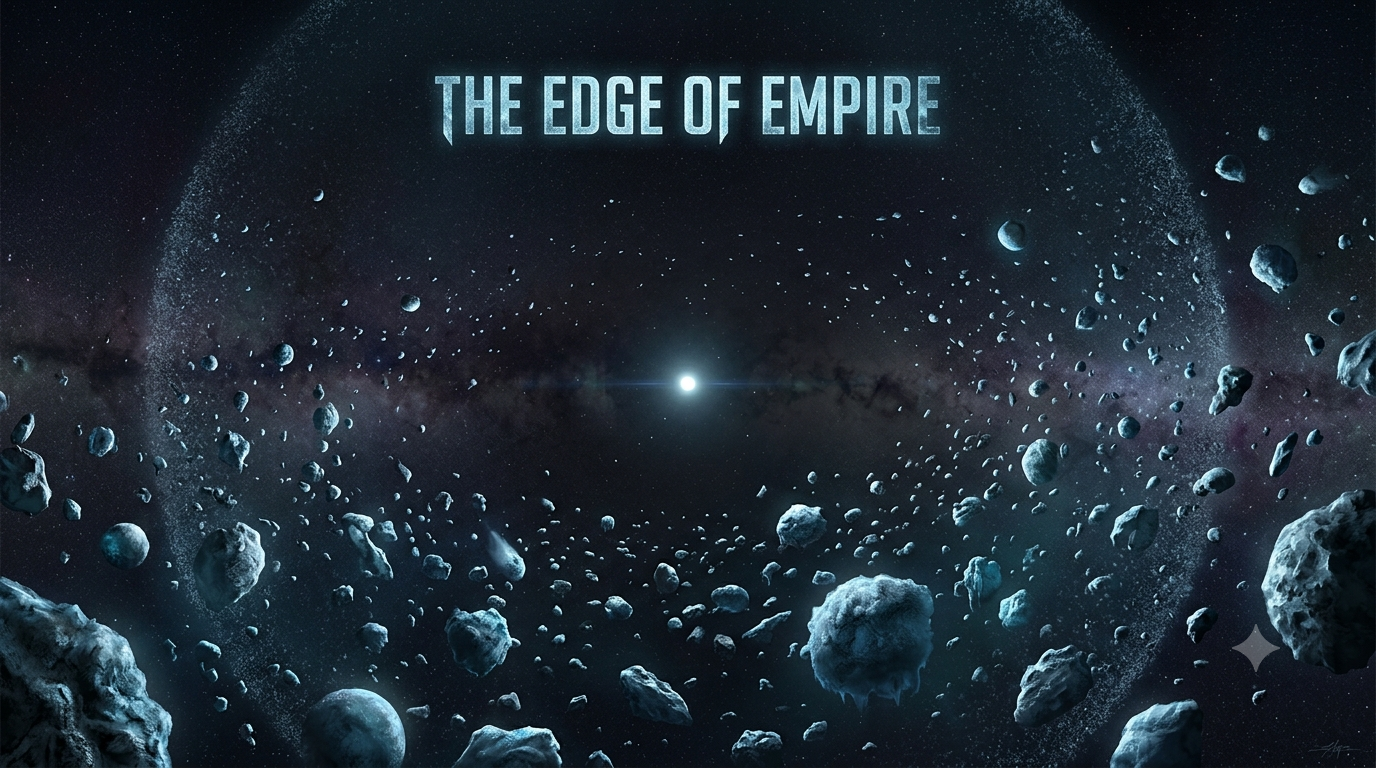
When we imagine the outer limits of the solar system, we often picture the orbit of Neptune or the icy dwarf planets of the Kuiper Belt. But the true frontier lies exponentially farther out in the dark. It is called the Oort Cloud, a theoretical, colossal spherical shell of icy debris that completely envelops our sun. Proposed in 1950 by Dutch astronomer Jan Hendrik Oort, this vast reservoir is the birthplace of long-period comets and marks the ultimate cosmological boundary where the Sun’s gravitational dominance yields to the interstellar void.
The Abyss at the Edge of Gravity
The scale of the Oort Cloud defies human comprehension. While the Earth sits at one Astronomical Unit (AU) from the Sun, the inner edge of the Oort Cloud is believed to begin between 2,000 and 5,000 AU away. Its outer edge stretches outward into deep space, potentially reaching up to 100,000 or even 200,000 AU. At these extremes, the cloud extends up to 3.2 light-years away, effectively reaching almost halfway to Proxima Centauri, the nearest star.
To put this profound distance into perspective, sunlight, which reaches Earth in eight minutes, takes between 10 to 28 days just to hit the inner boundary of the Oort Cloud, and up to a year and a half to traverse its outer limits. Even Voyager 1, humanity’s farthest spacecraft currently hurtling through interstellar space, will not reach the Oort Cloud for approximately 300 years. Once it arrives, the probe will spend an estimated 30,000 years continuously flying through the cloud before emerging on the other side.
A Graveyard of Trillions
Far from a dense, glowing nebula, the Oort Cloud is an incredibly dark and diffuse structure. It is believed to be divided into two distinct regions: a doughnut-shaped inner sector known as the Hills cloud, and a massive, spherical outer shell.
Within this freezing darkness, there are estimated to be trillions of objects larger than one kilometer across, and billions that measure over 20 kilometers in diameter. Despite this massive population, individual objects are likely separated by tens of millions of kilometers. The total combined mass of the outer cloud is roughly equivalent to five Earths.
These objects are deep-frozen relics of the early solar system, composed largely of icy volatiles like water, methane, ethane, carbon monoxide, hydrogen cyanide, and ammonia. They are the scattered remnants of the original protoplanetary disc that formed 4.6 billion years ago. As the giant planets—primarily Jupiter—migrated and grew, their immense gravity violently ejected these planetesimals outward. Once pushed to the very fringes of the solar system, galactic tidal forces and the gravitational tugs of neighboring stars circularized their orbits, trapping them in a permanent, distant shell.
The Origin of the Cosmic Phantoms
While the Oort Cloud remains physically unvisited by any probe, it occasionally sends emissaries inward. It is the accepted source of long-period comets—spectacular, icy wanderers that take anywhere from 200 to millions of years to complete a single orbit around the Sun.
Because these comets reside at the absolute edge of the Sun’s gravitational grip, they are incredibly sensitive to external forces. The gravitational pull of a passing star or the tidal forces of the Milky Way galaxy can gently nudge an icy body, sending it plummeting inward toward the inner solar system.
As advanced telescopes like the Rubin Observatory come online, astronomers anticipate doubling the known catalog of these long-period comets, revealing more about this invisible realm. For now, the Oort Cloud remains our solar system’s ultimate veil—a silent, frozen sphere of ancient debris guarding the threshold to the stars.