As you read this, a piece of 1970s human engineering is hurtling through the pitch-black freezing void of interstellar space at 38,000 miles per hour.
NASA’s Voyager 1 spacecraft is currently pushing toward an unprecedented cosmic milestone: it is nearly one “light-day” away from Earth. This means it is so incredibly distant that a radio signal traveling at the speed of light takes a full 24 hours to cross the chasm back to its creators.
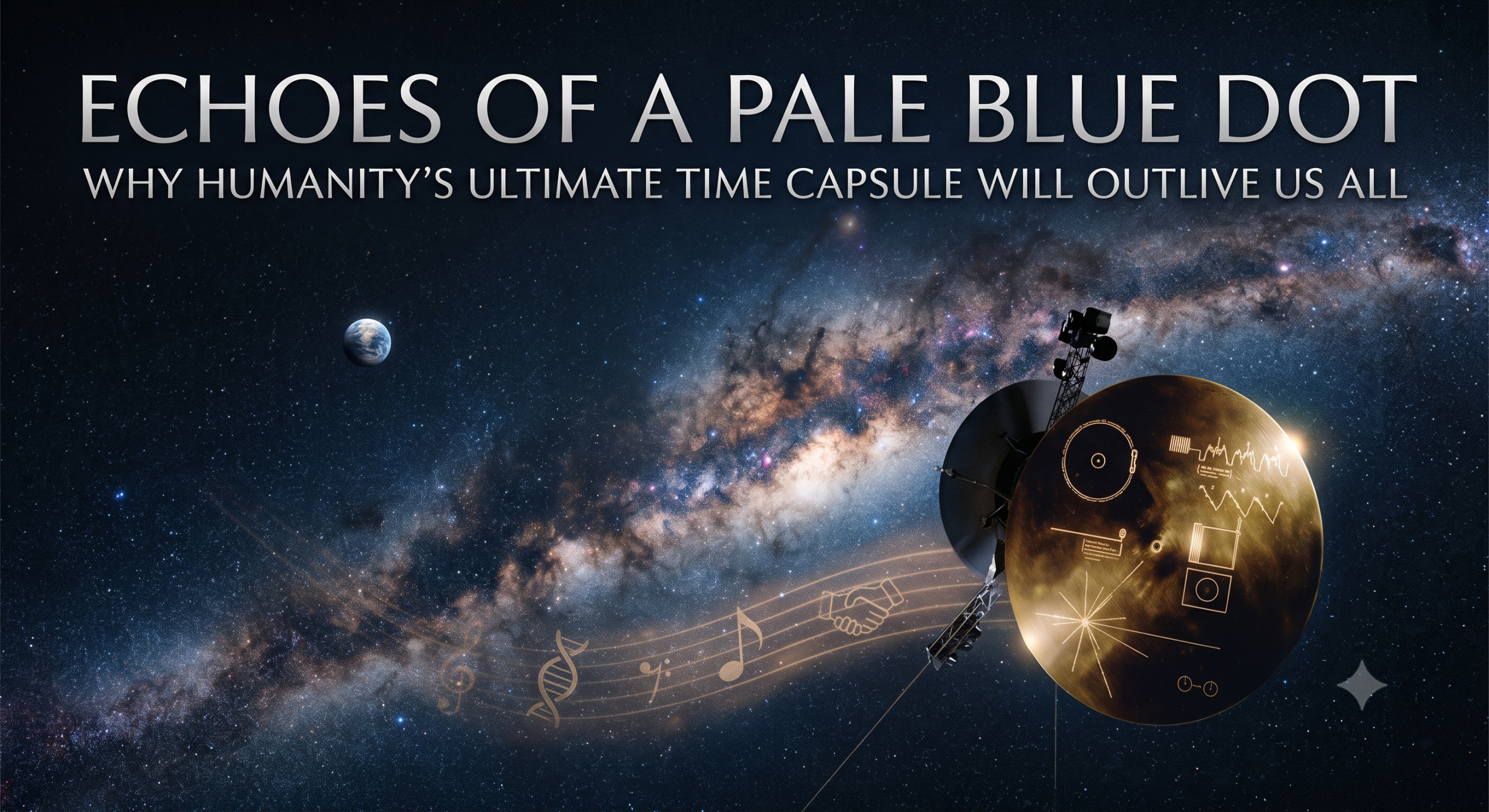
Its twin, Voyager 2, is not far behind. Within a decade, both spacecraft will exhaust their fading plutonium batteries, freeze over, and cease communication forever. But they will not be truly dead. Long after their radios go silent, both probes will carry a physical monument to our existence: the Voyager Golden Records.
Bolted securely to the exterior of each craft, these 12-inch, gold-plated copper discs are the ultimate time capsules of planet Earth. As they drift seamlessly into the cosmic deep, they raise profound questions: Who are they actually for, what do they say about us, and will they become the last remaining evidence that we ever existed?
A Cosmic Mixture: What the Records Say About Us
Chaired by the legendary astronomer Carl Sagan, the committee that designed the Golden Records in 1977 had a staggering task: distill the entire sum of human history, culture, and emotion onto a single phonograph record.
What they created was an audio-visual mosaic of life on Earth. The records contain:
-
Sounds of Earth: A audio essay featuring the rumble of volcanoes, a mother comforting her crying child, the calls of humpback whales, and a roaring steam train.
-
Voices of the Planet: Spoken greetings in 55 different languages, ranging from ancient Sumerian to modern Mandarin, alongside a message from the UN Secretary-General.
-
The World’s Playlist: 90 minutes of music bridging human history. It juxtaposes the intricate mathematical beauty of Bach and Beethoven with the raw, energetic rock ‘n’ roll of Chuck Berry’s “Johnny B. Goode.”
-
The Earth’s Photo Album: Encoded in analog signals are 115 images depicting human anatomy, architecture, our solar system, and people eating, farming, and laughing.
Conspicuously missing from the records is any mention of war, poverty, pollution, or the darker chapters of human history. The record was intentionally curated to put humanity’s best foot forward—acting not as a complete historical ledger, but as a hopeful greeting card.
Who Is the Audience?
The Golden Records are fitted with a cartridge, an aluminum cover etched with symbolic instructions on how to play them, and a map showing Earth’s location relative to 14 pulsars (cosmic clocks).
But who is meant to read them?
Scientifically speaking, the chances of an advanced alien civilization intercepting a 720-kilogram hunk of metal in the mind-boggling vastness of empty space are functionally zero. Space is simply too empty. It will take Voyager 1 about 40,000 years just to pass within 1.7 light-years of a neighboring red dwarf star.
As Sagan himself famously noted, the records were always as much about the creators as the receivers:
“The spacecraft will be encountered and the record played only if there are advanced spacefaring civilizations in interstellar space. But the launching of this ‘bottle’ into the cosmic ‘ocean’ says something very hopeful about life on this planet.”
The true audience was us. It was an exercise in self-reflection during the height of the Cold War—a statement that despite our deep geopolitical divisions, we were fundamentally a single, fragile species sharing a “pale blue dot” in space.
Outliving Humanity: The Billion-Year Guarantee
Perhaps the most haunting aspect of the Voyager Golden Records is their longevity.
In the vacuum of interstellar space, there is no atmospheric weathering, no water to cause rust, no tectonic activity to swallow them up, and no human conflicts to destroy them. The primary threat in deep space is micro-meteorites and cosmic radiation, both of which erode matter at an incredibly slow rate.
Astronomers estimate that the copper discs, protected by their aluminum jackets, will remain readable for at least one billion years.
To put that into perspective, one billion years from now, continental drift will have completely reshaped Earth beyond recognition. The Sun will have grown hotter, likely rendering our oceans vapor and the planet uninhabitable to complex life. Humanity as we know it will either be long extinct or evolved into something entirely unrecognizable.
While the monuments of Rome, the pyramids of Egypt, and our digital servers will crumble into dust within millennia, the Golden Records will remain pristine, coasting through the spiral arms of the Milky Way. Long after the human race has fallen silent, Bach will still be playing, children will still be laughing, and Chuck Berry will still be strumming his guitar—drifting as a beautiful, ghostly echo of a world that once was.
1 2 3 4 5 6 7 8 9 10 11 12 13 14 15 16 17 18 19 20 21 22 23 24 25 26 27 28 29 30 31 32 33 34 35 36 37 38
700 701 702 703 704 705 706 707 708 709 710 711 712 713 714 715 716 717 718 719 720 721 722 723 724 725 726 727 728 729 730 731 732 733 734 735 736 737 738 739 740 741 742 743 744 745 746 747 748 749 750 751 752 753 754 755 756 757 758 759 760 761 762 763 764 765 766 767 768 769 770 771 772 773 774 775 776 777 778 779 780 781 782 783 784 785 786 787 788 789 790 791 792 793 794 795 796 797 798 799 800 801 802 803 804 805 806 807 808 809 810 811 812 813 814 815 816 817 818 819 820 821 822