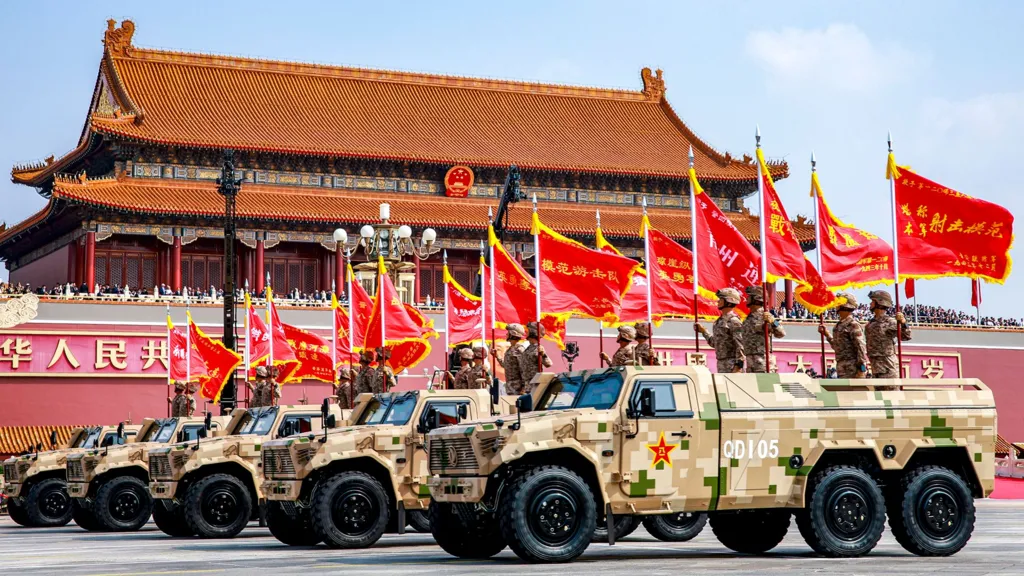
Beijing’s grand military parade this week was more than a celebration of history — it was a signal of China’s growing global ambitions.
On Wednesday, thousands of troops, tanks, and advanced missile systems filled Tiananmen Square to mark the 80th anniversary of the end of World War II. The spectacle, attended by Russian President Vladimir Putin, North Korea’s Kim Jong Un, and other world leaders, showcased China’s military strength and its bid for greater influence in the international order.
Watching from Washington, former US President Donald Trump acknowledged the display. “They were hoping I was watching, and I was watching,” he remarked, calling the event “very, very impressive.”
Competing Messages
While Trump struck a tone of admiration, the underlying message from Beijing was clear: China sees itself as a rising counterweight to the US-led order of the past century. The carefully choreographed parade, heavy with symbolism, suggested that China is ready to challenge American dominance — not just militarily, but historically.
Chinese officials used the event to highlight their nation’s role in defeating fascism during World War II. Analysts say this narrative is part of a broader push to reshape global perceptions and “rewrite the rules of the road.”
“It’s the first step in a concerted effort to rewrite history,” said Richard Wilkie, a former US veterans affairs secretary. He noted that Chinese nationalists and US forces were far more central to Japan’s defeat than the communist army, but Beijing’s retelling seeks to position itself as the rightful heir to global leadership.
Trump’s Trade Gambit and Global Fallout
Beyond the pageantry, the parade underscored the ripple effects of Trump’s economic policies. His sweeping tariffs, designed to protect US industries, have strained relations with key trading partners and created space for China, Russia, and even India to find common cause.
Just days before the parade, Chinese President Xi Jinping hosted Putin and Indian Prime Minister Narendra Modi at an economic summit in Tianjin — a striking image of potential alignment among three powers often at odds. Analysts say Trump’s trade wars have pushed Beijing and New Delhi closer together, complicating Washington’s efforts to maintain influence in Asia.
Trump, however, has remained steadfast. He views tariffs not only as a tool to safeguard American jobs but also as a source of federal revenue. Any diplomatic fallout, he has suggested, is a price worth paying.
“The real threat is growing Chinese military power,” said Wilkie, now co-chair of the Trump-aligned America First Foreign Policy Institute. “That’s what our allies in Asia truly recognize.”
Parades and Power Politics
Trump himself has long shown an affinity for military parades. From attending France’s Bastille Day celebration to staging his own tribute to the US Army in Washington, he has embraced displays of force as a symbol of national pride. Yet, his versions have often leaned into nostalgia, echoing his “Make America Great Again” vision of a return to past glory.
Beijing’s parade, by contrast, projected a future-oriented image of strength, with cutting-edge weapons and tightly disciplined troops presenting a portrait of modern military readiness.
Legal and Political Risks at Home
Trump’s approach to trade faces serious hurdles in US courts. Last week, an appellate court ruled that several of his tariffs were rooted in a flawed interpretation of federal law. The former president has vowed to appeal to the Supreme Court, but even conservative justices may balk at his expansive reading of presidential power.
That legal uncertainty adds to the risks of a policy that has already upended traditional alliances and redrawn global economic relationships. While Trump promises his strategy will usher in a “second American golden age,” critics warn it could leave the US isolated as rivals forge new partnerships.
The Bigger Picture
The images from Tiananmen Square were meant for both domestic and international audiences, but they also carried a message to Washington: China is positioning itself as a formidable alternative to US leadership.
For Trump, the moment illustrated the high stakes of his trade and foreign policy experiment. On parade grounds in Beijing and in US courtrooms alike, the consequences of his high-risk strategy are becoming harder to ignore.
700 701 702 703 704 705 706 707 708 709 710 711 712 713 714 715 716 717 718 719 720 721 722 723 724 725 726 727 728 729 730 731 732 733 734 735 736 737 738 739 740 741 742 743 744 745 746 747 748 749 750 751 752 753 754 755 756 757 758 759 760 761 762 763 764 765 766 767 768 769 770 771 772 773 774 775 776 777 778 779 780 781 782 783 784 785 786 787 788 789 790 791 792 793 794 795 796 797 798 799 800 801 802 803 804 805 806 807 808 809 810 811 812 813 814 815 816 817 818 819 820 821 822