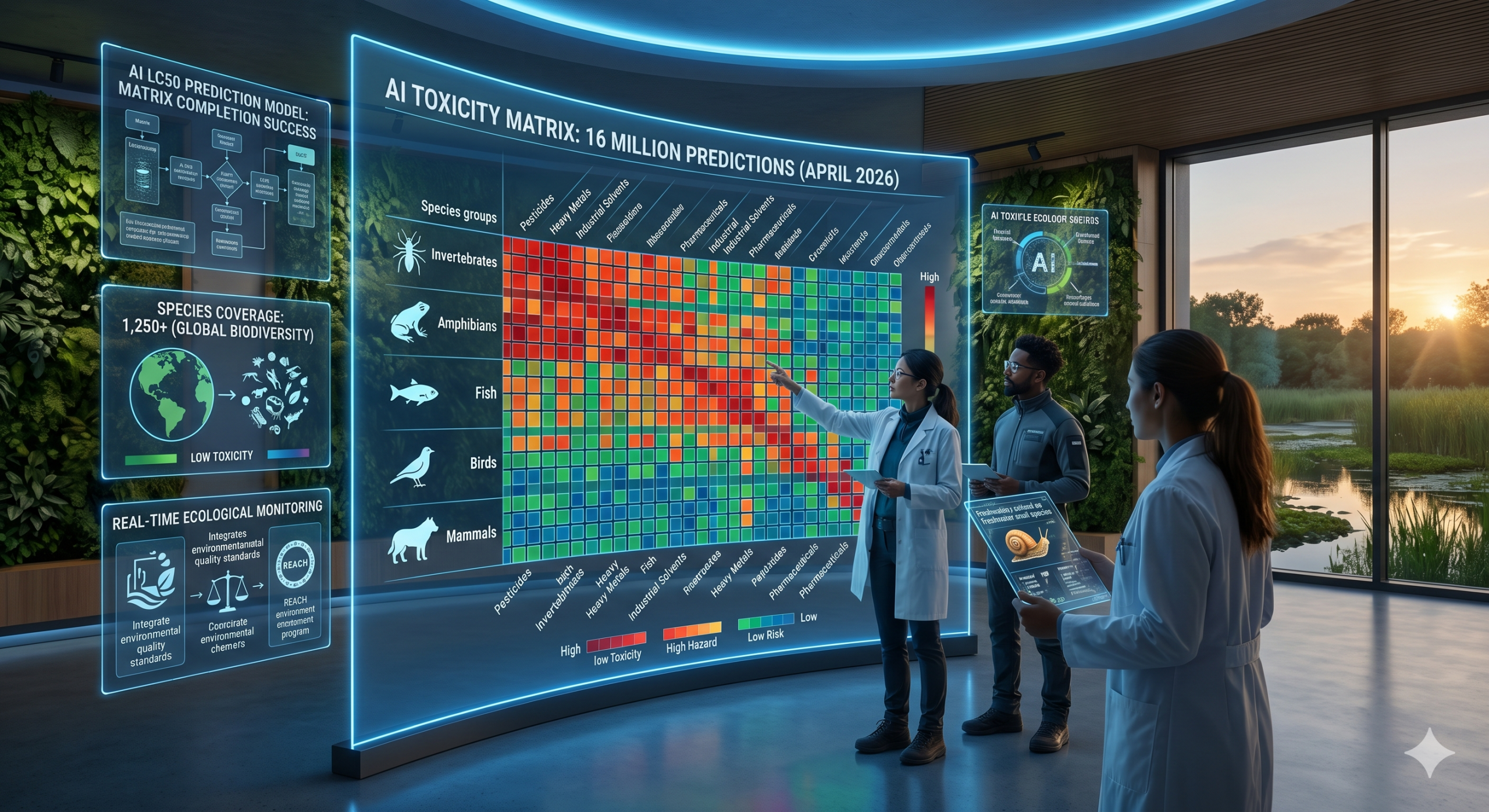
On April 22, 2026, the European Commission and leading environmental researchers announced a landmark achievement in computational toxicology: an AI-driven framework that has successfully generated 16 million toxicity predictions across more than 1,250 species.
This breakthrough, detailed in the latest “Science for Environment Policy” report, effectively bridges a massive data gap in chemical safety that traditional laboratory testing would have taken decades—and millions of animal lives—to close.
1. The “Matrix Completion” Breakthrough
The core of this achievement lies in a sophisticated AI technique known as Matrix Completion, a method similar to the recommendation algorithms used by streaming services.
-
The Problem: Traditionally, toxicity is tested one chemical and one species at a time to find the LC50 (the concentration lethal to 50% of a population). With hundreds of thousands of synthetic chemicals in circulation, testing every possible combination is physically impossible.
-
The AI Solution: Rather than analyzing chemicals in isolation, the researchers treated the species-chemical dataset as a giant, mostly empty grid. By using a pairwise-learning approach, the AI analyzed known patterns across existing data to “fill in the blanks” for 1,267 chemicals and 3,295 species.
-
Precision: The model achieved unprecedented accuracy in predicting how sensitive specific organisms—such as freshwater snails or predatory birds—would be to particular heavy metals and synthetic compounds.
2. Replacing Decades of Manual Testing
The scale of this project is difficult to overstate. To achieve 16 million LC50 data points through manual “wet lab” testing:
-
Time: Estimates suggest it would have required 30 to 50 years of continuous laboratory work.
-
Ethics: The AI approach effectively eliminates the need for the millions of animal subjects that would have been required for traditional in-vivo testing.
-
Cost: The computational cost of running these 16 million simulations is less than 0.1% of the financial investment required for equivalent physical trials.
3. Real-World Applications: “Safe by Design”
This massive dataset is already being integrated into global regulatory frameworks to improve environmental health.
-
Hazard Heatmaps: Researchers have produced visual “heatmaps” that allow policymakers to see at a glance which chemical groups pose the greatest threat to specific ecosystems.
-
SSbD (Safe and Sustainable by Design): Companies can now query the AI matrix during the early stages of product development. If a newly designed chemical shows a high predicted hazard score for 1,250+ species, it can be abandoned before reaching the manufacturing stage.
-
Regulatory Reform: The data is expected to become a cornerstone for the REACH (Registration, Evaluation, Authorisation, and Restriction of Chemicals) program and the Water Framework Directive, helping to set more protective environmental quality standards across the globe.
4. Future Outlook: Real-Time Global Monitoring
Looking ahead, the researchers aim to expand the model to include long-term chronic toxicity and “non-tested” novel chemicals as they are synthesized. By integrating this AI with satellite-based remote sensing and IoT water sensors, ecologists believe we are entering an era of real-time global environmental monitoring, where potential contamination events can be predicted before they cause permanent damage to biodiversity.
“By treating chemical toxicity as a holistic, interconnected problem rather than a series of isolated experiments, we have effectively unlocked a map of environmental risk that was previously invisible to us,” noted one lead researcher.
700 701 702 703 704 705 706 707 708 709 710 711 712 713 714 715 716 717 718 719 720 721 722 723 724 725 726 727 728 729 730 731 732 733 734 735 736 737 738 739 740 741 742 743 744 745 746 747 748 749 750 751 752 753 754 755 756 757 758 759 760 761 762 763 764 765 766 767 768 769 770 771 772 773 774 775 776 777 778 779 780 781 782 783 784 785 786 787 788 789 790 791 792 793 794 795 796 797 798 799 800 801 802 803 804 805 806 807 808 809 810 811 812 813 814 815 816 817 818 819 820 821 822