The universe is unimaginably vast, ancient, and packed with the ingredients for life.
Our galaxy alone, the Milky Way, contains anywhere from 100 billion to 400 billion stars. Scientists estimate that a significant percentage of those stars host Earth-like planets orbiting within their habitable zones. Given that the universe is roughly 13.8 billion years old, intelligent life has had billions of years to emerge, evolve, build spaceships, and colonize the stars.
Even at the relatively sluggish pace of current human technology, a civilization would only need a few tens of millions of years to entirely map and populate a galaxy.
So, if life is mathematically highly probable, a simple yet terrifying question remains—one first posed by Nobel Prize-winning physicist Enrico Fermi over a casual lunch in 1950:
“Where is everybody?”
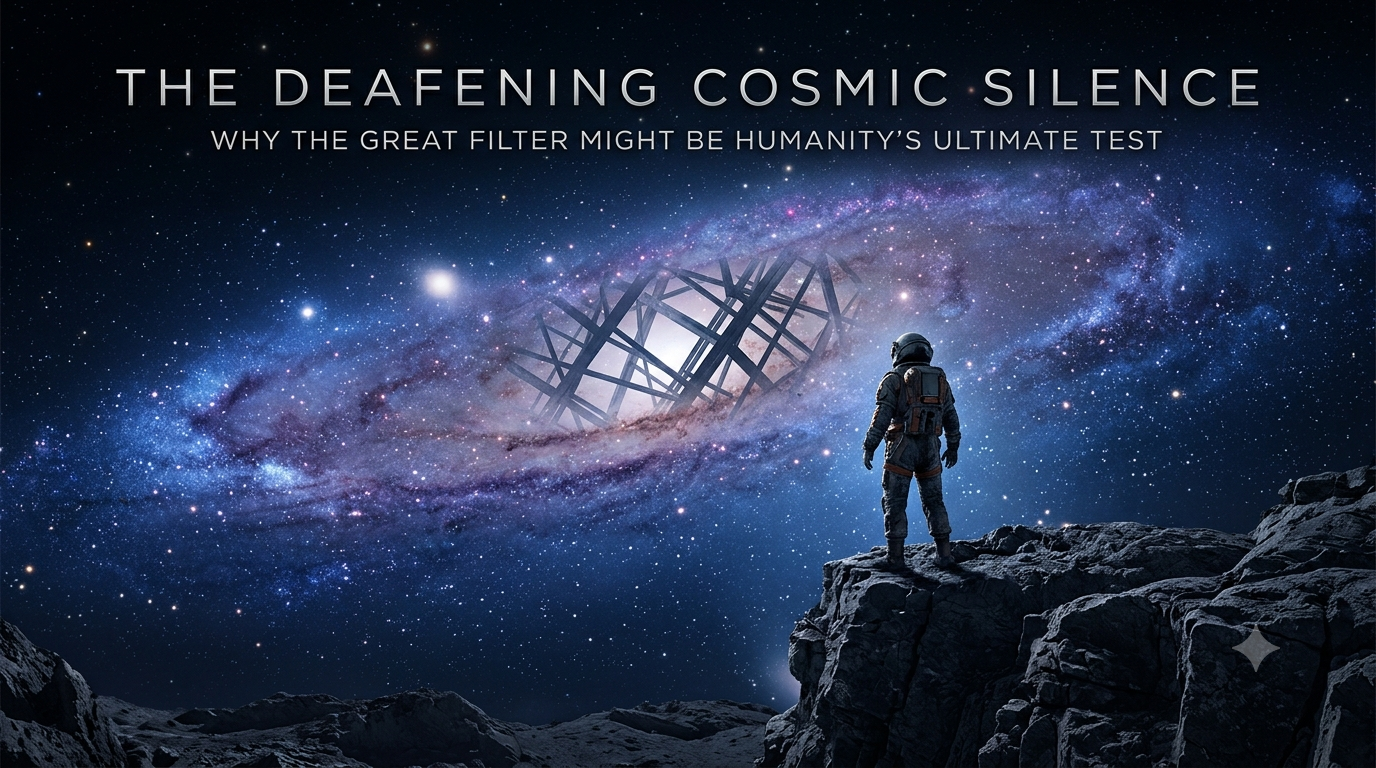
This riddle is known as the Fermi Paradox, and the most compelling, unsettling solution to it is a concept called The Great Filter.
The Barrier to the Stars
Coined by economist Robin Hanson in 1996, the Great Filter theory suggests that there is an incredibly difficult evolutionary barrier or catastrophic event that prevents civilizations from surviving long enough to achieve interstellar travel or interstellar communication.
Think of the timeline of intelligent life as an obstacle course with multiple hurdles. The Great Filter is a hurdle so high, so brutal, that almost no species manages to clear it. It acts as a cosmic evolutionary bottleneck.
To understand where humanity stands, scientists divide the timeline into two fundamentally different scenarios: Either the filter is behind us, or it lies ahead of us.
[Lifeless Planet] ➔ [Microbial Life] ➔ [Complex Life] ➔ [Intelligent Tools] ➔ 🛑 THE FILTER? ➔ [Interstellar Empire]
Scenario A: The Filter is Behind Us (The Optimistic View)
If the Great Filter is behind us, it means humanity has already accomplished something incredibly rare. It implies that the emergence of intelligent life is far more difficult than our mathematical models suggest.
Several critical evolutionary leaps could serve as the filter we’ve already cleared:
-
Abiogenesis (The Spark of Life): The transition from non-living chemicals to the very first self-replicating single-celled organisms might be an incredibly rare flub of nature.
-
The Leap to Complex Life: For over two billion years, Earth was populated exclusively by simple, single-celled microbes. The accidental merger of cells that created complex, multicellular life (eukaryotes) might be a one-in-a-trillion freak accident.
-
The Toolmaker’s Brain: Evolution doesn’t automatically favor high intelligence; it favors survival. Dinosaurs ruled Earth for 165 million years without ever building a radio telescope. Advanced technological intelligence might be an evolutionary anomaly.
If any of these milestones represent the Filter, it means the universe is a vast, empty graveyard of bacteria. We are alone, but we are the lucky ones who made it through.
Scenario B: The Filter is Ahead of Us (The Terrifying View)
The alternative is far more bleak. If the filter lies ahead of us, it means that life routinely evolves to our current level of technological capability across the galaxy, but some universal cataclysm always wipes civilizations out before they can leave their home planets.
As technology advances, the number of ways a civilization can inadvertently destroy itself multiplies. Potential future filters include:
-
Nuclear Annihilation: The moment a species discovers how to harvest the atom, it creates a ticking clock for its own destruction.
-
Runaway Artificial Intelligence: A civilization may accidentally build superintelligent systems that eclipse, subjugate, or eliminate their creators.
-
Climate and Ecological Collapse: Industrial civilizations may inevitably consume their planet’s finite resources and ruin its biosphere faster than they can develop the technology to escape it.
-
The “Suicidal” Nature of Progress: It is possible that any technology capable of powering interstellar travel is also inherently capable of being used as a planet-destroying weapon, making self-destruction a statistical certainty.
If the filter is ahead of us, it means humanity is currently cruising toward a brick wall that has shattered every civilization before us.
Why Finding Alien Life Might Be Bad News
This brings us to a counterintuitive conclusion championed by philosophers like Nick Bostrom: when it comes to searching for alien life, no news is good news.
If Mars rovers or sub-surface ocean probes on Europa discover independent, complex multicellular life forms, it would prove that the transition from simple microbes to complex organisms is actually quite easy. It would mean the Great Filter cannot be behind us.
Instead, finding a bustling ecosystem of alien life nearby would heavily imply that the Filter is waiting for us in our near future, looming somewhere between our current digital age and our dreams of exploring the stars.
For now, the sky remains utterly silent. Whether that silence is a comforting sign that we are the first to beat the cosmic odds, or a ghostly warning of our impending doom, is a question humanity must actively answer as we take our first tentative steps into the cosmic dark.
1 2 3 4 5 6 7 8 9 10 11 12 13 14 15 16 17 18 19 20 21 22 23 24 25 26 27 28 29 30 31 32 33 34 35 36 37 38
700 701 702 703 704 705 706 707 708 709 710 711 712 713 714 715 716 717 718 719 720 721 722 723 724 725 726 727 728 729 730 731 732 733 734 735 736 737 738 739 740 741 742 743 744 745 746 747 748 749 750 751 752 753 754 755 756 757 758 759 760 761 762 763 764 765 766 767 768 769 770 771 772 773 774 775 776 777 778 779 780 781 782 783 784 785 786 787 788 789 790 791 792 793 794 795 796 797 798 799 800 801 802 803 804 805 806 807 808 809 810 811 812 813 814 815 816 817 818 819 820 821 822