For half a century, the Moon has stood as a silent, untouched monument to humanity’s greatest brief adventure. The Apollo missions proved we could bridge the cosmic void, but they were ultimately fleeting visits. We planted flags, collected rocks, and returned home.
The Artemis generation operates under a fundamentally different philosophy: we are going back to the Moon, and this time, we are staying.
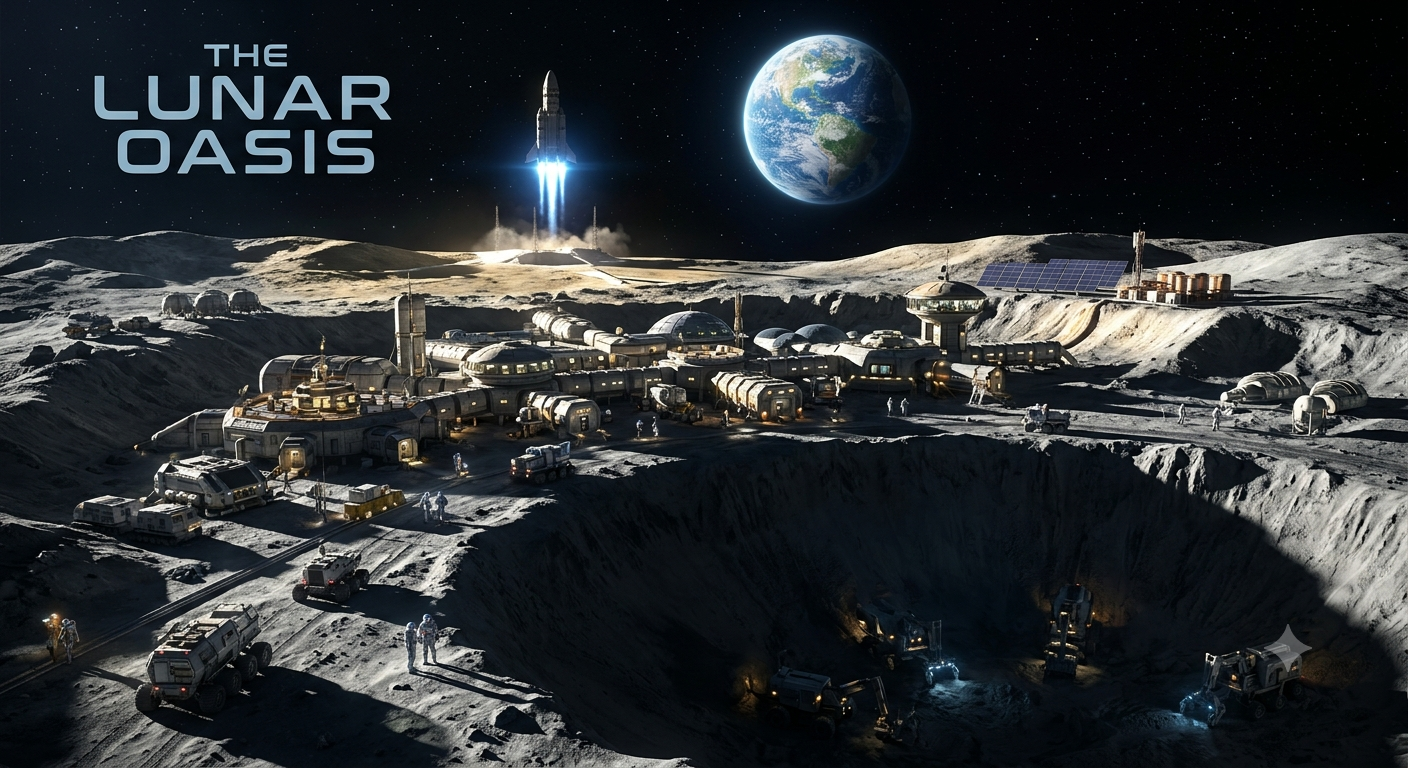
At the heart of this monumental shift is the Artemis Base Camp—a planned permanent human outpost located at the lunar south pole. This desolate, crater-pocked landscape at the bottom of the Moon is slated to become humanity’s first extraterrestrial settlement. But the Artemis Base Camp is not just a destination. It is the ultimate staging ground, a critical cosmic springboard designed for one primary purpose: launching a crewed mission to Mars.
To understand why the lunar south pole is the key to the Red Planet, we must look at the most valuable resource in the solar system: water.
The Shadows of the South Pole
The lunar south pole is a realm of extremes. Because the Moon’s axis has only a slight tilt, the sun remains perpetually on the horizon at the poles, casting long, haunting shadows across the rugged terrain. This unique orbital geometry creates Permanently Shadowed Regions (PSRs)—deep craters and valleys that have not seen a single ray of sunlight for billions of years.
Within these pitch-black depressions, temperatures plunge to a staggering -414 degrees Fahrenheit (-248 degrees Celsius). It is a deep freeze so profound that it acts as a cosmic cold trap. Over eons, hydrogen and oxygen delivered by ancient comet impacts have been locked into the regolith as pristine, ancient water ice.
The New Gold Rush: In the harsh economics of space travel, water is infinitely more valuable than gold. Finding millions of tons of it frozen in the lunar crust changes the entire paradigm of interplanetary exploration.
In-Situ Resource Utilization: The Cosmic Gas Station
Why do we need lunar ice to reach Mars? The answer lies in the tyrannical mathematics of Earth’s gravity.
Currently, escaping Earth’s deep gravity well requires colossal amounts of propellant. For a rocket to break free of Earth’s pull, roughly 90% of its total mass must be dedicated purely to fuel. If we were to launch a massive, crewed spacecraft directly to Mars from Earth, carrying all the fuel needed for the round trip, the rocket would be impossibly heavy and astronomically expensive.
The Artemis Base Camp offers a brilliant workaround through a concept known as In-Situ Resource Utilization (ISRU)—living off the land.
By mining the water ice at the lunar south pole, astronauts can use solar or nuclear power to undergo a process called electrolysis, splitting the $H_2O$ molecules into their base elements: liquid hydrogen and liquid oxygen. These are the exact ingredients used for high-efficiency rocket fuel.
Instead of dragging thousands of tons of fuel out of Earth’s gravity, a Mars-bound spacecraft can launch light, dock with the Moon, and refuel in lunar orbit. Because the Moon possesses only one-sixth of Earth’s gravity and has no thick atmosphere to cause aerodynamic drag, launching a fully fueled spacecraft from the lunar surface—or its orbit—requires a fraction of the energy.
The Moon, essentially, becomes an interplanetary gas station.
Building the Base Camp
To turn this vision into reality, the Artemis Base Camp will require unprecedented infrastructure. The initial blueprint calls for three primary elements:
-
The Lunar Terrain Vehicle (LTV): An unpressurized, robust rover capable of transporting astronauts across the rugged south pole terrain to survey deep craters and establish mining operations.
-
The Habitable Mobility Platform: A pressurized, mobile laboratory that will allow crews to traverse the lunar surface for up to 45 days at a time, protecting them from solar radiation and micrometeorites.
-
The Foundation Surface Habitat: The permanent stationary base where crews will live, conduct deep-space biological research, and refine the extraction of lunar resources.
As the base expands, it will serve as the ultimate proving ground. The technologies required to keep humans alive on the lethal, unforgiving surface of the Moon—closed-loop life support, radiation shielding, and autonomous robotics—are the exact same technologies required to survive the nine-month transit to Mars and the harsh conditions upon arrival.
We are no longer just looking at the Moon as a celestial neighbor. Through the Artemis Base Camp, it is transforming into a bustling shipyard on the shores of the cosmic ocean, ready to launch humanity into the deep.
700 701 702 703 704 705 706 707 708 709 710 711 712 713 714 715 716 717 718 719 720 721 722 723 724 725 726 727 728 729 730 731 732 733 734 735 736 737 738 739 740 741 742 743 744 745 746 747 748 749 750 751 752 753 754 755 756 757 758 759 760 761 762 763 764 765 766 767 768 769 770 771 772 773 774 775 776 777 778 779 780 781 782 783 784 785 786 787 788 789 790 791 792 793 794 795 796 797 798 799 800 801 802 803 804 805 806 807 808 809 810 811 812 813 814 815 816 817 818 819 820 821 822