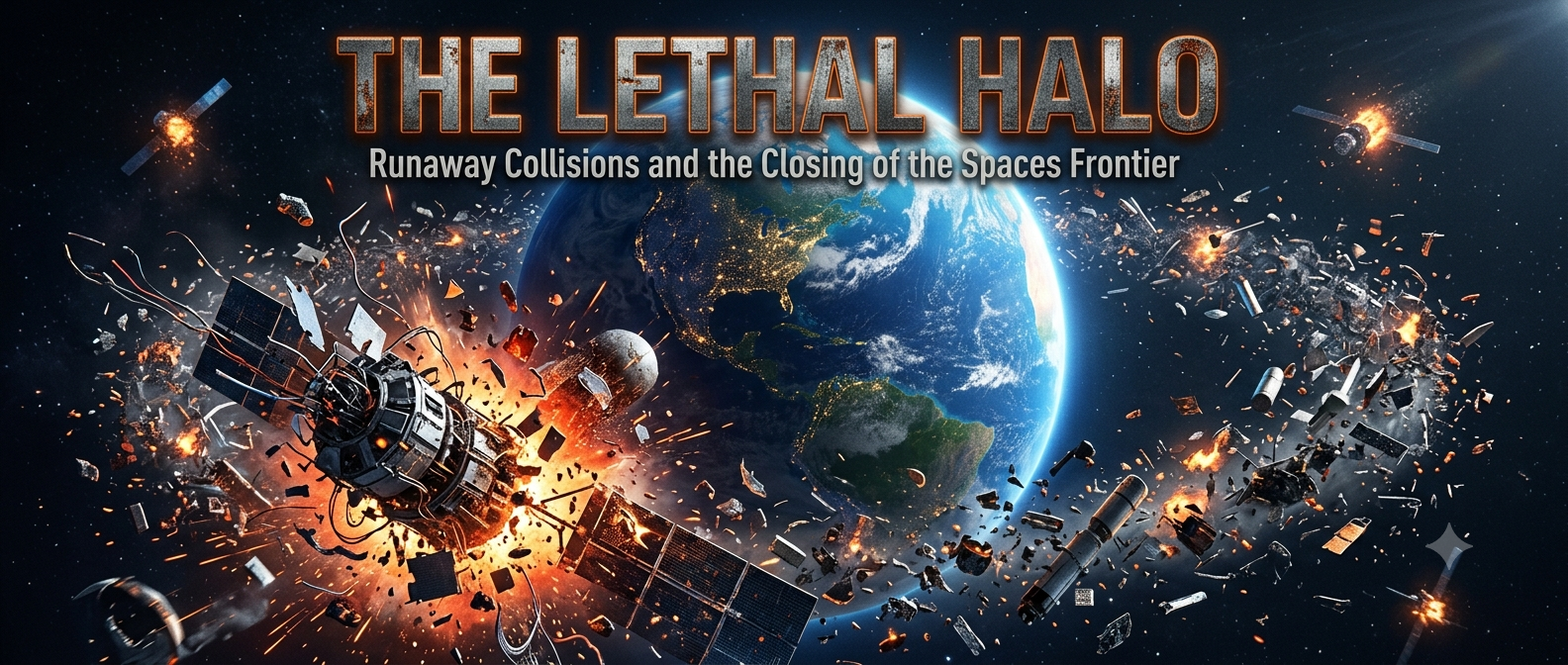
The dawn of the space age promised an era of boundless exploration. But humanity has left a sprawling, chaotic legacy in its wake. Low Earth Orbit (LEO) is no longer a pristine void; it is a hypervelocity minefield. We are circling the drain of a theoretical nightmare first proposed in 1978: the Kessler Syndrome. This scenario describes a runaway cascade where the density of orbital debris becomes so great that every collision spawns a cloud of shrapnel, which in turn causes secondary impacts. If this unstoppable chain reaction accelerates, it could render entire regions of orbit unusable for hundreds of years and sever the global data supply chains for telecommunications, navigation, and weather forecasting.
A Sky Full of Bullets
To understand the terror of space debris, one must understand the extreme physics of orbital velocity. Objects in LEO travel at blistering speeds of roughly 7 to 8 kilometers per second. In a head-on collision scenario, relative velocities can reach or exceed 15 kilometers per second. At these speeds, kinetic energy scales with the square of the velocity. A mere 1-centimeter sphere of aluminum traveling at 10 kilometers per second carries the explosive kinetic energy of a hand grenade. An object measuring 10 centimeters delivers the destructive energy of roughly 7 kilograms of TNT—more than enough to completely destroy a functioning satellite.
Our current surveillance networks are struggling to map this chaos. As of 2026, space surveillance networks track over 40,000 to 43,000 objects larger than 10 centimeters. However, this is only a fraction of the threat. The European Space Agency’s MASTER-8 modeling system reveals a far more sinister reality: there are an estimated 1.2 million fragments measuring between 1 and 10 centimeters currently in orbit. ESA chillingly categorizes this specific class of debris as the “lethal non-trackable” range. These fragments are too small to trigger conjunction warnings from ground-based sensors, yet large enough to obliterate any spacecraft upon impact. Below that size, statistical models estimate that approximately 140 million micro-fragments smaller than 1 centimeter pepper the orbital environment.
The Tipping Point
The latest data suggests that the Kessler cascade is no longer an abstract warning; it is an unfolding reality. According to the ESA’s 2026 Space Environment Report, the collision risk in LEO has spiked by 20 percent since just 2024. This surge is driven by a massive expansion of satellite megaconstellations, the accumulating debris from anti-satellite weapon tests, and a fragmentation rate that atmospheric drag simply cannot clean up.
The environment is increasingly saturated. A 2025 study determined that the current population of intact objects in almost all altitudes between 520 and 1,000 kilometers has already crossed the runaway Kessler threshold. At these altitudes, collisions generate new debris fragments faster than natural atmospheric processes can remove them.
This extreme congestion forces space operators into a constant state of evasion. To illustrate the severity of the situation, SpaceX’s Starlink constellation was forced to execute approximately 300,000 collision avoidance maneuvers throughout 2025. The margin for error has almost entirely evaporated. Researchers measure this shrinking safety net using the “CRASH” (Collision Realization and Significant Harm) Clock. In 2018, if satellite operators suddenly lost the ability to maneuver, a catastrophic collision was mathematically expected within 121 days. As of 2025, that critical buffer had compressed to just 2.8 days.
A Prison Made of Shrapnel
We are rapidly approaching an existential bottleneck. If the Kessler Syndrome reaches its climax, it will not just blind our satellites—it will physically barricade the space frontier, making Earth’s orbit uninhabitable for both future space exploration and human space travel. Every new rocket launch and deployment exacerbates the crisis. Humanity must rapidly develop competitive and cost-effective technologies to clear this lethal halo, or we risk locking ourselves on Earth, watching the stars permanently disappear behind an invisible storm of shrapnel.
700 701 702 703 704 705 706 707 708 709 710 711 712 713 714 715 716 717 718 719 720 721 722 723 724 725 726 727 728 729 730 731 732 733 734 735 736 737 738 739 740 741 742 743 744 745 746 747 748 749 750 751 752 753 754 755 756 757 758 759 760 761 762 763 764 765 766 767 768 769 770 771 772 773 774 775 776 777 778 779 780 781 782 783 784 785 786 787 788 789 790 791 792 793 794 795 796 797 798 799 800 801 802 803 804 805 806 807 808 809 810 811 812 813 814 815 816 817 818 819 820 821 822