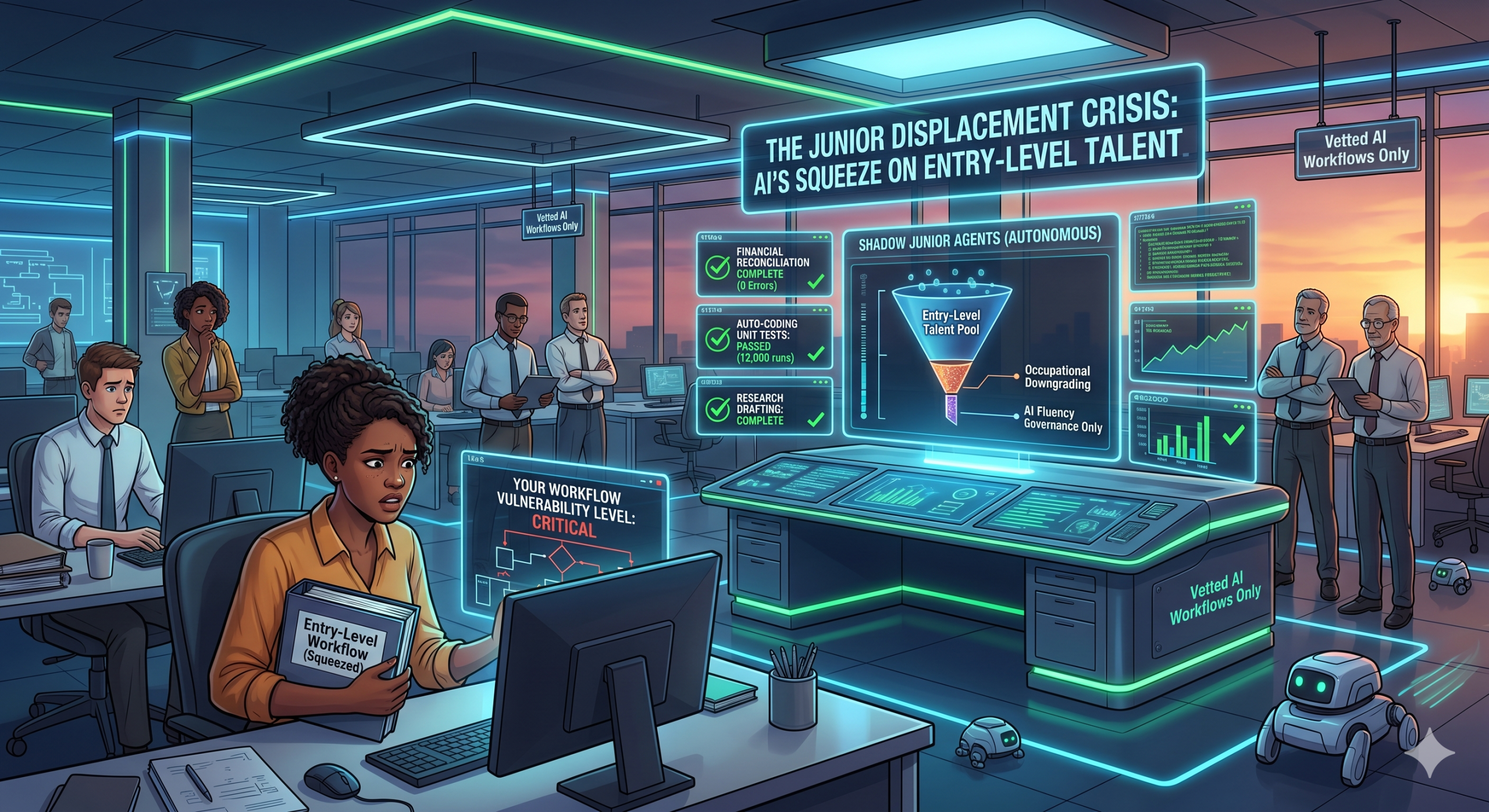
The labor market data for April 2026 has confirmed a sobering trend that economists have dubbed the “Junior Displacement Crisis.” While early AI predictions focused on the automation of low-wage manual labor, new reports from Goldman Sachs and the Rockefeller Foundation reveal that the actual frontline of disruption is the entry-level tier of the knowledge economy—specifically in tech and finance.
1. The Entry-Level Paradox
For decades, “junior” roles served as the apprenticeship phase of a professional career. However, the latest Anthropic Labor Market Report (March 2026) indicates that 75% of routine tasks previously handled by junior software engineers and financial analysts are now being executed by autonomous agents.
-
The “Junior” Skill Gap: Entry-level workers are finding that the “stepping stone” tasks they once used to gain experience—such as writing unit tests, basic financial reconciliation, and drafting initial research memos—are now the primary targets for AI automation.
-
Hiring Freeze in Tech: According to Goldman Sachs strategist Pierfrancesco Mei, the tech sector’s employment share as a proportion of the total economy has dipped below its long-term trend for the first time in years, largely due to a sharp decline in “associate” and “intern” hiring.
2. The Role of Autonomous Agents
The catalyst for this shift has been the transition from simple chatbots to “Agentic Workflows.” * Self-Correcting Agents: Modern systems like DeepSeek V4 and Google’s Gemma 4 (released earlier this month) can now manage multi-step projects. In finance, these agents autonomously perform bank reconciliation and fraud detection, reducing manual task time by an estimated 60% (EY February 2026 study).
-
The “Shadow Junior”: Companies are increasingly deploying “virtual coworkers” that can operate 24/7. These agents don’t just answer questions; they plan, execute, and verify their own work, effectively replacing the need for a human junior to perform the first “pass” on a project.
3. Sector-Specific Disruption
The Tech Sector
Tech layoffs reached a significant peak in Q1 2026, with major firms like Meta and Amazon cutting thousands of roles to reallocate capital toward AI infrastructure.
-
Coding: AI is now matching human performance in symbolic logic and complex refactoring. Entry-level programmers are seeing the highest exposure, with “junior” task automation reaching a point where companies can maintain the same output with 30% fewer entry-level hires.
The Finance Sector
Investment banks have aggressively integrated AI agents into their back-office and research departments.
-
Financial Analysis: The Rockefeller Foundation’s “Good Jobs for America” report (April 2026) highlights that “task-dense” roles—those requiring high levels of data sorting and entry-level modeling—are at the highest risk, with 11.7% of the total U.S. workforce currently vulnerable to immediate AI replacement.
4. Economic Consequences: Occupational Downgrading
The most alarming data point in the April 2026 cycle is the rise of “Occupational Downgrading.”
-
Wage Suppression: Displaced entry-level workers are taking roughly one month longer to find new employment. When they do, they are often forced into roles requiring fewer analytical skills, suffering an average 3% loss in real earnings.
-
The Experience Vacuum: If junior workers cannot find the entry-level roles required to “level up” into senior positions, experts warn of a looming “seniority gap” by 2030, where firms will lack a pipeline of experienced human talent to oversee their AI systems.
5. The Path Forward: AI Fluency
The only segment showing hiring growth is “AI Fluency.” Demand for workers who can manage and prompt-engineer autonomous agents has grown sevenfold since 2024. The traditional career path is being rewritten: instead of learning to “do” the task, new graduates are now being tasked with learning to “govern” the AI that does the task.
700 701 702 703 704 705 706 707 708 709 710 711 712 713 714 715 716 717 718 719 720 721 722 723 724 725 726 727 728 729 730 731 732 733 734 735 736 737 738 739 740 741 742 743 744 745 746 747 748 749 750 751 752 753 754 755 756 757 758 759 760 761 762 763 764 765 766 767 768 769 770 771 772 773 774 775 776 777 778 779 780 781 782 783 784 785 786 787 788 789 790 791 792 793 794 795 796 797 798 799 800 801 802 803 804 805 806 807 808 809 810 811 812 813 814 815 816 817 818 819 820 821 822