From the safe vantage point of our terrestrial telescopes, Uranus and Neptune look like serene, pale-blue gems hanging quietly in the outer frozen reaches of the solar system.
But beneath their placid, featureless cloud decks lies one of the most extravagant and violent geological phenomena in the cosmos.
Deep inside these “ice giant” worlds, the laws of physics and chemistry are warped by unfathomable forces. Scientists have long theorized—and recently demonstrated in cutting-edge laser laboratories—that thousands of miles beneath the surface, these planets act as colossal cosmic planetary forges. Here, the atmosphere literally collapses under its own weight, transforming ordinary carbon gas into a continuous, multi-million-carat downpour of glittering, solid diamonds.
The Molecular Rupture
To understand how a planet can rain precious gemstones, one must descend past the outer atmospheres of hydrogen and helium and into the thick, slushy mantles of Uranus and Neptune.
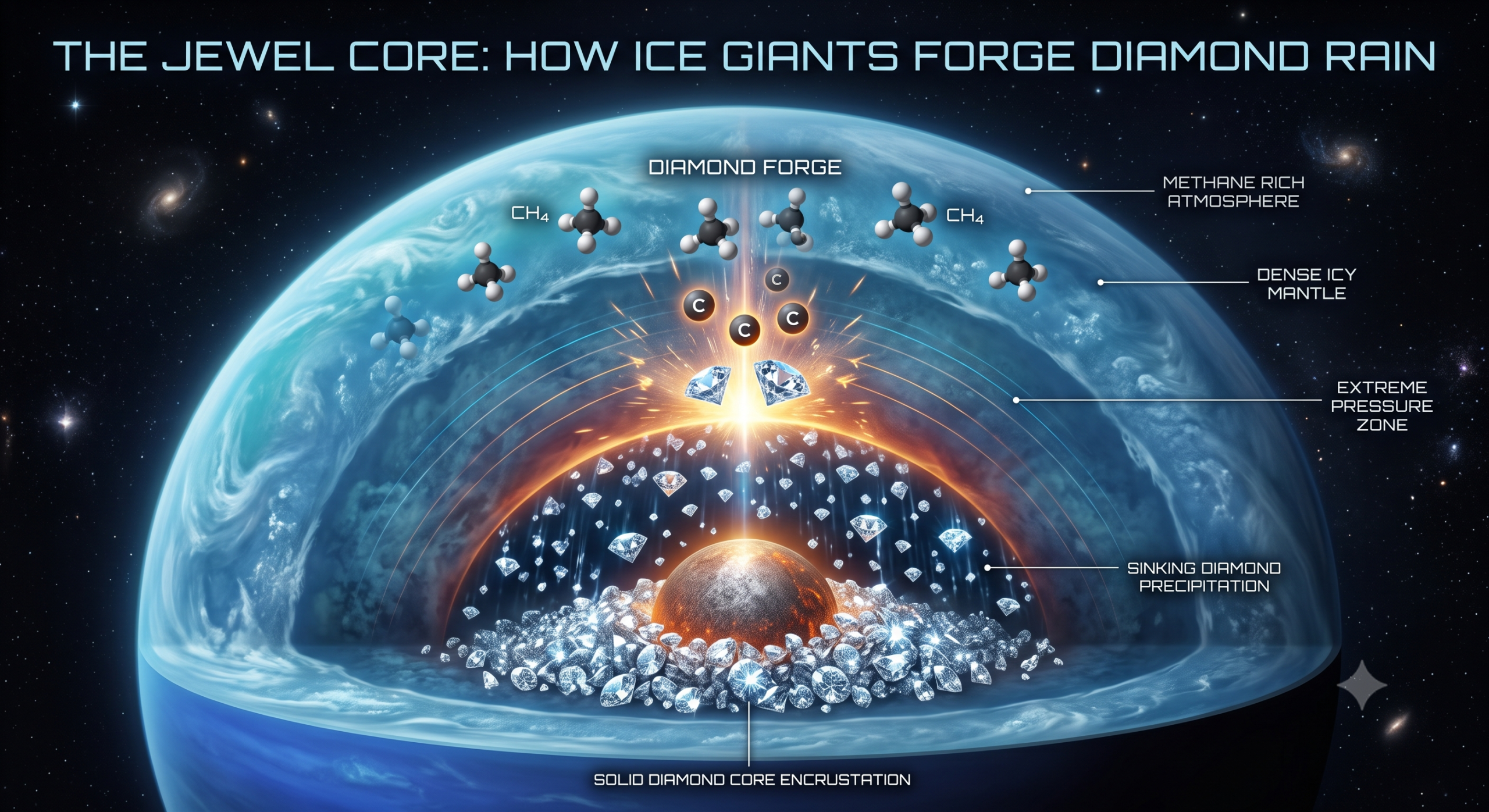
These worlds are not “gas giants” like Jupiter and Saturn; they are ice giants, meaning their interiors are dominated by a hot, hyper-dense fluid layer of water, ammonia, and methane. Methane is the crucial ingredient here—a molecule consisting of a single carbon atom bound tightly to four hydrogen atoms.
As you plunge deeper into the planet, the weight of the sky above causes the environment to change drastically:
-
The Pressure: Climbs into the millions of atmospheres (hundreds of gigapascals).
-
The Temperature: Escalates to thousands of degrees Fahrenheit, mimicking the conditions of a stellar furnace.
Under these terrifying extremes, chemical bonds simply fail. The intense heat and pressure rip the methane molecules apart, severing the bonds between hydrogen and carbon. The freed carbon atoms are then squeezed together so violently that they have no choice but to snap into the tightest, most stable atomic configuration possible: the crystal lattice of a diamond.
Sinking Through the Slush
Once these diamonds crystallize, they don’t float or drift like terrestrial snowflakes.
Earthly diamonds are formed within the solid rock of our mantle, remaining trapped until volcanic activity pushes them upward. On Uranus and Neptune, however, the surrounding environment is a vast, swirling, liquid-slush ocean of conductive water and ammonia.
[Upper Cloud Tops] ➔ [Hydrocarbon Slush Layer] ➔ [Molecular Rupture: Diamond Formation] ➔ [Gravitational Sink to Core]
Because solid diamond has a density of roughly 3.5 grams per cubic centimeter, it is substantially heavier than the surrounding watery medium. Consequently, the newly formed gemstones begin to sink. They plunge downward through thousands of miles of darkness, potentially accumulating more carbon atoms as they fall and growing into massive diamond blocks. This creates a perpetual, slow-motion mineral snowstorm drifting silently through the planetary interior, destined to settle into a thick, glittering gemstone crust wrapping around the planets’ rocky cores.
The Engines of the Deep
For decades, the concept of diamond rain was merely a compelling mathematical model. However, recent groundbreaking experiments utilizing ultra-powerful X-ray free-electron lasers have successfully subjected hydrocarbon plastics to ice-giant conditions. In a fraction of a second, scientists watched almost every carbon atom in the samples snap into nanodiamonds, proving the theory is undeniably real.
Furthermore, this dazzling weather system solves two of the greatest mysteries surrounding our outer solar system neighbors:
The Heat Paradox: Astronomers have long wondered why Neptune radiates significantly more heat into space than it receives from the distant Sun. The answer lies in the diamond rain. As billions of carats of diamond sink toward the core, they release a tremendous amount of gravitational potential energy, converting it into frictional heat that warms the planet from the inside out.
Exotic Magnetic Fields: Unlike Earth’s symmetrical magnetic field, the fields of Uranus and Neptune are off-center, tilted, and chaotic. Recent data suggests that as the dense diamond rain sinks, it actively stirs the electrically conductive fluid layers above the core. This chaotic churning acts as a planetary dynamo, generating the planets’ bizarre, asymmetrical magnetospheres.
The diamond rain of the ice giants stands as a brilliant reminder that the cosmos routinely turns our grandest luxury into ordinary weather. In the deep dark of the solar system, the line between a jeweler’s dream and an atmospheric nightmare is entirely a matter of pressure.
1 2 3 4 5 6 7 8 9 10 11 12 13 14 15 16 17 18 19 20 21 22 23 24 25 26 27 28 29 30 31 32 33 34 35 36 37 38
700 701 702 703 704 705 706 707 708 709 710 711 712 713 714 715 716 717 718 719 720 721 722 723 724 725 726 727 728 729 730 731 732 733 734 735 736 737 738 739 740 741 742 743 744 745 746 747 748 749 750 751 752 753 754 755 756 757 758 759 760 761 762 763 764 765 766 767 768 769 770 771 772 773 774 775 776 777 778 779 780 781 782 783 784 785 786 787 788 789 790 791 792 793 794 795 796 797 798 799 800 801 802 803 804 805 806 807 808 809 810 811 812 813 814 815 816 817 818 819 820 821 822