SAN FRANCISCO — February 23, 2026 — Anthropic has ignited a firestorm in the enterprise IT sector with the launch of a new “Code Modernization Playbook” and advanced capabilities for Claude Code specifically designed to dismantle the world’s reliance on COBOL.
By targeting the “ancient” codebases that underpin 95% of U.S. ATM transactions and countless government services, Anthropic is positioning its AI not just as a coding assistant, but as a strategic solution to a multi-trillion-dollar “ticking time bomb”: the critical shortage of retired mainframe programmers.
The “Nixon-Era” Bottleneck
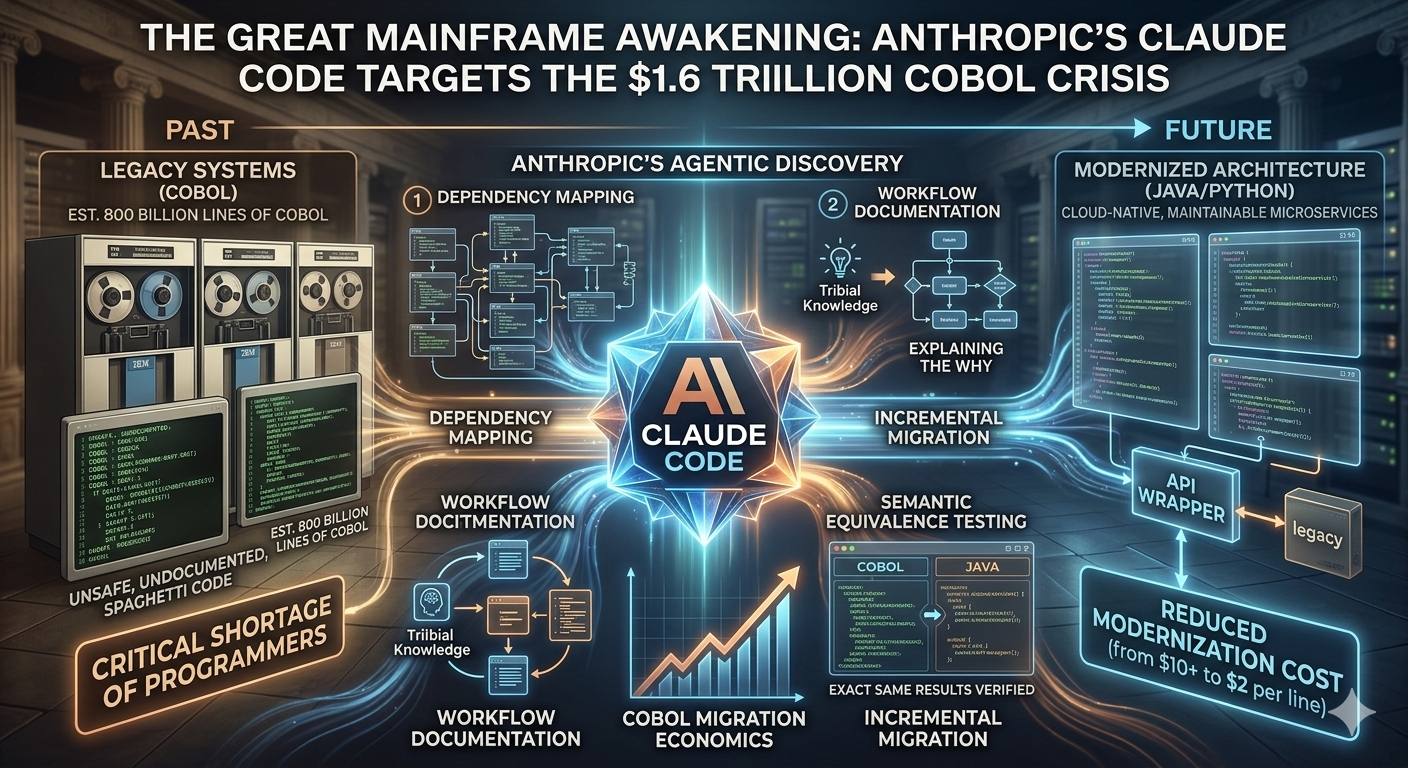
Despite being over 60 years old, COBOL (Common Business-Oriented Language) remains the invisible backbone of global finance and public infrastructure. An estimated 800 billion lines of COBOL are currently in production.
The problem is twofold:
-
The Talent Gap: The “greybeards” who wrote this code are largely retired, leaving behind “spaghetti” systems with little to no documentation.
-
The Cost Barrier: Historically, modernizing a single line of COBOL was priced at $10–$12 due to the manual labor required. Anthropic claims Claude Code can slash this cost to as little as $2 per line.
“We’re reverse-engineering business logic from systems built when Richard Nixon was President,” an Anthropic spokesperson stated. “Claude Code doesn’t just translate syntax; it reconstructs the ‘tribal knowledge’ buried in the code itself.”
How Claude Code “Unravels” the Past
Unlike traditional translation tools that often produce “unmaintainable” code, Anthropic’s new approach focuses on Agentic Discovery. The process moves through four distinct phases:
1. Dependency Mapping
Claude scans the entire codebase—not just individual files—to identify hidden relationships. It maps how data flows between 50-year-old modules and identifies “entry points” that human analysts might take months to find.
2. Workflow Documentation
The AI generates functional documentation for processes that have been undocumented for decades. It creates visual processing pipelines, explaining why a certain calculation happens, not just how.
3. “Semantic Equivalence” Testing
To satisfy strict banking regulators, Claude Code generates automated test suites. These verify that the new Java or Python code produces the exact same results as the original COBOL logic, down to the last decimal point.
4. Incremental Migration
Rather than a “big bang” flip-of-the-switch, the AI builds “API wrappers” around legacy components. This allows agencies to modernize one piece at a time while the old and new systems run side-by-side in production.
Market Shockwaves: IBM and the “Consulting Crisis”
The announcement sent shockwaves through Wall Street. On February 23, IBM shares plummeted 13.2%—their worst single-day drop since 2000—wiping out over $30 billion in market value.
Investors fear that if AI can automate the “grunt work” of mainframe migration, it will erode the high-margin consulting revenues that giants like IBM, Accenture, and Cognizant have relied on for decades.
“AI flips the equation,” Anthropic argued in its blog post. “Modernization stalled for years because understanding the code cost more than rewriting it. We are making the economics work for the first time.”
The Industry Response: “It’s Not Just a Language Problem”
IBM and other industry veterans have been quick to push back. Rob Thomas, IBM’s Senior Vice President of Software, argued that “translating code is not modernization.”
He emphasized that the true challenge isn’t the COBOL language itself, but the underlying architecture—how the system scales, recovers from failure, and integrates with massive mainframe databases. “The code is the starting point, not the destination,” Thomas wrote.
Use Cases: From the IRS to Air India
The impact is already being felt in the public and private sectors:
-
Government Agencies: Anthropic is working with state and local governments to modernize DMV and SNAP (food stamp) benefit systems, aiming to save millions in taxpayer money.
-
Global Airlines: Air India is currently using Claude Code to accelerate custom software delivery as part of a broader push to retire legacy technical debt.
-
Financial Services: Global banks are piloting “agentic” migrations to move core ledgers to the cloud while maintaining 99.999% uptime.
700 701 702 703 704 705 706 707 708 709 710 711 712 713 714 715 716 717 718 719 720 721 722 723 724 725 726 727 728 729 730 731 732 733 734 735 736 737 738 739 740 741 742 743 744 745 746 747 748 749 750 751 752 753 754 755 756 757 758 759 760 761 762 763 764 765 766 767 768 769 770 771 772 773 774 775 776 777 778 779 780 781 782 783 784 785 786 787 788 789 790 791 792 793 794 795 796 797 798 799 800 801 802 803 804 805 806 807 808 809 810 811 812 813 814 815 816 817 818 819 820 821 822