Astronomers have long known that the universe is littered with structural “failures”—cosmic building blocks that, for one reason or another, never quite managed to construct anything. Now, thanks to the precision optics of the Hubble Space Telescope, scientists have officially confirmed the existence of a completely new class of astronomical object: a pristine, starless “ghost” cloud that serves as an untouched relic from the dawn of galaxy formation.
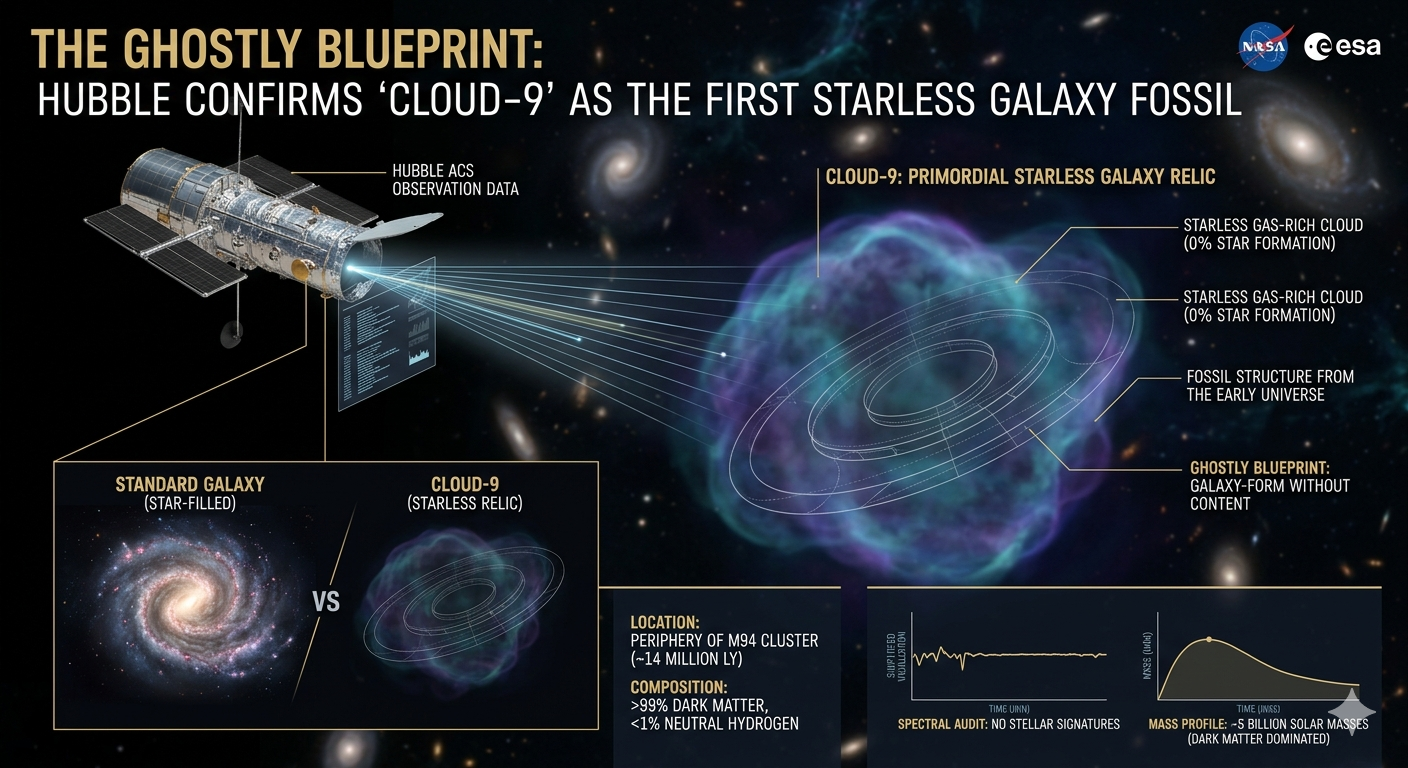
Nicknamed “Cloud-9,” the structure is a dark matter-dominated island of gas floating roughly 14 million light-years from Earth on the outskirts of the spiral galaxy Messier 94. While traditional galaxies are defined by their hundreds of millions or billions of stars, Cloud-9 contains absolutely none. Instead, it is a cosmic fossil, preserved in a state of suspended animation since the early universe.
What is a RELHIC?
In academic circles, Cloud-9 is classified as a Reionization-Limited H I Cloud (RELHIC). The “H I” refers to neutral, un-ionized hydrogen gas, while the term “RELHIC” describes a theoretical phantom object that astronomers have hunted for decades.
“This is a tale of a failed galaxy,” explained Alejandro Benítez-Llambay, the program’s principal investigator from the University of Milano-Bicocca. “In science, we usually learn more from the failures than from the successes. In this case, seeing no stars is what proves the theory right. It tells us that we have found a primordial building block of a galaxy that simply never formed.”
Before Hubble turned its Advanced Camera for Surveys (ACS) toward the region, ground-based observations couldn’t rule out the possibility that Cloud-9 was just an incredibly dim dwarf galaxy. Hubble’s unparalleled sensitivity definitively nailed down the truth: the cloud is entirely devoid of stellar life.
The Anatomy of Cloud-9
Though it features no starlight, Cloud-9 is far from empty space. It is a massive, highly spherical structure held together by an invisible gravitational anchor.
By measuring the radio waves emitted by the cloud, scientists mapped out its staggering mass profile. While its visible core of neutral hydrogen gas spans roughly 4,900 light-years in diameter, the gas pressure requires an enormous amount of gravity to keep it from dissipating into intergalactic space.
| Cosmic Metric | Cloud-9 Inventory | Significance |
| Diameter of Gas Core | ~4,900 Light-Years | A highly compact, spherical distribution compared to typical tidal gas clouds. |
| Neutral Hydrogen Mass | ~1 Million Solar Masses | The raw, unmolested material originally intended to seed star birth. |
| Estimated Dark Matter Mass | ~5 Billion Solar Masses | Outweighs ordinary matter 5,000 to 1, proving it is a pure dark matter halo. |
Stuck in a Cosmic Sweet Spot
Why did Cloud-9 fail to birth a single star? According to astrophysicists, the relic is trapped in an evolutionary “sweet spot.”
If the cloud had been slightly more massive—exceeding 5 billion solar masses—its immense gravity would have forced the hydrogen gas to collapse under its own weight, triggering a runaway chain reaction of star birth and turning it into a conventional dwarf galaxy. Conversely, if it had been any smaller, the intense radiation from the universe’s early Reionization Era would have heated, dispersed, and stripped the gas away entirely, leaving nothing behind.
Instead, Cloud-9 sat perfectly on the cosmic fence: heavy enough to retain its gas, but too light to compress it into stars.
A Global Detective Story
Isolating an invisible cloud in deep space required a masterclass in global astronomical collaboration. Cloud-9 was initially flagged as a faint, anomalous radio signature by the Five-hundred-meter Aperture Spherical Telescope (FAST) in China. Because it was the ninth sequential gas cloud cataloged on the fringes of Messier 94, it earned its “Cloud-9” moniker.
Follow-up radio tracking from the Green Bank Telescope and the Very Large Array (VLA) in the United States confirmed the boundaries of the hydrogen gas. However, it was Hubble’s final optical audit that secured the historic breakthrough by confirming the complete absence of a stellar population.
By giving researchers an unobstructed look at a pure dark matter halo free from the chaotic winds, supernova explosions, and light pollution of burning stars, Cloud-9 acts as the ultimate natural laboratory. It provides a clean, uncompromised window into the fundamental physics of the “dark side” of our universe.
700 701 702 703 704 705 706 707 708 709 710 711 712 713 714 715 716 717 718 719 720 721 722 723 724 725 726 727 728 729 730 731 732 733 734 735 736 737 738 739 740 741 742 743 744 745 746 747 748 749 750 751 752 753 754 755 756 757 758 759 760 761 762 763 764 765 766 767 768 769 770 771 772 773 774 775 776 777 778 779 780 781 782 783 784 785 786 787 788 789 790 791 792 793 794 795 796 797 798 799 800 801 802 803 804 805 806 807 808 809 810 811 812 813 814 815 816 817 818 819 820 821 822