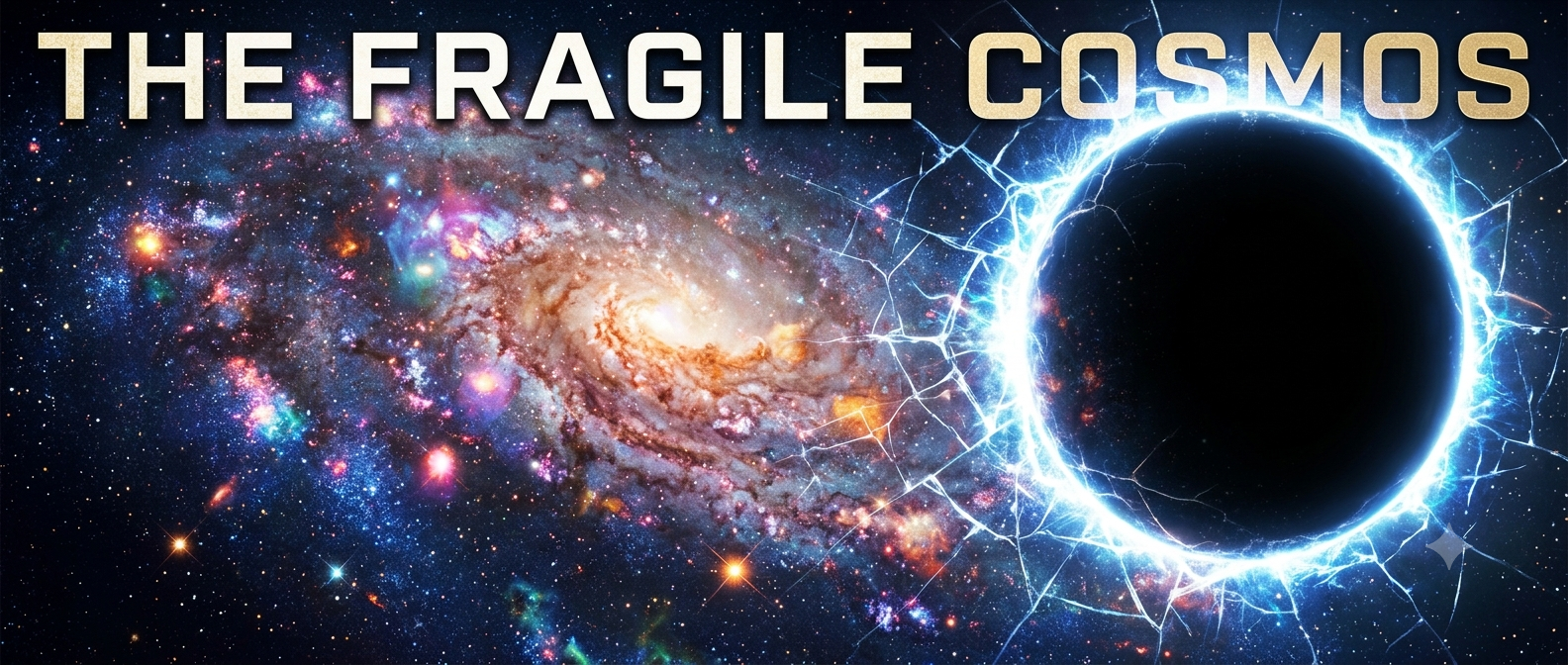
Looking up at the night sky, the universe feels like the ultimate monument to permanence. Galaxies rotate with clockwork precision, stars burn for billions of years, and the very fabric of spacetime seems resolutely stable.
Yet, deep within the foundational math of quantum mechanics lies a chilling revelation: everything we see, smash, and inhabit might be built on a cosmic trapdoor.
Physicists call this concept false vacuum decay. It is the ultimate existential threat—a mathematically plausible scenario where a completely random, subatomic quantum fluctuation could trigger a bubble of “true vacuum” that expands outward at the speed of light, fundamentally rewriting the laws of physics and erasing the universe instantly. There would be no warning, no preparation, and no aftermath. Reality would simply cease to exist.
The Illusion of Stability
To understand how the universe could undo itself, one must look to the fields that govern reality. Every particle in existence is merely an excitation in an underlying cosmic field. The most famous of these is the Higgs field, which permeates all space and dictates the mass of fundamental particles.
In physics, everything seeks its lowest possible energy state. A ball rolling down a hill will eventually stop at the very bottom, reaching absolute stability. For a long time, scientists assumed our universe had reached this ultimate baseline—the “true vacuum.”
However, measurements of the Higgs boson mass suggest a terrifying alternative: our universe might not be resting at the bottom of the valley. Instead, it may be stuck on a temporary plateau, a ledge halfway down the mountain.
[Energy Level]
  ^
  |      (Our Universe)
  |     [False Vacuum]  <-- Trapped on a temporary ledge
  |         \___
  |             \
  |              \____  [True Vacuum] <-- Absolute lowest energy state
  +-------------------------------------------------------------> [Field Configuration]
This state is known as metastability. The universe appears perfectly stable, and it has for 13.8 billion years, but it is technically living on borrowed time. It is resting on a false floor.
The Quantum Trigger
If our universe is trapped on an energy ledge, a massive barrier of energy is what keeps it there, preventing it from rolling down into the true vacuum. Under the classical laws of physics, the universe would remain trapped forever because it lacks the energy to climb over that barrier.
But we live in a quantum universe, where the rules of everyday life do not apply.
Through a phenomenon known as quantum tunneling, subatomic particles can routinely defy energy barriers. They don’t climb over the mountain; they simply disappear from one side and materialize on the other.
The Catalyst: At any given moment, in any random corner of deep space, a high-energy quantum fluctuation could occur. If that fluctuation allows a tiny patch of space to successfully tunnel through the energy barrier into the true vacuum, the trapdoor snaps open.
The Cataclysmic Bubble
The moment a microscopic pocket of true vacuum is created, the stability of the cosmos collapses. Because the true vacuum represents a lower, more stable energy state, the boundary of this pocket—the bubble wall—will violently expand outward to swallow the higher-energy false vacuum around it.
Driven by the immense energy differential, this bubble wall would instantly accelerate to the speed of light.
As the bubble expands, it alters the Higgs field permanently. Inside the bubble, the laws of physics are completely transformed. The masses of electrons, quarks, and photons would change completely, or mass itself might vanish. The fundamental forces that hold atoms together would dissolve.
Because the bubble travels at the speed of light, it moves at the exact same speed as the information revealing its approach. If the bubble were triggered a light-year away, we would have no astronomical warning. The moment the edge reached Earth, the atoms in our bodies, the planet beneath our feet, and the star we orbit would disintegrate into an unrecognizable soup of exotic particles in a fraction of a millisecond.
A Cosmic Roll of the Dice
While false vacuum decay sounds like the ultimate cosmic nightmare, physicists urge planetary citizens not to panic. The mathematical probability of a quantum tunneling event triggering this decay is infinitesimally small. Calculations suggest that the lifespan of our false vacuum is likely trillions of years longer than the current age of the universe.
Even so, the mere fact that reality can decay highlights the fundamentally volatile nature of deep space. We exist inside a beautifully complex, incredibly fragile bubble of physics—a cosmic masterpiece floating safely on a ledge, until the universe decides to roll the dice one final time.
1 2 3 4 5 6 7 8 9 10 11 12 13 14 15 16 17 18 19 20 21 22 23 24 25 26 27 28 29 30 31 32 33 34 35 36 37 38
700 701 702 703 704 705 706 707 708 709 710 711 712 713 714 715 716 717 718 719 720 721 722 723 724 725 726 727 728 729 730 731 732 733 734 735 736 737 738 739 740 741 742 743 744 745 746 747 748 749 750 751 752 753 754 755 756 757 758 759 760 761 762 763 764 765 766 767 768 769 770 771 772 773 774 775 776 777 778 779 780 781 782 783 784 785 786 787 788 789 790 791 792 793 794 795 796 797 798 799 800 801 802 803 804 805 806 807 808 809 810 811 812 813 814 815 816 817 818 819 820 821 822