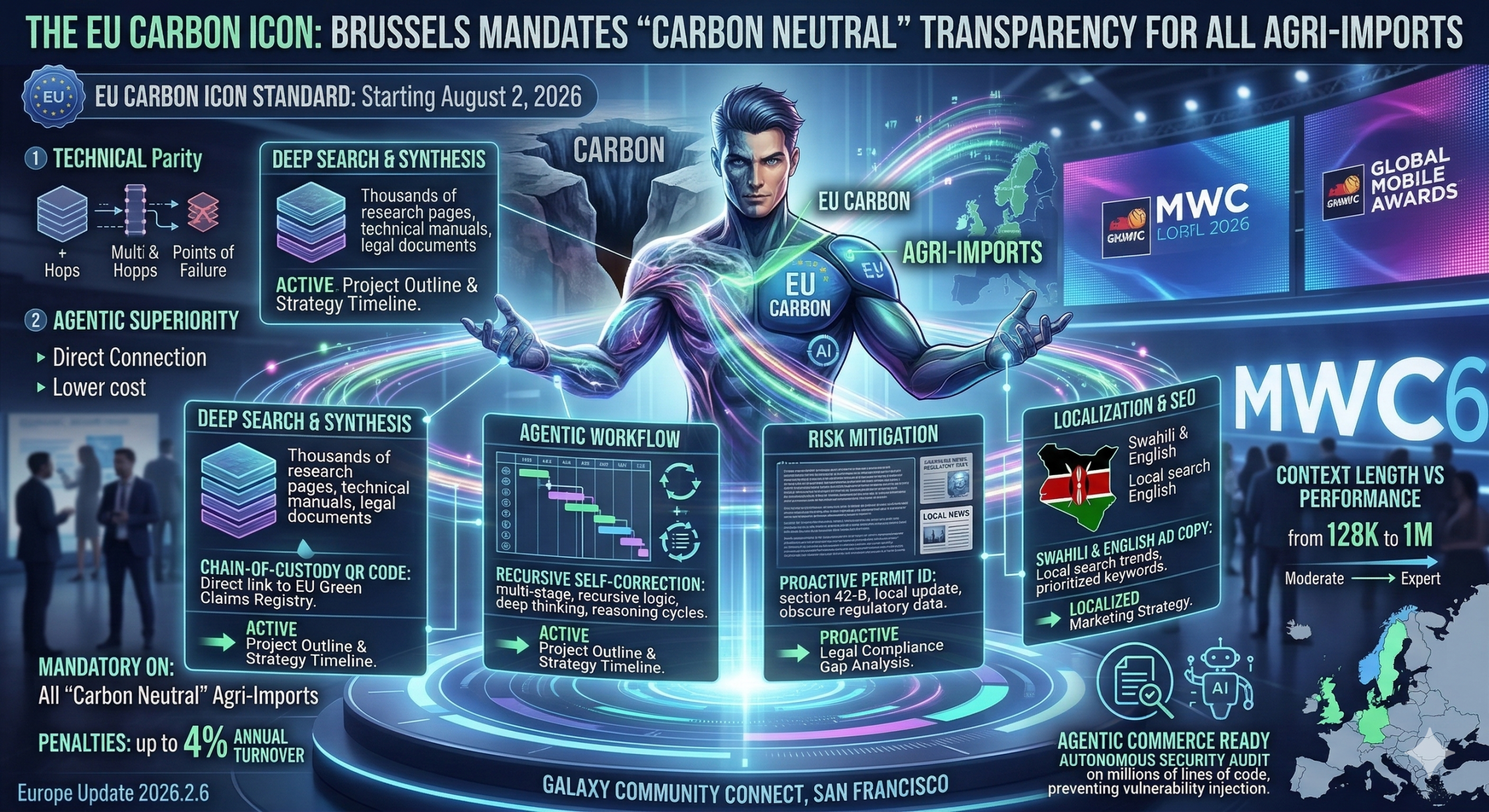
BRUSSELS — March 8, 2026 — In a move that aligns environmental policy with the recently unveiled EU Icon Standard for AI, the European Commission has officially finalized the “Carbon Neutral” Labeling Directive for agricultural imports. Starting August 2, 2026, any agricultural product entering the European Union marketed as “Carbon Neutral” or “Climate Positive” must feature a standardized, verifiable EU Carbon Icon on its primary packaging.
The directive, which bridges the Green Claims Directive and the Empowering Consumers for the Green Transition (EmpCo) rules, aims to eliminate “greenwashing” in the food and fiber sectors. Under the new law, generic claims of climate neutrality based primarily on carbon offsets rather than actual value-chain reductions will be banned across all 27 Member States.
Beyond the Watermark: A Three-Layered Trust System
The “Carbon Icon” for agriculture follows the same structural logic as the AI transparency markers discussed earlier this week. It is built on a “Three-Layer” verification architecture to ensure that the label represents real-world soil health and emission reductions:
-
The Visual Icon: A persistent, universally recognized symbol (localized for all EU languages) that must be “instantly and constantly visible” at the point of sale, both on physical packaging and digital storefronts.
-
The “Chain-of-Custody” QR Code: Every icon must be accompanied by a QR code that links directly to the EU Green Claims Registry. This allows consumers to see the specific LCA (Life Cycle Assessment) data and the independent third-party auditor who verified the claim.
-
Digital Provenance (C2PA): For digital marketing and export documentation, the data is embedded as metadata, ensuring that the “Carbon Neutral” status remains attached to the product even as it moves through various wholesalers.
Impact on Global Smallholders: The Compliance Cliff
While the icon aims to build consumer trust, it presents a significant hurdle for exporters in the Global South, particularly in markets like Kenya. As we discussed in the recent iGrow News report on the “Carbon Chasm,” the high cost of verification (MRV) remains the primary barrier for African smallholders.
-
Audit Costs: A single farm-level audit to meet the EU’s “High-Integrity” standard can cost upwards of $4,000, which is often more than the annual profit of a small coffee or tea farm.
-
The “LillyPod” Gap: While Western firms use Blackwell Ultra-powered supercomputers to model their emissions, African exporters are often excluded from these tools due to lack of local digital infrastructure and data sovereignty.
-
CBAM Integration: While the Carbon Border Adjustment Mechanism (CBAM) currently focuses on heavy industries like fertilizers, the Commission has hinted that high-emissions agricultural sectors (such as beef and industrial-scale soy) could be integrated into the “Carbon Icon” reporting framework by 2028.
Penalties and Enforcement
The August 2026 deadline is being treated as a “Hard Start.” Non-compliant goods risk:
-
Customs Blockage: National authorities will have the power to stop shipments at the border if they bear “Carbon Neutral” claims without the mandatory EU icon and registry entry.
-
Financial Penalties: Fines for misleading environmental claims can reach up to 4% of a company’s annual turnover in the EU.
-
Blacklisting: Repeated offenders will be published on a public “Greenwash Registry,” effectively barring their products from premium retail shelves across the continent.
Comparison: The New vs. Old Labeling Standard
| Feature | Pre-August 2026 | Post-August 2026 (EU Icon Standard) |
| Claim Basis | Often 100% Offsets (VCM) | Primary Value-Chain Reductions Only |
| Verification | Self-declared or Private Label | Mandatory Independent Third-Party Audit |
| Visibility | Variable / Small Print | Universal Icon (Top-Right Placement) |
| Digital Link | Rare | Mandatory QR Code to EU Registry |