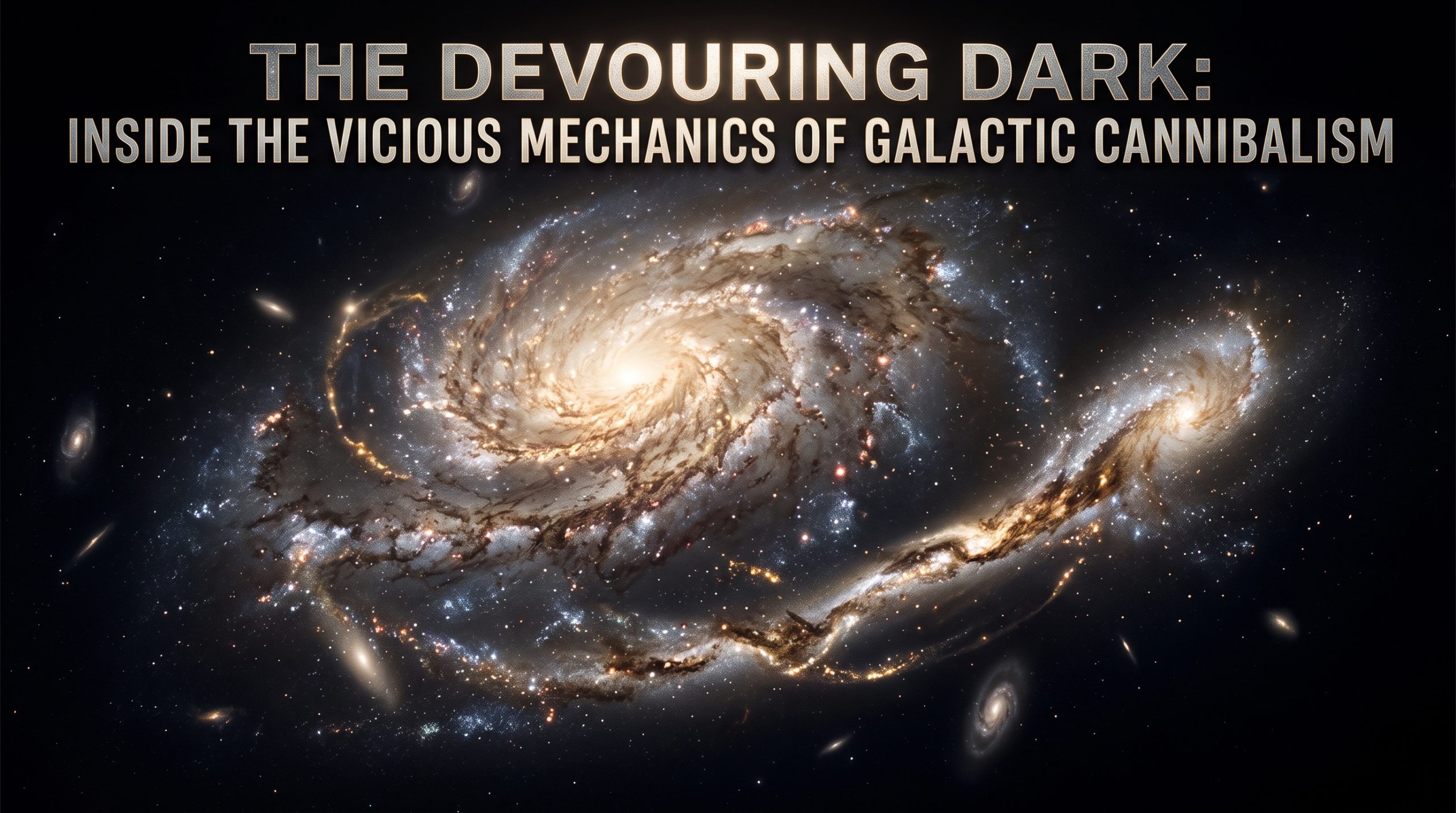
The Milky Way appears as a serene, glowing river of stars suspended in the night sky, projecting an illusion of cosmic tranquility. In reality, our home galaxy is an apex predator. For billions of years, the Milky Way has survived and grown through a violent, relentless process known as galactic cannibalism. It maintains its massive, majestic spiral structure by systematically dragging smaller dwarf galaxies into its deep gravity well, stripping them of their stars, and swallowing them whole.
The Physics of the Cosmic Hunt Galactic cannibalism is driven by the merciless mechanics of tidal forces. When a massive structure like the Milky Way approaches a smaller satellite galaxy, the gravitational pull exerted on the near side of the dwarf galaxy is significantly stronger than the pull on its far side. This differential gravity physically stretches and distorts the smaller galaxy, warping its original shape. Over hundreds of millions of years, the dwarf galaxy is stretched beyond its breaking point. Its structural integrity collapses entirely, and its stars, planetary systems, cosmic gas, and dark matter are violently siphoned into the larger host galaxy’s halo.
The Trails of the Eaten Astrophysicists do not have to look far to witness this astronomical feast; the evidence is currently unwinding in our own galactic backyard. The Sagittarius Dwarf Spheroidal Galaxy is presently in the active stages of being devoured by the Milky Way. As it orbits our galactic center, it is being slowly ripped apart, leaving behind a colossal ribbon of stars known as a stellar stream. These stellar streams act as the luminous crumbs of the Milky Way’s past meals. By mapping these faint, looping rivers of ancient stars across the outer galactic halo, astronomers have identified the dispersed remains of multiple ancient dwarf galaxies—such as the Gaia-Enceladus structure, which was absorbed by the Milky Way approximately 10 billion years ago.
The Ultimate Merger The mechanics of galaxies and time dictate that the hunter will eventually meet its match. In approximately 4.5 billion years, the Milky Way’s era of consuming tiny satellite dwarf galaxies will be violently interrupted by the arrival of the Andromeda Galaxy. This will not be a simple devouring, but a colossal, chaotic collision of equals. The gravitational dance between these two behemoths will completely deform their spiral structures, stripping stars from their current orbits and eventually fusing them into an entirely new, massive elliptical galaxy. Until that day arrives, our galaxy will continue its silent, predatory sweep through the cosmic void, building its mass one devoured star system at a time.
700 701 702 703 704 705 706 707 708 709 710 711 712 713 714 715 716 717 718 719 720 721 722 723 724 725 726 727 728 729 730 731 732 733 734 735 736 737 738 739 740 741 742 743 744 745 746 747 748 749 750 751 752 753 754 755 756 757 758 759 760 761 762 763 764 765 766 767 768 769 770 771 772 773 774 775 776 777 778 779 780 781 782 783 784 785 786 787 788 789 790 791 792 793 794 795 796 797 798 799 800 801 802 803 804 805 806 807 808 809 810 811 812 813 814 815 816 817 818 819 820 821 822