For the past three years, the undisputed symbol of the artificial intelligence revolution was the blinking cursor in a blank text box. Enterprise maturity was measured by how efficiently an employee could “prompt” a sprawling, billion-parameter model to draft an email, summarize a report, or write a snippet of code.
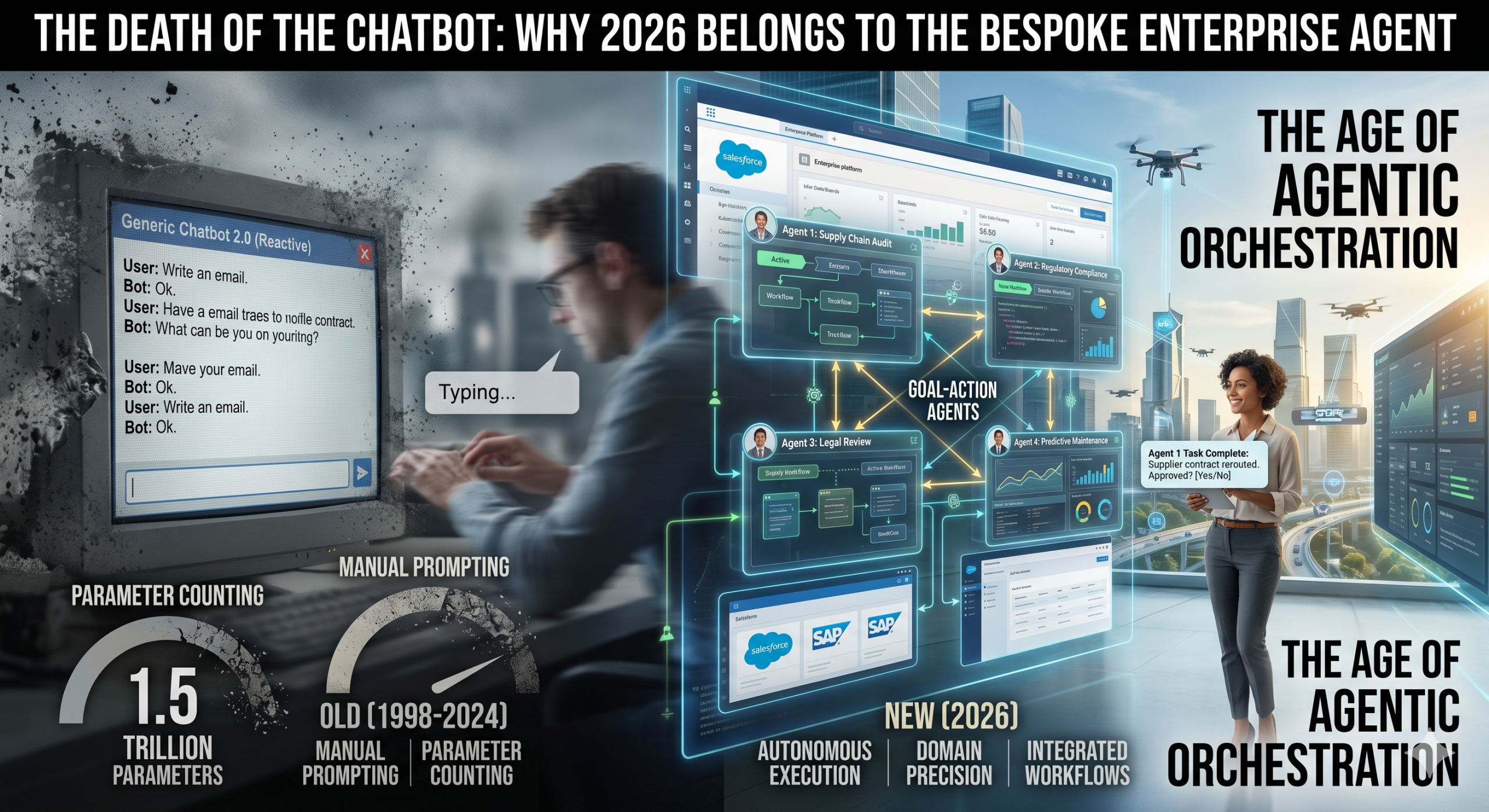
According to industry analysts, that era is officially over. 2026 has ushered in a definitive structural migration away from generic, general-purpose chatbot interfaces and the brute-force “parameter counting” benchmarks that used to dominate tech headlines. In their place, the enterprise landscape has pivoted sharply toward small, hyper-specialized, and deeply domain-specific agentic workflows built to plug directly into core corporate platforms.
The novelty of chatting with AI has worn off; businesses now demand that AI gets to work.
Moving Past the “Stochastic Parrot”
The downfall of the enterprise chatbot stems from its fundamental architectural limitation: it is reactive. Standard large language models (LLMs) operate on a prompt-response mechanism, acting as stateless machines that require a human to guide them through every individual step of a complex task.
“We are witnessing a fundamental shift from the ‘Prompt-Response’ paradigm to a ‘Goal-Action’ reality,” notes a recent sector report on the 2026 AI ecosystem. “Instead of directing a tool through continuous manual intervention, human operators are now managing automated outcomes.”
Rather than building larger, more expensive general models, software developers are wrapping highly optimized, smaller foundational models inside sophisticated execution frameworks. Backed by structured memory engines, native tool access, and firm operational guardrails, these systems don’t just output text—they execute multi-layered workflows across disparate enterprise software.
The Rise of Bespoke Agentic Workflows
The real corporate differentiator in 2026 is no longer who has access to the largest model, but who has designed the most effective agentic orchestration. This has resulted in a boom for deeply niche, domain-specific digital workers trained for precision rather than broad trivia.
Consider how a modern corporate workflow handles a standard logistical hurdle, like a supply chain delay. In 2024, a supply manager might have used a chatbot to draft an email asking a vendor for an status update. In 2026, a bespoke supply-chain agent operates entirely in the background:
-
Perception: The agent autonomously monitors shipping data and enterprise resource planning (ERP) systems, instantly flagging a supplier delay.
-
Reasoning & Planning: It references past transaction history, looks up alternative pre-approved vendors, and calculates the financial impact of a reroute.
-
Execution: It automatically drafts and negotiates a spot-rate contract with a secondary carrier, logs the update in the internal CRM, and presents the finalized solution to a manager for a single-click approval.
By automating the execution phase of complex tasks, these specialized agents are turning corporate software environments from passive informational dashboards into proactive decision-intelligence engines.
The End of Parameter Counting
This pivot has also fundamentally changed the underlying economics of AI software development. For years, tech giants raced to brag about parameter counts—believing that bigger always meant better. However, running trillion-parameter models for basic enterprise automation is proving to be cost-prohibitive and structurally inefficient.
By utilizing smaller, open-weight, or tightly fine-tuned models optimized solely for specific actions (such as API calling, legal contract auditing, or inventory calculation), companies are slashing their processing token costs while drastically reducing the risk of hallucination. The focus is entirely on utility and integration.
As these custom workflows integrate deeply into everyday platforms, the corporate workforce is rapidly learning a new type of digital literacy. Employees are no longer learning how to talk to a chatbot; they are learning how to orchestrate a digital workforce. The chat box is quickly becoming the manual transmission of the digital world—functional, but far too slow for an automated era.
1 2 3 4 5 6 7 8 9 10 11 12 13 14 15 16 17 18 19 20 21 22 23 24 25 26 27 28 29 30 31 32 33 34 35 36 37 38
700 701 702 703 704 705 706 707 708 709 710 711 712 713 714 715 716 717 718 719 720 721 722 723 724 725 726 727 728 729 730 731 732 733 734 735 736 737 738 739 740 741 742 743 744 745 746 747 748 749 750 751 752 753 754 755 756 757 758 759 760 761 762 763 764 765 766 767 768 769 770 771 772 773 774 775 776 777 778 779 780 781 782 783 784 785 786 787 788 789 790 791 792 793 794 795 796 797 798 799 800 801 802 803 804 805 806 807 808 809 810 811 812 813 814 815 816 817 818 819 820 821 822