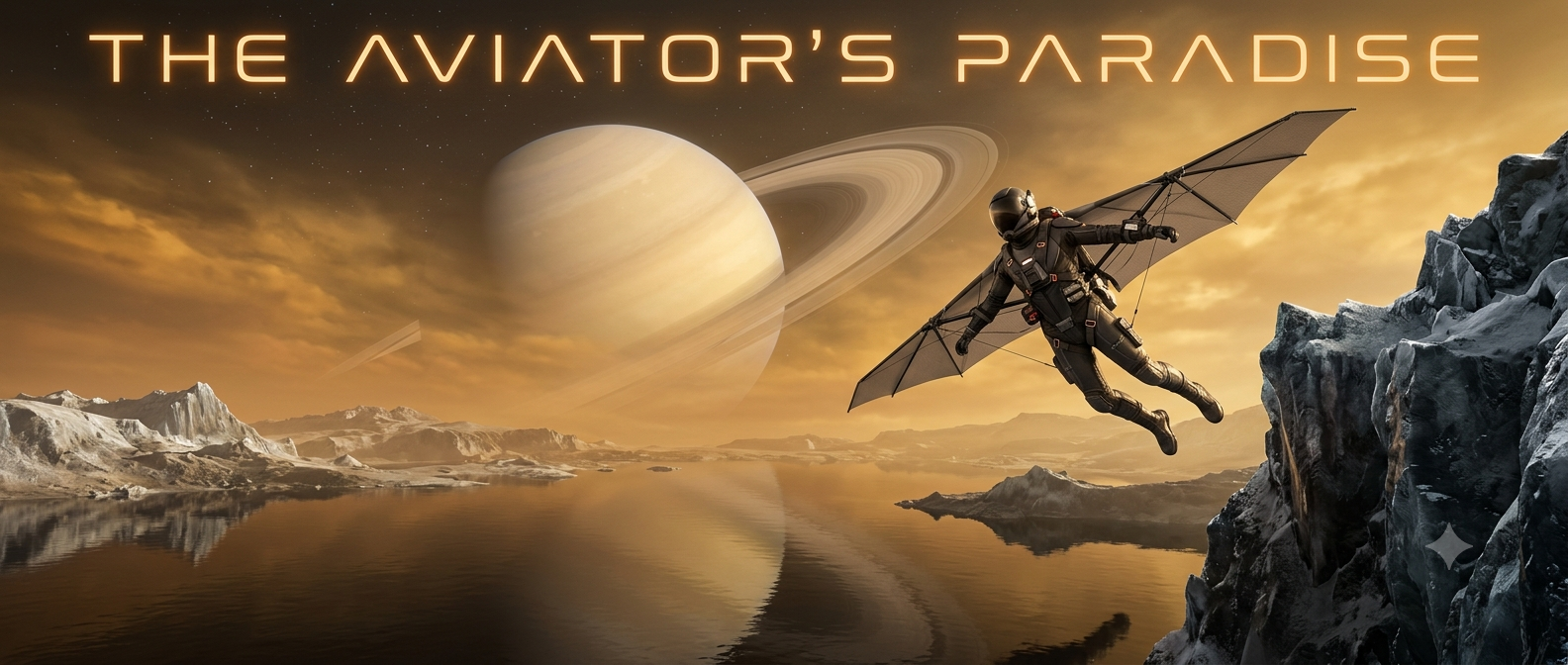
If you traveled 800 million miles away to Saturn’s largest moon, Titan, you might look around and find the landscape comfortingly familiar. You would see sprawling coastlines, rolling sand dunes, carved river valleys, and gentle rain clouds sweeping across a darkened sky.
But step outside your spacecraft, and the illusion of Earth quickly shatters.
Titan is a cosmic mirror world where nature has kept the familiar geological blueprints but completely swapped out the ingredients. It is a world where the “water” cycle is made of liquid fuel, the mountains are carved from frozen water, and the physics are so profoundly forgiving that a human could take to the skies like a bird.
The Hydrological Cycle—Without the Water
On Earth, water is the driving force of geology and life. On Titan, it is far too cold for liquid water to exist. With surface temperatures hovering around a brutal -179°C (-290°F), any water is frozen harder than granite.
Instead, Titan relies on a completely different molecule to run its weather system: methane.
[Methane Clouds] ➔ [Liquid Methane Rain] ➔ [Hydrocarbon Rivers] ➔ [Methane Lakes] ⇄ (Evaporation)
Titan is the only other body in the solar system known to feature liquid rivers, lakes, and seas on its surface. However, these bodies of water—like the massive Kraken Mare—are actually vast reservoirs of liquid methane and ethane.
When it rains on Titan, it rains liquid natural gas. This cold hydrocarbon rain collects into rivers, carves deep canyons through the landscape, and fills massive polar seas. The evaporation of these lakes feeds the dense orange smog overhead, perpetuating a fully functional, alien “hydrological” cycle.
Bedrock of Ice, Sand of Plastic
Because the fluid chemistry is inverted, the geology of Titan is similarly turned on its head.
On Earth, we build houses on silicate rock and chill our drinks with water ice cubes. On Titan, water ice is the bedrock. The mountains, pebbles, and shorelines are entirely composed of water ice that has been frozen so solid by the extreme temperatures that it behaves exactly like rock and stone on Earth.
Meanwhile, the moon’s vast desert dunes aren’t made of silicate sand. They are composed of dark grains of complex organic molecules called tholins. These tholins form in the upper atmosphere when sunlight breaks apart methane molecules, causing them to rain down as a fine soot. Over time, Titan’s winds sweep this organic soot into massive dune fields that look remarkably like the Namib Desert—except the sand has a chemical composition closer to crushed plastic.
The Ultimate Flight School
Perhaps the most magical aspect of Titan isn’t its alien chemistry, but what its unique physics means for future human explorers.
If you were to step out onto a Titanian cliffside in a heavily insulated spacesuit (complete with an oxygen mask and heaters), you would notice two distinct physical properties:
-
Low Gravity: Titan is small. Its gravitational pull is only about 14% of Earth’s—even weaker than our own Moon’s gravity. You would feel incredibly light, capable of leaping high into the air with minimal effort.
-
Thick Atmosphere: Despite its small size, Titan boasts a tremendously dense atmosphere, exerting 1.5 times the atmospheric pressure of Earth. The air is thick, heavy, and packed with nitrogen.
This precise combination—low gravity and high air density—creates the perfect recipe for flight. Because the air is so thick, it provides massive aerodynamic lift. Because the gravity is so low, you require very little force to counteract your own weight.
The Human Flight Equation: If you were to strap a pair of simple artificial wings to your arms, your human muscles would be more than strong enough to generate the lift required to take off.
By simply flapping your arms, you could lift off the ground, soar over lakes of liquid natural gas, coast past mountains of solid water ice, and effortlessly navigate the orange skies.
While missions like NASA’s Dragonfly rotorcraft are designed to explore this fascinating moon robotically, the unique physics of Titan mean that it will always remain the ultimate dream destination for the human imagination—a place where we can finally discard our heavy machinery and fly on our own power.
700 701 702 703 704 705 706 707 708 709 710 711 712 713 714 715 716 717 718 719 720 721 722 723 724 725 726 727 728 729 730 731 732 733 734 735 736 737 738 739 740 741 742 743 744 745 746 747 748 749 750 751 752 753 754 755 756 757 758 759 760 761 762 763 764 765 766 767 768 769 770 771 772 773 774 775 776 777 778 779 780 781 782 783 784 785 786 787 788 789 790 791 792 793 794 795 796 797 798 799 800 801 802 803 804 805 806 807 808 809 810 811 812 813 814 815 816 817 818 819 820 821 822