Forty light-years away, in the constellation of Cancer, orbits a world that defies the imagination.
Discovered in 2004, the exoplanet 55 Cancri e—officially named Janssen—is a “Super-Earth” roughly eight times more massive than our home planet. But any similarity to Earth ends there. While Earth takes a leisurely 365 days to circle the Sun from a safe, comfortable distance, 55 Cancri e is locked in a frantic, breakneck embrace with its host star, completing a full orbit in just 18 hours.
It is so incredibly close to its stellar parent that it experiences a perpetual, scorching nightmare. Recent spectroscopic data from the James Webb Space Telescope (JWST) has confirmed that this planet is a chaotic, shifting laboratory of extreme geology—a true “Hell Planet” where the ground liquefies into open oceans and the atmosphere itself might glitter with alien rain.
A Shifting Sea of Liquid Stone
Because 55 Cancri e orbits so close to its star, it is tidally locked by gravity. This means the same side of the planet permanently faces the blistering radiation of its sun, much like the Moon faces Earth.
On this permanent “dayside,” temperatures soar to a devastating 4,000°F (2,200°C)—far hotter than the melting point of almost any known rock or metal.
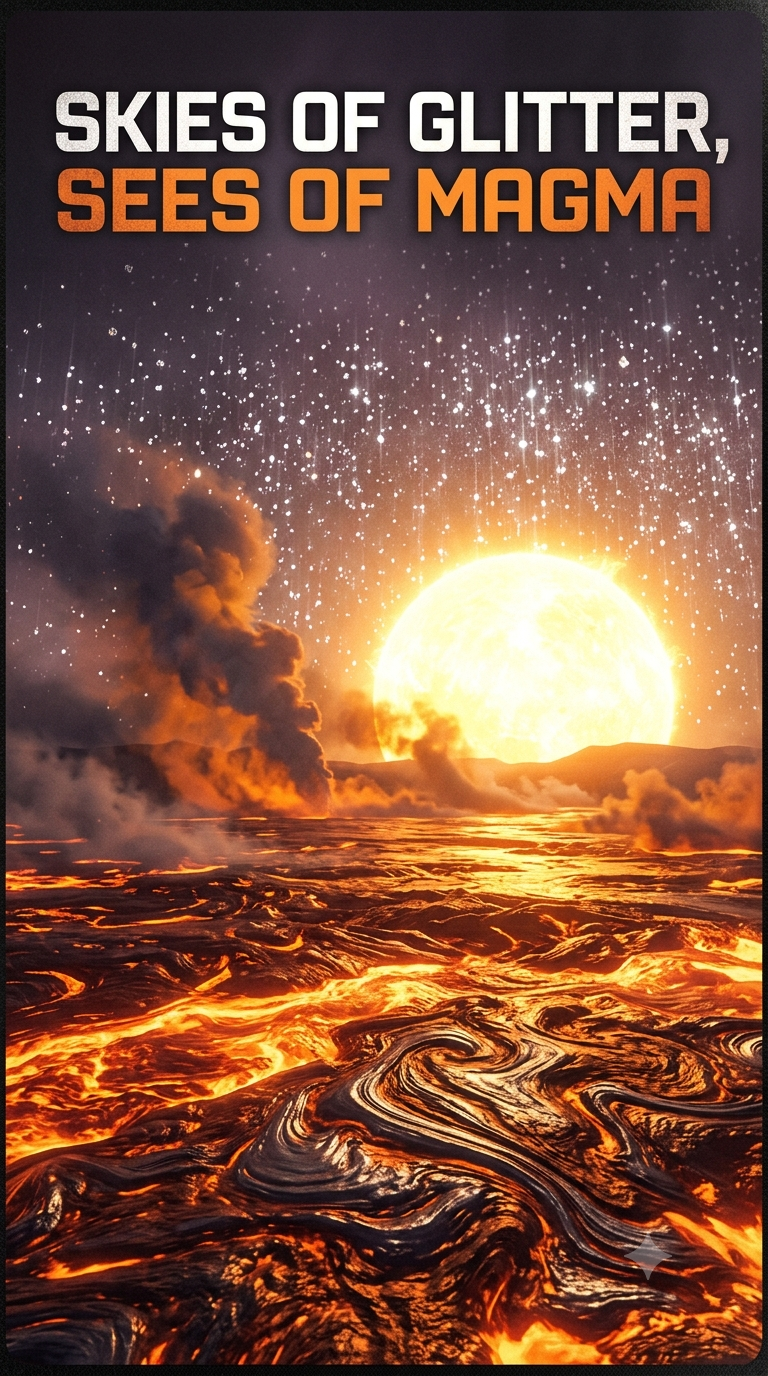
Consequently, the dayside of 55 Cancri e has no solid ground. It is a vast, interconnected, and constantly churning ocean of liquid magma. Silicon, iron, and various mineral deposits flow like water, creating massive thermal currents.
[Day Side: 4,000°F Magma Ocean] ⇄ [Twilight Zone: Thermal Fronts] ⇄ [Night Side: Hardened Rock Crust]
However, data has shown that the planet’s hottest spot isn’t actually the point directly beneath its sun. This anomaly indicates that a dynamic atmosphere is actively moving heat around the planet. On the permanent nightside, temperatures drop significantly enough for the lava to cool and solidify into a dark, craggy obsidian crust. But the boundary between day and night is far from stable. Intense volcanic activity and shifting atmospheric tides mean that rivers of fire constantly breach the dark side, creating a world in a perpetual state of melting and re-freezing.
Sparkling Skies: The Carbon-Rich Crust
Aside from its volcanic fury, what makes 55 Cancri e truly fascinating to astrophysicists is its chemical composition.
Based on mass and radius models, scientists believe this planet is incredibly carbon-rich. While Earth is a silicate-based world with very little carbon in its deep layers, 55 Cancri e likely formed from a primordial dust cloud packed with carbon.
This leads to a mind-bending geological hypothesis: a massive portion of the planet’s interior and crust could be composed of elemental carbon in the form of graphite and pure diamond.
This extreme chemistry translates to truly bizarre weather patterns. The intense heat causes elements like carbon and silicon to vaporize directly off the magma oceans, rising into the thin, volatile atmosphere. As these vaporized minerals drift toward the slightly cooler twilight zones or upper atmospheric layers, they condense.
Instead of raining water droplets, the skies of 55 Cancri e likely rain superheated minerals and crystalline carbon structures. Essentially, the planet’s atmosphere may actively condense into a glittering, abrasive downpour of microscopic diamond dust, raining sparkles down onto a boiling sea of liquid stone.
A Window Into Planetary Extremes
For a long time, worlds like 55 Cancri e were thought to be completely stripped bare of their atmospheres by intense stellar radiation. But JWST’s sensitive infrared instruments have detected clues of a thick, albeit toxic, shroud of carbon monoxide or carbon dioxide wrapping the planet.
This discovery proves that the magma oceans are actively “outgassing”—replenishing the atmosphere just as fast as the star strips it away.
55 Cancri e is a stark reminder of the wild diversity of the cosmos. It stands as an architectural marvel of extreme physics: a world built of diamonds, choked by toxic smog, and drowning in a continuous sea of liquid fire. It is a beautiful, terrifying cosmic forge that humanity can happily admire from a safe distance of 40 light-years away.
700 701 702 703 704 705 706 707 708 709 710 711 712 713 714 715 716 717 718 719 720 721 722 723 724 725 726 727 728 729 730 731 732 733 734 735 736 737 738 739 740 741 742 743 744 745 746 747 748 749 750 751 752 753 754 755 756 757 758 759 760 761 762 763 764 765 766 767 768 769 770 771 772 773 774 775 776 777 778 779 780 781 782 783 784 785 786 787 788 789 790 791 792 793 794 795 796 797 798 799 800 801 802 803 804 805 806 807 808 809 810 811 812 813 814 815 816 817 818 819 820 821 822