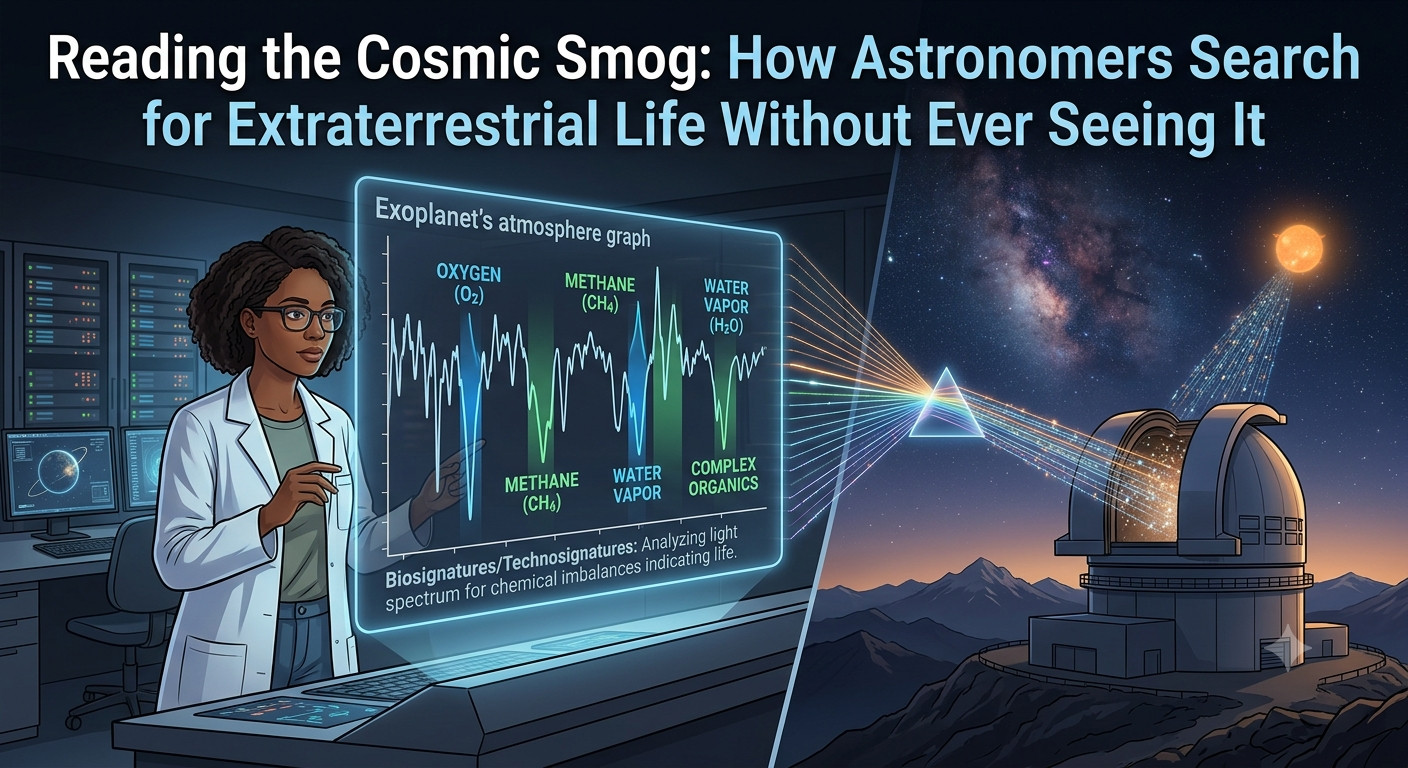
For decades, the search for extraterrestrial intelligence (SETI) was dominated by a singular image: a lonely radio dish pointed at a silent sky, listening for a deliberate “Hello” from the stars. It was a search based on the hope that someone out there was actively trying to get our attention.
Today, a profound shift is taking place in astrobiology. Astronomers are no longer just listening; they are looking. But they aren’t looking for flashing lights or flying saucers. Instead, using next-generation observatories like the James Webb Space Telescope (JWST), scientists are hunting for the accidental chemical and physical footprints left behind by alien worlds.
This modern frontier splits the hunt into two categories: Biosignatures—the chemical markers of basic, biological life—and Technosignatures—the unintended side effects of an industrial civilization. By looking at how these signatures interact with light, humanity is learning to read the cosmic smog of planets hundreds of light-years away.
Part I: Biosignatures and the Unbalanced Atmosphere
To find basic life—like microbes, plants, or algae—astronomers don’t need a telescope powerful enough to see a foreign surface. They just need to analyze the starlight passing through an exoplanet’s atmosphere using a method called transmission spectroscopy.
When a planet transits (passes in front of) its host star, the starlight is filtered through the planet’s atmospheric ring. Different gases absorb very specific wavelengths of light, leaving telltale dark gaps in the spectrum. By analyzing which colors of light are missing, scientists can deduce exactly what the alien air is made of.
Astronomers look for a phenomenon known as chemical disequilibrium. On a lifeless rock, gases naturally react with one another until the atmosphere settles into a stagnant, chemically stable state. But when life is present, it constantly pumps fresh, volatile chemicals into the sky, forcing the atmosphere out of balance.
-
The Oxygen-Methane Combo: Oxygen ($O_2$) and methane ($CH_4$) hate each other; when left alone, they rapidly react to form water and carbon dioxide. If an astronomer detects high levels of both gases coexisting in an exoplanet’s atmosphere, it implies that something on the surface—like plants practicing photosynthesis and microbes producing waste—is continuously replenishing them at massive scales.
-
The Trap of False Positives: However, biosignatures are rarely a “smoking gun.” Geological processes like active volcanism or the chemical breakdown of water by intense stellar radiation can mimic these gases, forcing scientists to build complex computer models to rule out lifeless explanations.
Part II: Technosignatures and the Light of Civilization
If an alien species moves past simple biology and develops a technologically advanced society, their impact on their planet changes. They begin producing technosignatures—unnatural modifications to an environment that cannot be explained by biology or geology.
Technosignatures are particularly intoxicating to astronomers because, unlike fragile organic biosignatures, a technological footprint can potentially be detected across thousands of light-years.
1. Industrial Pollutants
Just as humanity has inadvertently altered Earth’s atmosphere with the Industrial Revolution, alien civilizations might do the same. Scientists have demonstrated that powerful space telescopes could detect artificial, highly complex chemicals like chlorofluorocarbons (CFCs) in distant atmospheres. Because CFCs are complex, synthetic greenhouse gases that do not occur naturally, finding them on a habitable world would be an undeniable indicator of an industrial society.
2. Artificial Light and City Glow
On Earth, the dark side of our planet is lit up by a glittering web of artificial light. Astronomers are currently developing techniques to detect the faint “nightside glow” of alien mega-cities. While incredibly difficult due to the overwhelming glare of the host star, direct-imaging space telescopes of the future may be able to isolate the specific spectrum emitted by artificial LED or sodium-based illumination on an exoplanet’s night side.
3. Waste Heat and Orbital Clutter
Every machine obeys the laws of thermodynamics, which means all technology generates waste heat. An advanced civilization utilizing massive orbital solar arrays, satellites, or megastructures would absorb vast amounts of starlight and re-radiate it as heat. This creates a distinct mid-infrared excess, causing a star system to glow much more brightly in infrared light than a natural star ever should.
The Ultimate Cosmic Background Check
The beauty of searching for bio- and technosignatures is that it requires no cooperation from the inhabitants of these distant worlds. The aliens do not need to build giant beacons or broadcast radio waves across space; they merely need to exist, breathe, and build.
As astronomical instruments grow more precise, our cosmic background check of the galaxy is accelerating. We are standing on the precipice of a historical paradox: the first time we discover alien life, it will not be through a dramatic face-to-face first contact, but rather as a quiet, undeniable spike of data on a scientist’s computer screen—a chemical whisper telling us we are not alone.
700 701 702 703 704 705 706 707 708 709 710 711 712 713 714 715 716 717 718 719 720 721 722 723 724 725 726 727 728 729 730 731 732 733 734 735 736 737 738 739 740 741 742 743 744 745 746 747 748 749 750 751 752 753 754 755 756 757 758 759 760 761 762 763 764 765 766 767 768 769 770 771 772 773 774 775 776 777 778 779 780 781 782 783 784 785 786 787 788 789 790 791 792 793 794 795 796 797 798 799 800 801 802 803 804 805 806 807 808 809 810 811 812 813 814 815 816 817 818 819 820 821 822