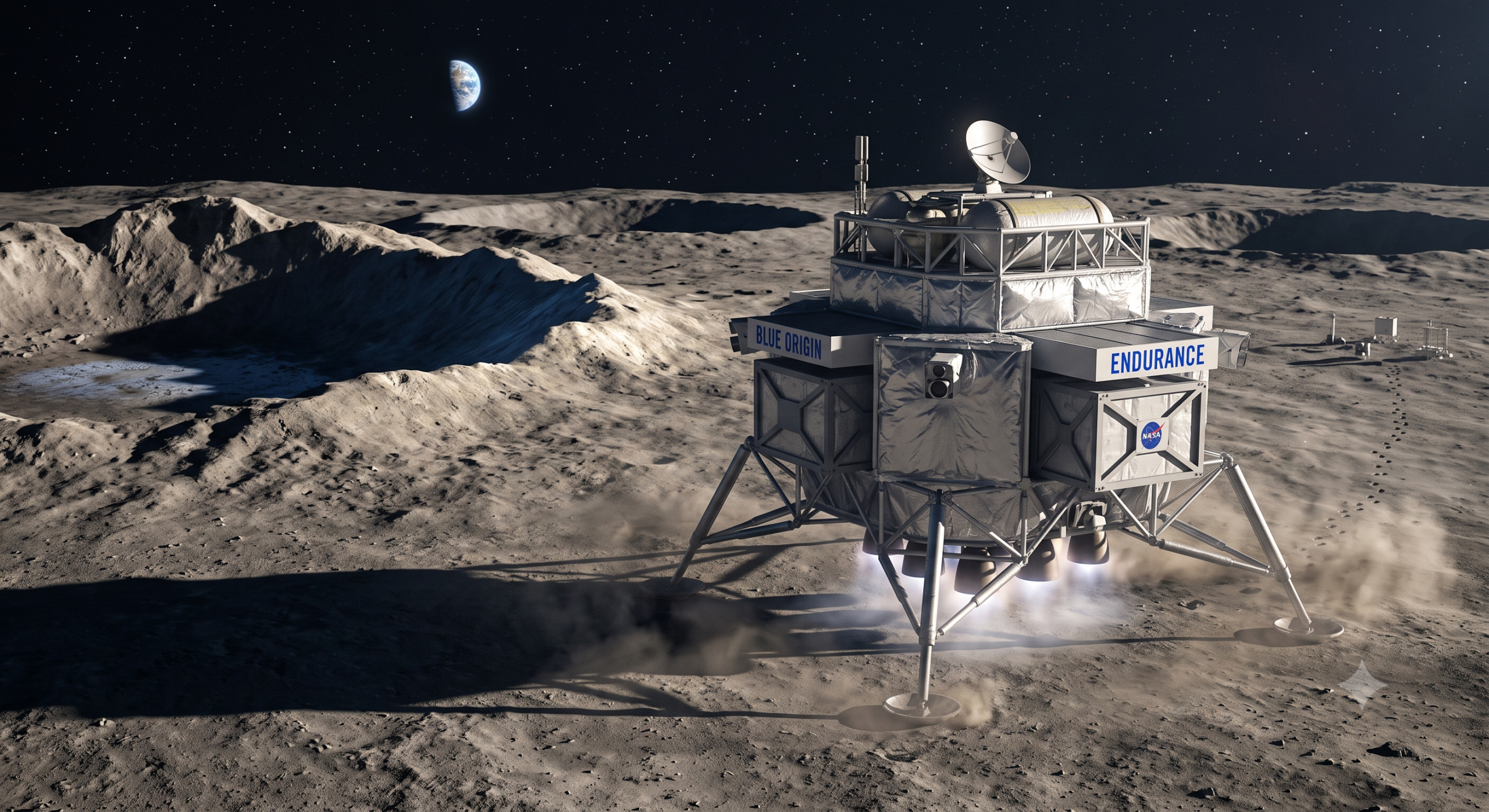
NASA has officially selected Blue Origin’s cryogenically propelled cargo lander, Endurance, to spearhead a historic uncrewed infrastructure run to the lunar surface. The spacecraft will target the strategically critical Shackleton de Gerlache Ridge, located near the Moon’s South Pole. This milestone deployment represents the first privately funded lunar lander mission in history and serves as a vital proving ground for the systems destined to support sustained human presence on the Moon.
The primary objective of the mission, designated under the agency’s expanding public-private operational framework, is to validate complex landing, propulsion, and autonomous navigation technologies under real-world conditions. By executing a precision touchdown in the rugged southern polar terrain, the mission aims to clear the path and eliminate technical risks for future crewed surface activities.
Conquering the Cryogenic Frontier
At the heart of the Endurance lander is its advanced cryogenic propulsion system, which utilizes liquid hydrogen and liquid oxygen. Managing these super-cooled propellants over long-duration space flights has historically been one of aerospace engineering’s steepest hurdles due to the constant risk of fuel boil-off.
Success on this mission will prove that commercial infrastructure can maintain these volatile liquids in deep space, a capability that is essential for refueling networks and long-term lunar survival.
The mission will also perform critical surface science during its descent. Endurance is outfitted with specialized NASA payloads, including high-resolution stereo cameras designed to study the blast effects of the lander’s engine plume on the loose lunar soil. Additionally, it carries a laser retroreflector array to establish permanent, pinpoint positioning markers on the surface for orbiting spacecraft.
Stepping Stone to the Moon Base
The selection of Blue Origin highlights a broader strategic shift toward utilizing commercial cargo haulers to establish logistics lines before astronauts arrive. The Shackleton de Gerlache Ridge is highly coveted by international scientists because its elevated peaks receive near-constant sunlight for solar power, while its neighboring deeply shadowed craters are believed to harbor vast reserves of frozen water ice.
Data collected from the structural performance of Endurance during its descent and touchdown will directly influence the development of larger, human-rated landing systems. If the autonomous systems manage to successfully negotiate the extreme temperature swings and hazardous topography of the South Pole, humanity will have taken its most significant step toward turning a temporary landing site into a permanent cosmic outpost.
700 701 702 703 704 705 706 707 708 709 710 711 712 713 714 715 716 717 718 719 720 721 722 723 724 725 726 727 728 729 730 731 732 733 734 735 736 737 738 739 740 741 742 743 744 745 746 747 748 749 750 751 752 753 754 755 756 757 758 759 760 761 762 763 764 765 766 767 768 769 770 771 772 773 774 775 776 777 778 779 780 781 782 783 784 785 786 787 788 789 790 791 792 793 794 795 796 797 798 799 800 801 802 803 804 805 806 807 808 809 810 811 812 813 814 815 816 817 818 819 820 821 822