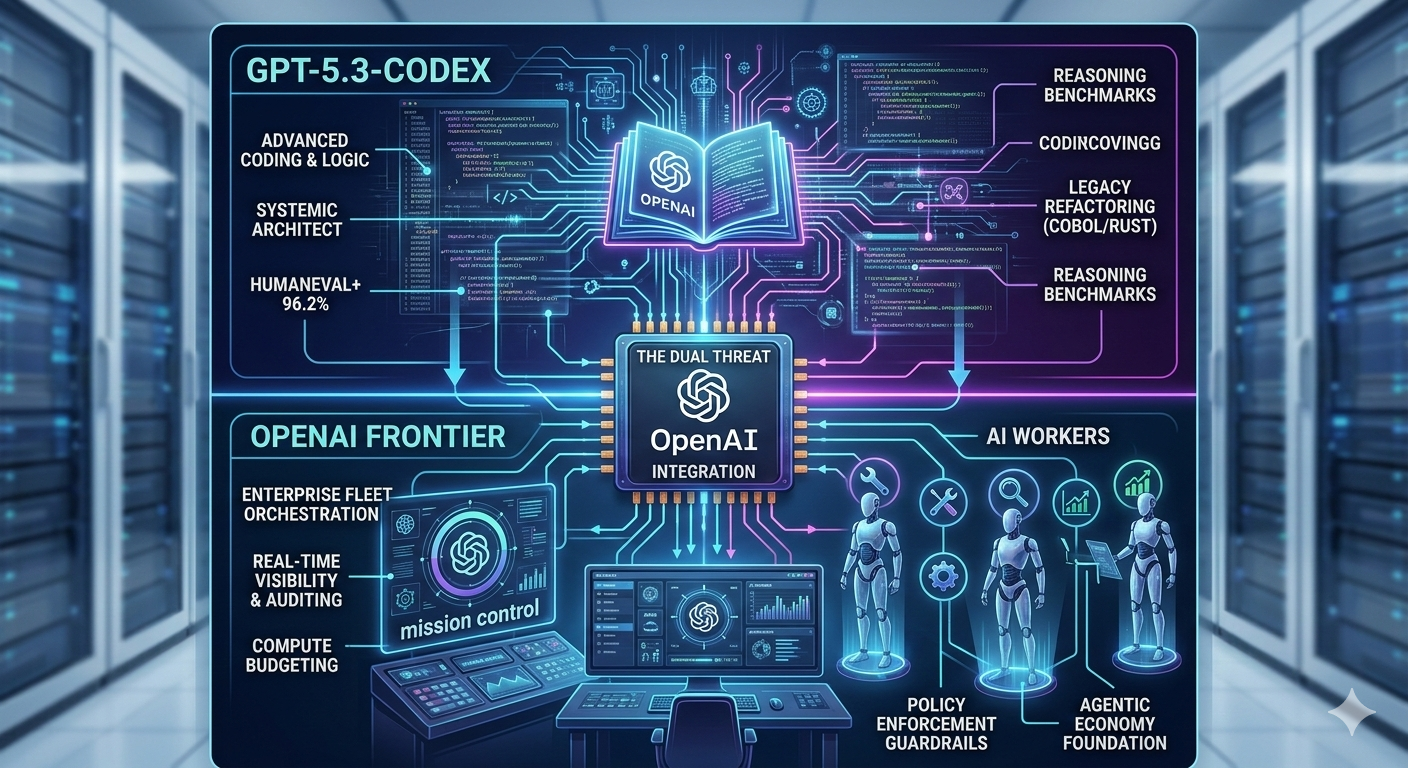
SAN FRANCISCO — February 18, 2026 — OpenAI today announced a massive expansion of its enterprise ecosystem with the simultaneous release of GPT-5.3-Codex, a groundbreaking specialized model for coding and logic, and OpenAI Frontier, a comprehensive platform designed to manage and monitor autonomous AI agents at an industrial scale.
This dual-pronged release signals OpenAI’s definitive shift from providing conversational interfaces to engineering the foundational infrastructure for the “agentic economy,” where AI “workers” increasingly handle complex, multi-step business processes.
GPT-5.3-Codex: Logic Redefined
While OpenAI’s flagship models are generalists, GPT-5.3-Codex is a hyper-specialist. Built upon the latest GPT-5 architecture, this model was trained on an unprecedented dataset of verified software repositories, mathematical proofs, and logical reasoning structures. The result is a system that isn’t just better at syntax, but fundamentally understands systemic logic.
Key Capabilities and Benchmarks
According to technical documentation released by OpenAI, GPT-5.3-Codex sets new records across key industry benchmarks:
-
HumanEval+ (Coding Proficiency): Scored an unprecedented 96.2%, up from the previous high of 88% seen in competitor models. This test requires solving complex novel coding problems.
-
LogicQC (Logical Reasoning): On OpenAI’s new proprietary benchmark for complex logical consistency in multi-step arguments, the model achieved 91.5% accuracy, showcasing a dramatic reduction in logical hallucinations.
-
Legacy Refactoring: The model features a proprietary specialized mode designed to ingest archaic codebases (COBOL, Fortran, legacy C++) and refactor them into modern, documented Python or Rust, maintaining 100% logical equivalence.
“GPT-5.3-Codex is not just a co-pilot; it’s an architect,” said Sam Altman, CEO of OpenAI. “It doesn’t just help you write the function; it understands how that function fits into the entire enterprise system architecture, from the database schema to the API endpoint security.”
OpenAI Frontier: The Enterprise Command Center
As organizations begin deploying dozens, or even thousands, of specialized AI agents—referred to as AI “workers”—they face a chaotic new challenge: management, visibility, and control.
OpenAI Frontier is the solution. It is a dedicated command platform (offered via API and a managed web console) that allows enterprises to orchestrate their fleet of OpenAI-powered agents, regardless of whether they are built on GPT-5.3-Codex, GPT-5, or specialized fine-tuned models.
Core Features of the Frontier Platform
-
Fleet Orchestration: Administrators can define high-level organizational goals and assign them to specific agent fleets. Frontier manages the workflow, dependencies, and communication between different agents.
-
Real-time Visibility & Auditing: The platform provides a live “mission control” dashboard. Every action, decision, API call, and reasoning step taken by an autonomous agent is logged, timestamped, and auditable, solving the “black box” problem of AI autonomy.
-
Compute Budgeting and Rate Limiting: Enterprises can set strict token and compute limits for individual agents or entire departments, preventing runaway costs from autonomous agents caught in logic loops.
-
Policy Enforcement (“Guardrails”): Frontier allows organization-wide safety and compliance policies to be injected into the agent fleet’s environment. For example, a policy can prevent any financial agent from approving transactions over $10,000 without human review.
“The defining bottleneck for AI adoption in 2026 isn’t the intelligence of the model; it’s the operational trust,” said Mira Murati, CTO of OpenAI. “Frontier is designed to give an organization’s CIO the same level of confidence in their AI workforce that they have in their human teams.”
The “SaaSpocalypse” View
The release of GPT-5.3-Codex and Frontier directly addresses the market shift identified earlier this month (as visualized in the ‘SaaSpocalypse’ concept). By combining a model capable of deep logic and refactoring (Opus 4.6 or GPT-5.3-Codex) with an orchestration platform (Frontier), organizations can automate complex workflows that previously required entire suites of SaaS tools.
For example, a marketing agent fleet managed via Frontier could use GPT-5.3-Codex to query internal databases, generate personalized campaigns, write and deploy the necessary HTML/CSS, and analyze the results—all with minimal human oversight.
Availability
GPT-5.3-Codex is available immediately through the OpenAI API to organizations on the Enterprise tier, with a wider developer rollout expected next month. OpenAI Frontier is currently entering a private beta with select Fortune 500 partners, with general availability scheduled for Q3 2026.
700 701 702 703 704 705 706 707 708 709 710 711 712 713 714 715 716 717 718 719 720 721 722 723 724 725 726 727 728 729 730 731 732 733 734 735 736 737 738 739 740 741 742 743 744 745 746 747 748 749 750 751 752 753 754 755 756 757 758 759 760 761 762 763 764 765 766 767 768 769 770 771 772 773 774 775 776 777 778 779 780 781 782 783 784 785 786 787 788 789 790 791 792 793 794 795 796 797 798 799 800 801 802 803 804 805 806 807 808 809 810 811 812 813 814 815 816 817 818 819 820 821 822