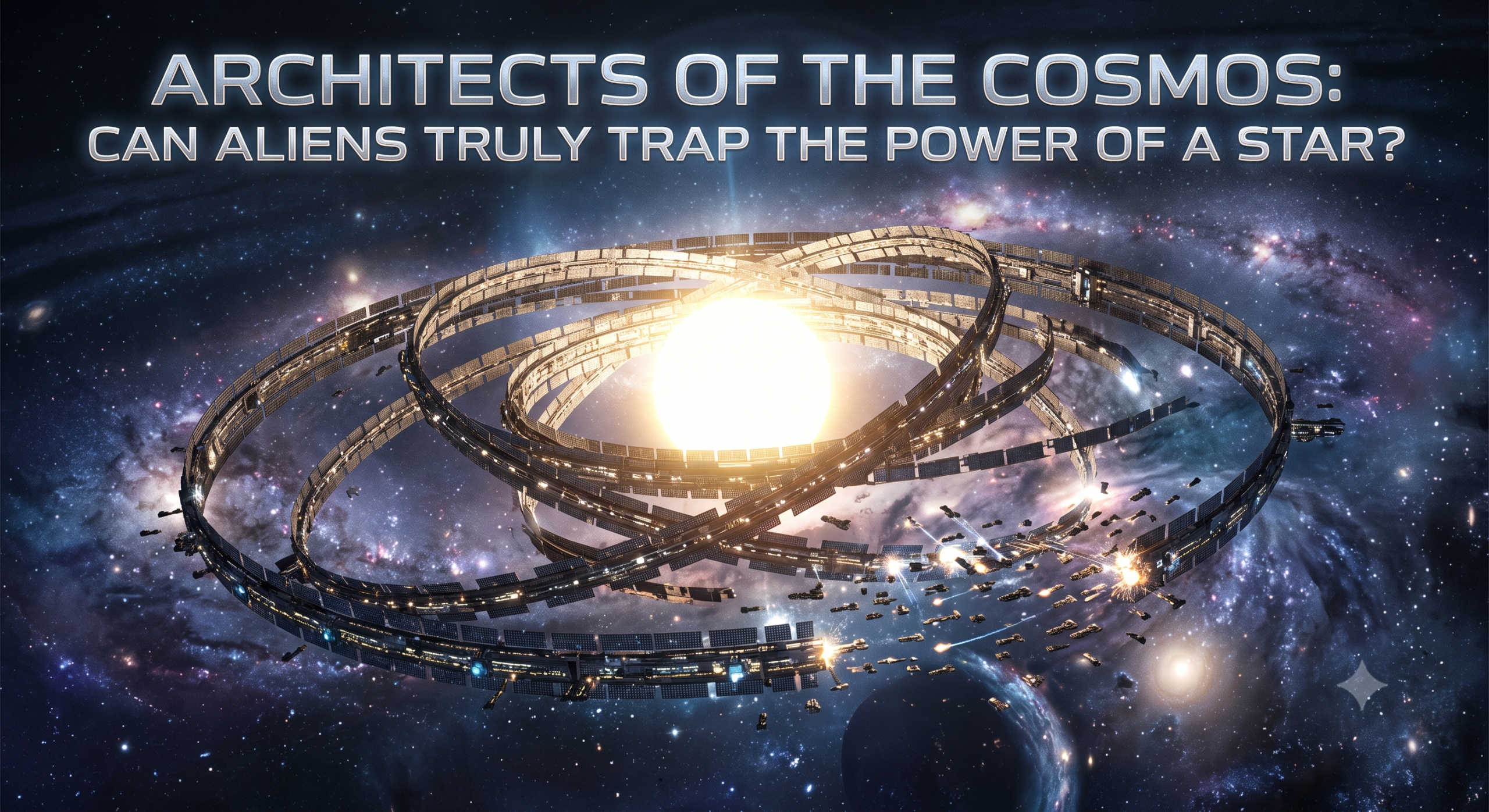
Every second, our Sun radiates a mind-boggling amount of energy into the empty void of space. Earth captures a mere fraction of a percent of this staggering bounty. For a burgeoning planet, it is plenty. But what happens when an advanced civilization outgrows its planetary cradle and faces an inescapable, roaring energy crisis?
According to the Kardashev scale—a method proposed by astrophysicist Nikolai Kardashev to measure a civilization’s level of technological advancement—the next logical step for a developing species is to become a Type II civilization. To achieve this status, a society must find a way to harvest 100% of its home star’s energy output.
Once relegated strictly to the pages of science fiction, the physics behind stellar megastructures are now the subject of serious academic workshops, machine-learning anomalies, and astrobiological debates. Could a sufficiently advanced alien civilization actually build these structures, and what would they look like?
The Classic Mega-Shell: The Dyson Sphere
The most famous megastructure concept is the Dyson sphere, popularized by physicist Freeman Dyson in 1960. In its most literal interpretation, a Dyson sphere is envisioned as a solid, unbroken shell of solar collectors entirely encasing a star to trap every single stray photon.
However, modern engineering analysis has proven that a solid, monolithic shell is a structural impossibility. A rigid shell would experience zero net gravitational pull from the star inside it (a quirk of the shell theorem), meaning the slightest nudge from an asteroid or internal solar flare would drift the shell into the star, causing a catastrophic cosmic collision. Furthermore, no material known to science could withstand the immense tensile stress required to keep such a structure intact.
Because of this, modern scientists point to a more practical cousin: the Dyson Swarm. Instead of a solid sphere, a civilization would deploy billions of independent, ultra-thin solar-collecting satellites, mirrors, and habitats orbiting the star in dense, interlocking nets.
The Klemperer Rosette: The Ultimate Geometric System
If a civilization wants to skip building a swarm of a billion independent satellites and prefers a highly organized, geometric solar system, they might look to a peculiar loophole in orbital mechanics: the Klemperer Rosette.
First described by physicist Wolfgang Klemperer in 1962, a Klemperer Rosette is a highly complex gravitational system where an even number of equal masses are arranged in a perfectly symmetrical, repeating polygonal pattern around a common center of mass.
In a sci-fi dream scenario, an advanced civilization could arrange a series of alternating planets and massive artificial space stations (or “computronium nodes” meant for immense AI processing) to orbit in a stable, repeating geometric ring.
By placing solar-harvesting mega-stations at precise Lagrangian points (gravitational sweet spots) relative to one another, the civilization creates a beautifully balanced, self-contained orbital dance. This allows them to maximize the surface area catching the star’s light without worrying about orbits crossing or satellites crashing into one another.
The Catch: Instability and the “Dismantling” Problem
As breathtaking as these megastructures sound, the cosmic blueprint has two glaring problems: material scarcity and physics.
First, to build even a basic Dyson Swarm or a series of orbital rings around a star like our Sun, you would need an unfathomable amount of matter. Freeman Dyson famously calculated that to harvest the Sun effectively, a civilization would have to completely break apart and dismantle a planet the size of Jupiter to use its raw elements for solar panels.
Second, the Klemperer Rosette is notoriously unstable. While it works perfectly on paper as an idealized mathematical model, the real universe is messy. The slightest gravitational pull from a passing comet or a minor solar flare would disrupt the delicate symmetry. Without active thrusters, massive artificial stabilizing engines, or advanced AI constantly making micro-adjustments, the entire rosette would quickly collapse into chaotic, destructive orbits.
Hunting for the Infrared Glow
Despite the immense engineering hurdles, astronomers are actively looking for these structures. Because of the laws of thermodynamics, any structure absorbing massive amounts of starlight must eventually shed that energy as waste heat. This means a star enclosed by a Dyson sphere wouldn’t look bright to our eyes; instead, it would glow brightly in the mid-infrared spectrum.
In recent years, specialized sky surveys and programs like Project Hephaistos have utilized machine learning to sift through astronomical data, identifying several “candidate stars” that exhibit an unusually heavy infrared signature. While these are most likely natural phenomena—such as a star choked by its own dust clouds—the search continues.
Ultimately, whether through billions of swarming satellites or perfectly balanced gravitational rosettes, cosmic megastructures represent the peak of technological ambition. If we ever point our telescopes at the night sky and find a star blinking in a precise infrared rhythm, we will know that someone out there successfully mastered the art of stellar engineering.
For a deeper dive into how scientists model these massive cosmic architectures, you can watch Klemperer Rosette Planetary Megastructures Explained, which provides an animated look at how multiple planets can be forced into perfectly balanced, repeating orbital rings.
1 2 3 4 5 6 7 8 9 10 11 12 13 14 15 16 17 18 19 20 21 22 23 24 25 26 27 28 29 30 31 32 33 34 35 36 37 38
700 701 702 703 704 705 706 707 708 709 710 711 712 713 714 715 716 717 718 719 720 721 722 723 724 725 726 727 728 729 730 731 732 733 734 735 736 737 738 739 740 741 742 743 744 745 746 747 748 749 750 751 752 753 754 755 756 757 758 759 760 761 762 763 764 765 766 767 768 769 770 771 772 773 774 775 776 777 778 779 780 781 782 783 784 785 786 787 788 789 790 791 792 793 794 795 796 797 798 799 800 801 802 803 804 805 806 807 808 809 810 811 812 813 814 815 816 817 818 819 820 821 822