When an enormous star runs out of nuclear fuel, it collapses under its own crushing gravity in a violent supernova explosion. If the star isn’t quite massive enough to form a black hole, it leaves behind a neutron star—a stellar corpse squeezed into a sphere only about 10 miles across. The density of these objects is nearly incomprehensible: a single sugar-cube-sized piece of neutron star material would weigh as much as Mount Everest.
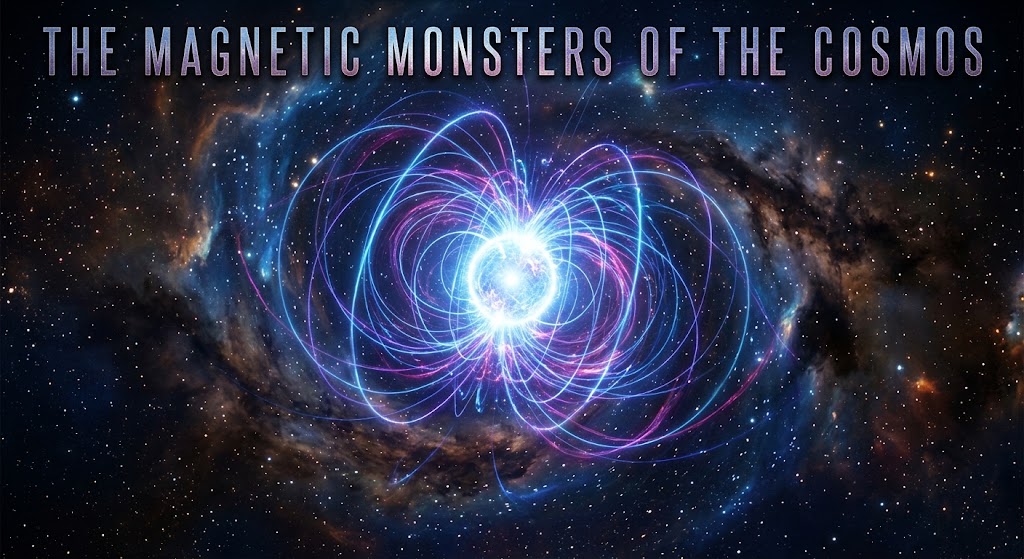
While all neutron stars are extreme, a rare subset known as magnetars represents the absolute pinnacle of cosmic magnetism. Born from stars that already possessed strong magnetic fields, a collapsing magnetar amplifies this force to unimaginable levels. They are protected by magnetic fields so powerful that if one were placed halfway to the Moon, it could instantly wipe every credit card on Earth—or, if one were just hundreds of miles away, its magnetic field would literally tear the atoms of your body apart.
The Engine Behind Superluminous Supernovae
For over 16 years, theoretical astrophysicists hypothesized that magnetars were the hidden engines powering “superluminous supernovae”—stellar explosions that shine up to ten times brighter than normal and last significantly longer. However, seeing through the dense, expanding debris of a supernova to find the central engine proved incredibly difficult.
In 2026, astronomers finally found the “smoking gun.” While observing a distant explosion dubbed SN 2024afav, researchers noticed something strange. Instead of the supernova’s light fading smoothly, it began to oscillate, with the time between each fluctuation growing shorter. Astronomers compared this accelerating pattern to the chirp of a bird.
This “chirping” light curve provided the first definitive evidence of a magnetar’s birth. The newborn magnetar was spinning at an astonishing 238 times per second, dragging the very fabric of spacetime around with it. According to the laws of general relativity, this intense frame-dragging caused a misaligned disk of surrounding matter to violently wobble (a phenomenon known as Lense-Thirring precession). As the wobbling disk occasionally blocked and reflected the magnetar’s light, it created the distinctive chirping signal, pulling back the curtain on an engine possessing a magnetic field roughly 300 trillion times stronger than Earth’s.
Bending Empty Space
Beyond powering colossal explosions, these magnetic monsters are providing scientists with a cosmic laboratory to test quantum physics in ways that are impossible on Earth.
In August 2026, researchers studying a magnetar known as 1E 1547 discovered evidence of an effect predicted by physicist Werner Heisenberg nearly 90 years ago. According to quantum mechanics, empty space is never truly empty; it is boiling with “virtual particles” that pop in and out of existence. Heisenberg theorized that an extraordinarily strong magnetic field could align these virtual particles, causing the vacuum of space itself to act like a prism and alter the way light travels through it—a phenomenon called vacuum birefringence.
By tracking the radio waves and X-rays emitted from 1E 1547, astronomers detected that the orientation of the light’s oscillations had been altered by the vacuum surrounding the star. Confirming vacuum birefringence means that magnetars are not just extreme celestial oddities; they are fundamentally warping the space and light around them, proving that the universe’s most violent stellar corpses still have profound secrets to share.
700 701 702 703 704 705 706 707 708 709 710 711 712 713 714 715 716 717 718 719 720 721 722 723 724 725 726 727 728 729 730 731 732 733 734 735 736 737 738 739 740 741 742 743 744 745 746 747 748 749 750 751 752 753 754 755 756 757 758 759 760 761 762 763 764 765 766 767 768 769 770 771 772 773 774 775 776 777 778 779 780 781 782 783 784 785 786 787 788 789 790 791 792 793 794 795 796 797 798 799 800 801 802 803 804 805 806 807 808 809 810 811 812 813 814 815 816 817 818 819 820 821 822