For decades, the limiting factor in space exploration has been the tyranny of the rocket equation: to go further and faster, spacecraft must carry massive amounts of heavy fuel, which in turn requires even more fuel just to lift off the launchpad. But what if a spacecraft didn’t need to carry propellant at all?
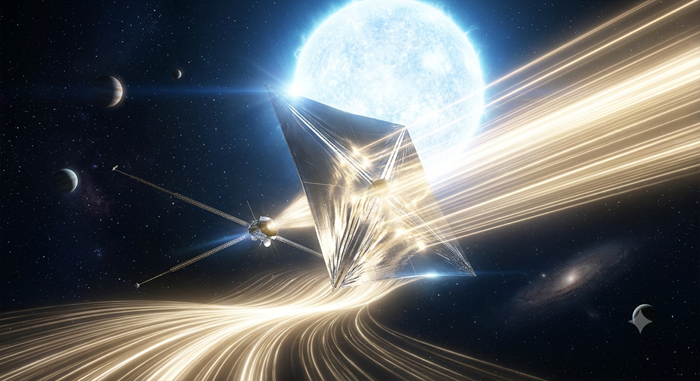
A revolutionary propulsion technology is rapidly maturing, allowing humanity to surf through the cosmos using nothing but the unending push of sunlight. Known as solar sail propulsion, this method eliminates chemical rockets entirely, relying instead on the bizarre quantum physics of light.
The Physics of Photonic Pressure
At first glance, solar sailing seems counterintuitive. How can light, which has no mass, push a physical object?
The answer lies in the dual nature of light. While photons are fundamentally massless, they do possess momentum. According to the laws of quantum mechanics and relativity, the momentum ($p$) of a photon is directly related to its energy ($E$) and the speed of light ($c$):
When a stream of photons strikes a highly reflective, mirror-like surface, the photons bounce off. This reflection transfers momentum from the light to the sail, exerting a microscopic but tangible physical push on the spacecraft.
The Power of the Nudge: The initial acceleration provided by solar radiation pressure is incredibly small. However, in the frictionless vacuum of space, this thrust is continuous. Over days, months, and years, this constant microscopic push accumulates, eventually allowing a solar sail spacecraft to reach blistering speeds that would be impossible for conventional chemical rockets.
Recent Milestones in Fuel-Free Flight
The concept of solar sailing has moved from science fiction to operational reality, driven by recent breakthroughs in materials science:
-
IKAROS and LightSail 2: Japan’s IKAROS, launched in 2010, was the first spacecraft to successfully demonstrate solar sail propulsion in flight. In 2019, The Planetary Society’s LightSail 2 proved that a small CubeSat could use sunlight alone to actively change its orbit around Earth.
-
NASA’s ACS3 Mission: Launched in April 2024, NASA’s Advanced Composite Solar Sail System (ACS3) successfully deployed an 80-square-meter sail from low Earth orbit. The mission tested revolutionary new composite booms made from flexible polymers reinforced with carbon fiber, which are lighter and more rigid than traditional metallic booms.
-
Scaling Up for Deep Space: The technology is currently scaling to unprecedented sizes. In April 2026, NASA awarded a $10.2 million contract to Opterus to engineer the deployment system for an enormous 1,600-square-meter solar sail—roughly the size of a hockey rink. Scheduled for delivery in early 2028, this massive sail will utilize 30-meter composite booms to maintain stable radiation pressure and propulsion.
The Future of the Cosmic Sea
Because they are not limited by consumable propellants, solar sails have an essentially infinite operating lifetime. They are restricted only by the eventual degradation of their synthetic materials in the harsh radiation environment of space.
This longevity unlocks entirely new mission architectures. Solar sails could power space weather early warning satellites, maneuverable near-Earth asteroid reconnaissance probes, or communication relays for future crewed exploration missions.
Looking further ahead, solar sails are currently our most viable technology for true interstellar travel. By replacing the Sun with massive, Earth-based high-energy laser arrays directed at ultra-thin sails, humanity could potentially accelerate micro-probes to a significant fraction of the speed of light, reaching neighboring star systems within a human lifetime.
We are finally learning to sail the cosmic sea, leaving the heavy fuel tanks behind and riding the light.
700 701 702 703 704 705 706 707 708 709 710 711 712 713 714 715 716 717 718 719 720 721 722 723 724 725 726 727 728 729 730 731 732 733 734 735 736 737 738 739 740 741 742 743 744 745 746 747 748 749 750 751 752 753 754 755 756 757 758 759 760 761 762 763 764 765 766 767 768 769 770 771 772 773 774 775 776 777 778 779 780 781 782 783 784 785 786 787 788 789 790 791 792 793 794 795 796 797 798 799 800 801 802 803 804 805 806 807 808 809 810 811 812 813 814 815 816 817 818 819 820 821 822