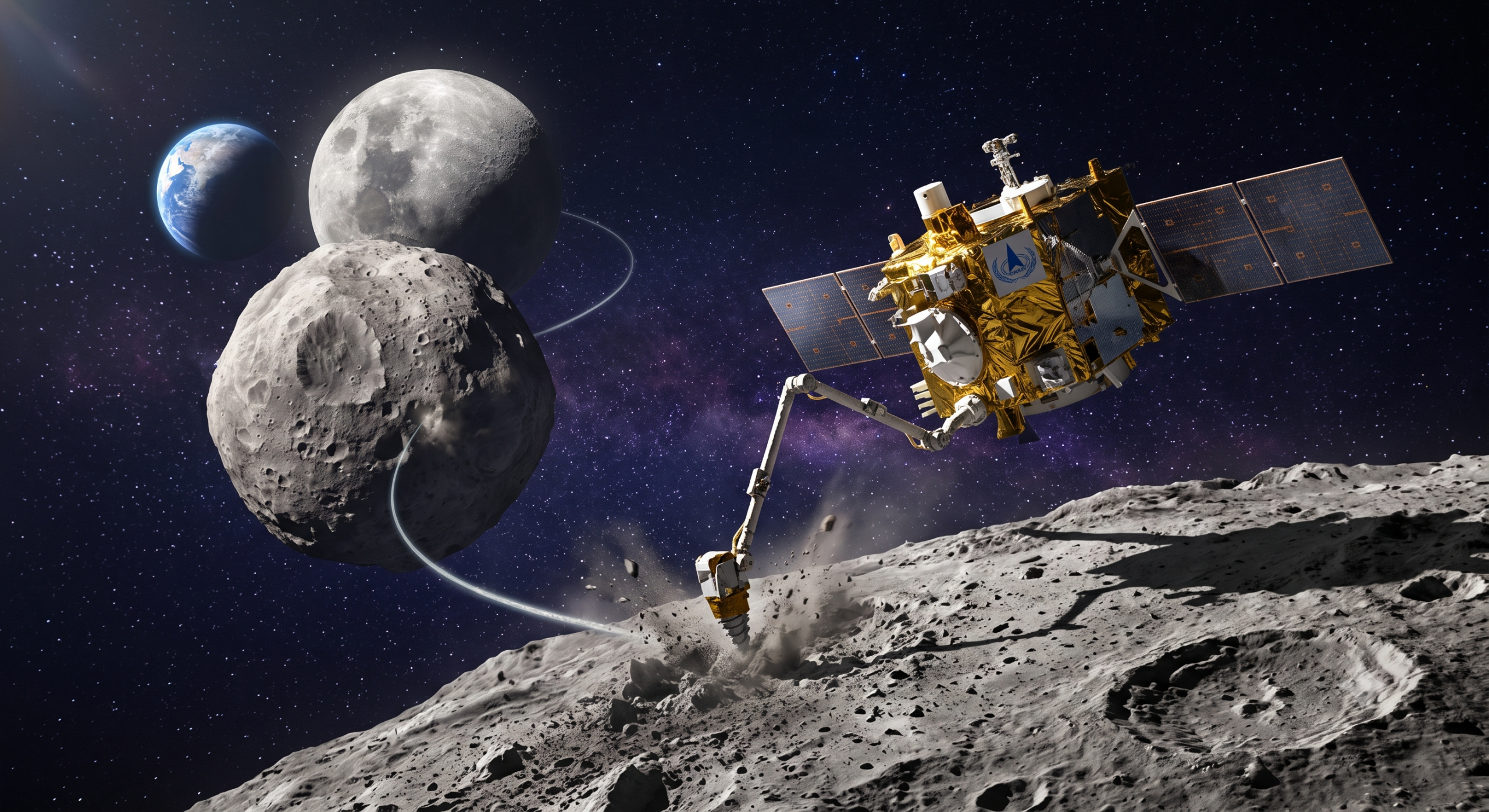
The China National Space Administration is advancing into the critical phase of its premier asteroid exploration initiative. The robotic Tianwen-2 spacecraft has successfully completed its long transit through deep space and has rendezvoused with its target, a unique near-Earth object known as Kamoʻoalewa. This celestial body is classified as a quasi-satellite because it loops along a path that closely synchronizes with Earth’s orbit around the Sun.
What makes this multi-year cosmic journey extraordinary is the suspected lineage of the target rock. Astrophysicists strongly believe that Kamoʻoalewa is not a standard asteroid originating from the main belt, but rather an ancient, long-lost fragment blasted off our own Moon during a violent meteoroid impact millions of years ago. By sampling its surface, Tianwen-2 could deliver the first physical evidence confirming a direct link between this drifting object and lunar history.
Navigating a Fast-Spinning Target
Having approached within a close range of 20 kilometers, Tianwen-2 is using its suite of onboard cameras, spectrometers, and radar sounders to map the alien terrain. These instruments are analyzing the asteroid’s topography to find an optimal descent location for a historic sampling attempt.
The operation presents serious technical hurdles for mission planners. Kamoʻoalewa is roughly the size of a Ferris wheel and rotates rapidly on its axis, completing a full turn approximately every 28 minutes. This high-speed rotation means the spacecraft must carefully match the object’s spin while dealing with negligible gravitational pull.
To secure its cargo, Tianwen-2 features two distinct sampling mechanisms depending on what the mapping data reveals about the surface structure:
-
Touch-and-Go: If Kamoʻoalewa is revealed to be a loosely consolidated rubble pile, the probe will briefly hover and extend a robotic arm to scoop up topsoil.
-
Anchor-and-Attach: If the surface proves to be solid rock, the spacecraft will execute a first-of-its-kind landing maneuver, drilling directly into the substrate while anchored firmly to the asteroid.
The Long Journey Home
The collection window aims to secure up to 100 grams of pristine regolith material. Once the retrieval phase concludes, the spacecraft will enter a waiting trajectory before initiating its return flight back toward Earth. The mission plan dictates that a dedicated return capsule carrying the precious lunar-relic cargo will detach and plunge through Earth’s atmosphere for a safe recovery in late 2027.
Meanwhile, the main Tianwen-2 mothership will not rest. Utilizing an efficient solar electric propulsion network, the primary probe will redirect itself out into the wider solar system, charting a course toward a secondary target, the main-belt comet 311P/PanSTARRS, which it is scheduled to intercept in 2035.
To learn more about the deep-space navigation and engineering challenges behind this mission, watch Tianwen-2: China closes in on Kamoʻoalewa, which details how the spacecraft will attempt to hover and snatch samples from this fast-spinning world.
700 701 702 703 704 705 706 707 708 709 710 711 712 713 714 715 716 717 718 719 720 721 722 723 724 725 726 727 728 729 730 731 732 733 734 735 736 737 738 739 740 741 742 743 744 745 746 747 748 749 750 751 752 753 754 755 756 757 758 759 760 761 762 763 764 765 766 767 768 769 770 771 772 773 774 775 776 777 778 779 780 781 782 783 784 785 786 787 788 789 790 791 792 793 794 795 796 797 798 799 800 801 802 803 804 805 806 807 808 809 810 811 812 813 814 815 816 817 818 819 820 821 822