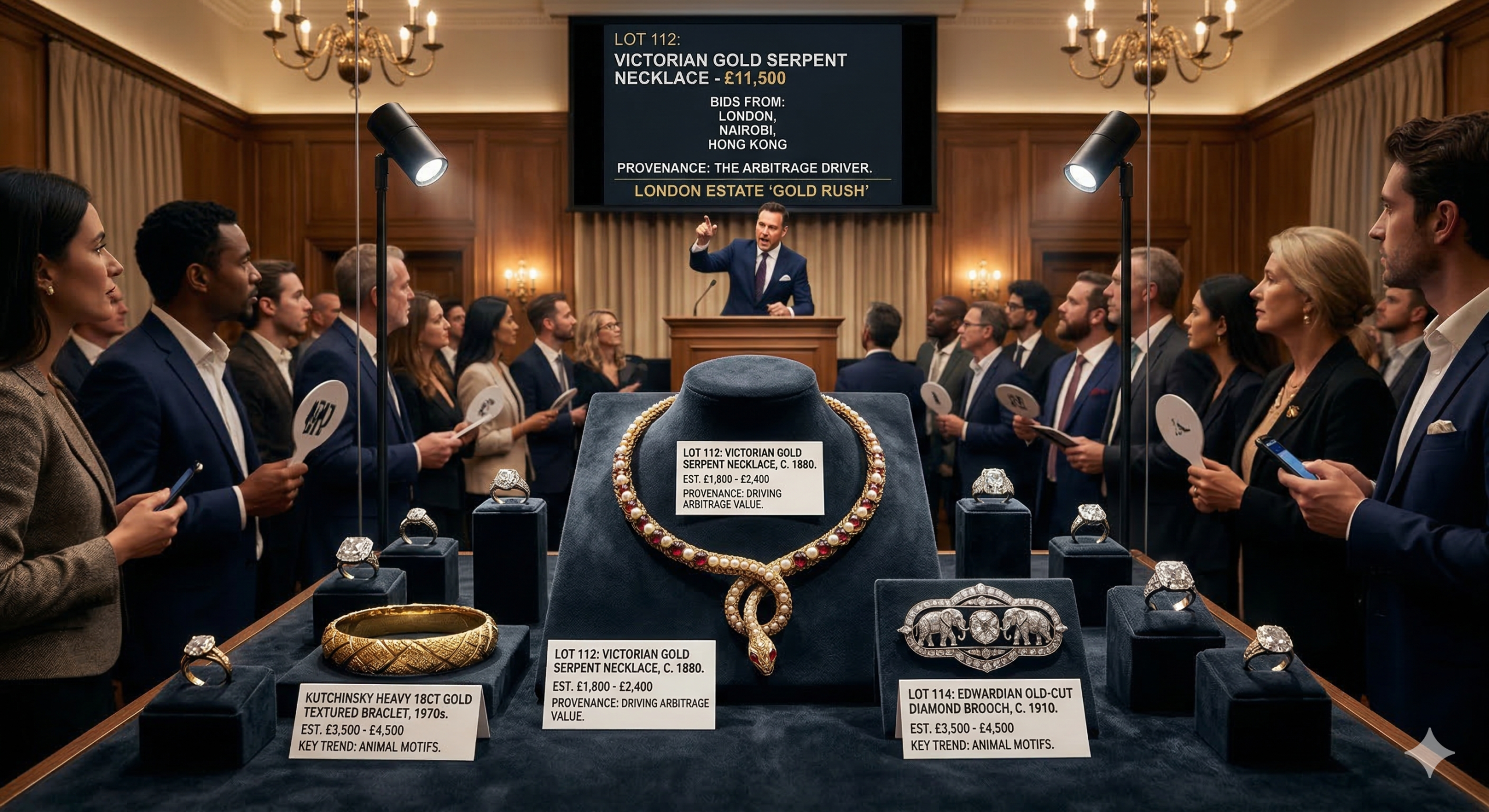
LONDON — March 19, 2026 — As global markets seek stability in “hard assets,” the London estate jewelry scene has transformed into a high-yield frontier for international entrepreneurs. For those moving goods between the UK and emerging luxury hubs like Kenya, the current auction landscape offers a rare “arbitrage” opportunity: sourcing historically significant, hallmarked British pieces at local auctions and placing them in high-demand secondary markets where “provenance” is the new currency.
Data from March 2026 sales at houses like Elmwood’s, Roseberys, and Dawsons reveals that the smartest money isn’t chasing new diamonds, but rather “signed” gold and era-specific motifs that cannot be easily replicated.
The “Big Three” High-Margin Trends for 2026
1. The Brooch Renaissance & Animal Motifs
The “statement brooch” has made a thunderous return to the Paris and London catwalks.
-
The Trend: Edwardian animal motifs—specifically elephants, serpents, and birds—are seeing a vibrant renaissance.
-
The Margin: On March 18, an early Victorian gold garnet serpent necklace hammered at a significant premium, while Edwardian gem-set elephant brooches are consistently outperforming their estimates by 40%.
-
Resale Tip: These pieces carry deep symbolic meaning (wisdom, resilience) that resonates strongly with the luxury safari aesthetic in East Africa.
2. “Heavy Gold” & Architectural Signatures
With gold prices reaching new heights in early 2026, collectors are moving away from delicate minimalism toward sculptural, heavy 18ct gold.
-
The Target: Mid-20th-century “textured” gold from houses like Kutchinsky and Boucheron.
-
The Logic: Pieces from the 1970s and 80s were created during eras of lower labor costs. Recreating these hand-engraved, substantial pieces today would be cost-prohibitive, giving vintage stock an “intrinsic value” floor.
3. Old-Cut Diamonds: Character Over Clarity
The market is shifting away from “clinically uniform” modern stones toward Old European and Old Mine cut diamonds.
-
The Appeal: These stones were shaped by hand to shimmer in candlelight, offering a warmer, more romantic glow.
-
The Opportunity: Often found in “unattributed” estate lots at smaller UK auctions, these stones can be sourced at a fraction of the price of modern “Triple Excellent” diamonds but command high prices in boutique Nairobi galleries as “one-of-a-kind” heritage pieces.
Strategy: Sourcing the London Market
For your current business model—sourcing high-quality second-hand goods for the Kenyan market—integrating a “Jewelry & Small Luxury” vertical offers significantly higher margins per kilogram than clothing alone.
| Recommended Auction House | Specialty for 2026 | Next Key Date |
| Elmwood’s (Notting Hill) | High-end “Disruptor” (0% Seller Fees) | March 25 (Fine Jewellery) |
| Roseberys (London) | Early 20th Century & Designer Signed | Quarterly Fine Sales |
| Fellows (London/Brim.) | Loose Gemstones & Unmounted Diamonds | April 16-17 |
| Dawsons | Bespoke International Marketing / Provenance | April 23 |
The “Digital Passport” Advantage
The most successful resellers in 2026 are using Physical AI to bridge the trust gap. By providing a digital audit trail—linking a London auction receipt to a blockchain-backed “authenticity certificate”—you can justify a 3x to 5x markup in the Kenyan market.
“In 2026, you aren’t just selling a ring; you are selling the certainty that it was once worn in a London ballroom,” noted a lead specialist at Sotheby’s. “Provenance is the ultimate price driver.”
1 2 3 4 5 6 7 8 9 10 11 12 13 14 15 16 17 18 19 20 21 22 23 24 25 26 27 28 29 30 31 32 33 34 35 36 37 38
700 701 702 703 704 705 706 707 708 709 710 711 712 713 714 715 716 717 718 719 720 721 722 723 724 725 726 727 728 729 730 731 732 733 734 735 736 737 738 739 740 741 742 743 744 745 746 747 748 749 750 751 752 753 754 755 756 757 758 759 760 761 762 763 764 765 766 767 768 769 770 771 772 773 774 775 776 777 778 779 780 781 782 783 784 785 786 787 788 789 790 791 792 793 794 795 796 797 798 799 800 801 802 803 804 805 806 807 808 809 810 811 812 813 814 815 816 817 818 819 820 821 822