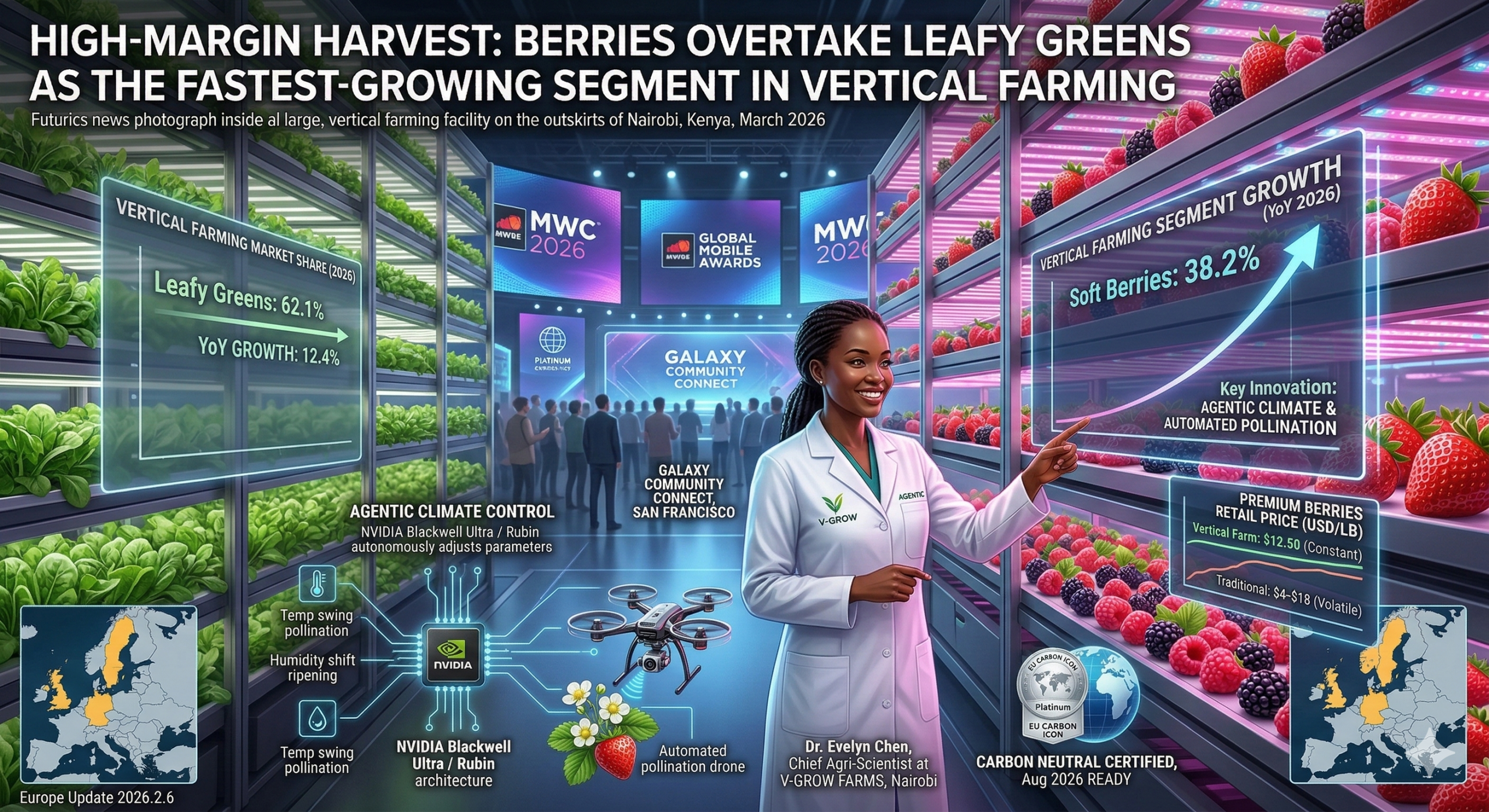
NAIROBI / SAN FRANCISCO — March 8, 2026 — While the massive warehouses growing baby spinach and arugula still dominate the vertical farming industry by total volume, the financial terrain of indoor agriculture has decisively shifted this year. According to multiple market reports released in March 2026, berries—particularly strawberries, raspberries, and blackberries—have become the fastest-growing segment in the AgTech sector, as operators chase high-margin stability over low-margin bulk.
The transition from “Leaf to Fruit” is being accelerated by breakthroughs in “Agentic Climate Control,” a direct spinoff from the advanced NVIDIA systems (such as the Blackwell Ultra and the emerging Rubin architectures) we have been tracking in the AI hardware race.
The “Agentic” Berry: Precise Climate as the Missing Link
For years, the “Berry Problem” stumped indoor farming engineers. Unlike leafy greens, which thrive in relatively straightforward environments, fruiting plants require a complex, multi-stage, seasonal climate to produce sweet, viable, high-quality fruit.
“A spinach leaf just needs light and nutrient water to grow,” explains Dr. Evelyn Chen, Chief Agri-Scientist at V-Grow Farms in Nairobi, a pioneer in high-altitude agentic farming. “A strawberry requires distinct temperature swings, specific humidity shifts during pollination, and a delicate nutrient cocktail during ripening. If any of these are slightly off, the fruit is bitter or doesn’t form at all.”
The 2026 breakthroughs in “Agentic Climate Control” allow V-Grow’s facility to recursively analyze thousands of sensor points (light, air flow, root temperature) across the 12-week berry cycle, making microscopic adjustments to the environment in real-time without human intervention. This has effectively “automated the season,” allowing vertical farms to mimic late-spring environments in March, or early-autumn environments in November, at will.
[Image showing a close-up of a perfectly formed, vibrant red indoor strawberry at V-Grow Farms in Nairobi. A 360-degree LiDAR array and a miniature automated pollinator drone are visible, illustrating the precision needed to automate the seasonal requirements for soft fruit.]
Market Dynamics: Margins vs. Market Share
While leafy greens still command approximately 62% of the total vertical farming market share by revenue, their growth has plateaued at roughly 12% annually as the market becomes saturated and pricing competition with traditional outdoor farming intensifies.
Berries, by contrast, are growing at a 38% compound annual growth rate in 2026. This growth is driven by economics, not volume:
-
High Margin Stability: Premium indoor berries can retail for 4–6 times the price of leafy greens per pound. More importantly, indoor farms can offer consistent pricing and quality 365 days a year, eliminating the price volatility and quality degradation seen in shipped soft fruit.
-
Localization and Shelf Life: In regions like East Africa, the ability to harvest premium berries in Nairobi and deliver them to stores in under four hours—rather than importing them from Europe or South Africa—has created an immediate and lucrative local market with a 98% sell-through rate.
Vertical Farming Market Share vs. Growth (March 2026)
| Segment | Market Share (2026) | Growth Rate (YoY) | Key 2026 Innovation |
| Leafy Greens | 62.1% | 12.4% | Optimized LED Recipes (Value Engineering) |
| Soft Berries | 19.8% | 38.2% | Agentic Climate & Automated Pollination |
| Herbs & Microgreens | 11.4% | 15.1% | Regional Supply Chain Integration |
| Other (Fruiting Veg/Mushrooms) | 6.7% | 22.9% | Specialized Hybrid Substrates |
Kenya’s Role: The High-Altitude “Agentic” Hub
Kenya is emerging as a critical hub for high-margin AgTech in 2026. V-Grow Farms in Nairobi is utilizing Kenya’s natural advantage—high altitude and strong sunlight—to supplement the energy requirements of their fully indoor, climate-controlled environments.
“V-Grow is not just a farm; it’s an ‘Agentic Optimization’ partner,” says Michele Catasta, a leading investor in African AI infrastructure. “By combining Kenya’s ideal growing environment with the precise automation previously only available in Western labs, they are proving that high-margin, sustainable AgTech is a global solution, not just a Silicon Valley one.”
A Sustainable Sweet Spot: EU Carbon Icon Ready
A critical differentiator for V-Grow’s local berries is their pre-compliance status with the forthcoming EU Carbon Icon Standard, set for August. By eliminating long-haul refrigeration and utilizing waste heat optimization from adjacent data centers, V-Grow anticipates receiving a “Platinum” level Carbon Neutral certification, allowing them to monetize their land-use efficiency and verifiable carbon reductions with full transparency to European buyers.
1 2 3 4 5 6 7 8 9 10 11 12 13 14 15 16 17 18 19 20 21 22 23 24 25 26 27 28 29 30 31 32 33 34 35 36 37 38
700 701 702 703 704 705 706 707 708 709 710 711 712 713 714 715 716 717 718 719 720 721 722 723 724 725 726 727 728 729 730 731 732 733 734 735 736 737 738 739 740 741 742 743 744 745 746 747 748 749 750 751 752 753 754 755 756 757 758 759 760 761 762 763 764 765 766 767 768 769 770 771 772 773 774 775 776 777 778 779 780 781 782 783 784 785 786 787 788 789 790 791 792 793 794 795 796 797 798 799 800 801 802 803 804 805 806 807 808 809 810 811 812 813 814 815 816 817 818 819 820 821 822