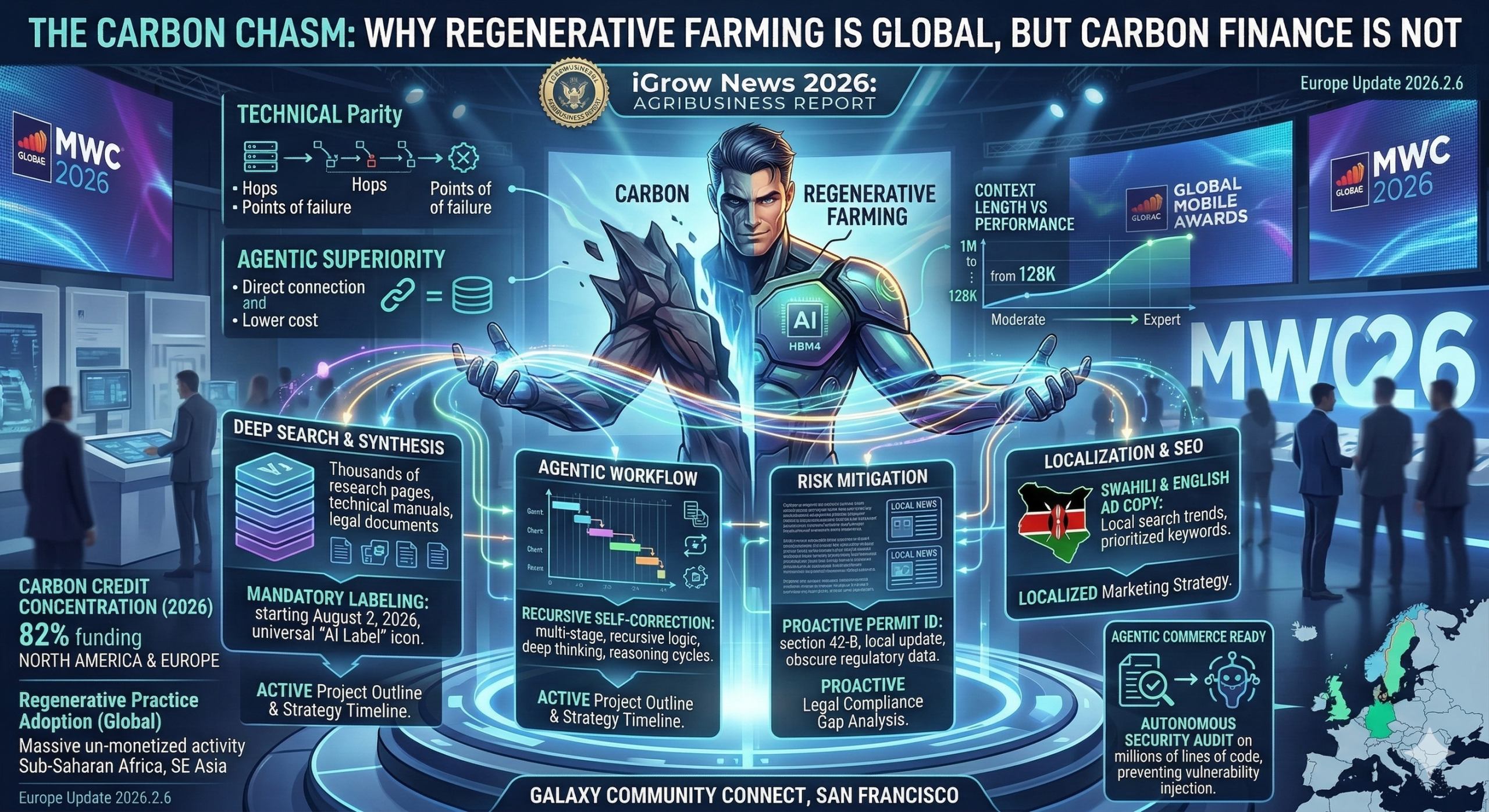
INDIANAPOLIS / NAIROBI — March 8, 2026 — A defining structural rift has emerged in the global effort to decarbonize the food system. According to the iGrow News 2026 AgriBusiness Report, while regenerative practices like cover cropping and no-till are being adopted at a record pace globally, the financial infrastructure to monetize these efforts—the agricultural carbon market—is failing to cross borders.
The data reveals a “geographical selective” reality: although smallholders in Africa and Asia are rapidly shifting toward soil-restoration techniques to combat yield volatility and rising fertilizer costs, they remain effectively “locked out” of the multi-billion dollar carbon credit market.
The “Exclusion by Architecture”
The report identifies MRV (Measurement, Reporting, and Verification) costs as the primary barrier. For a farmer in the U.S. Midwest or Europe, the digital infrastructure—ranging from satellite imagery to automated soil sensors—is often baked into their existing equipment or supported by corporate supply chain pilots.
For smallholders in the Global South, the math is different:
-
High Verification Ratios: In many cases, the cost of proving a ton of carbon has been sequestered is higher than the current market price of the credit itself ($4–$27 per tCO₂e).
-
Structural Mismatch: Carbon markets were built for “plantation-style” methodologies—large, contiguous plots with long-term lock-ins. They struggle to account for the seasonal, highly varied, and fragmented nature of smallholder farming.
-
The “LillyPod” Contrast: While companies like Eli Lilly use B300-powered supercomputers to simulate molecular biology, African farmers are often managing complex, multi-crop systems that current AI-driven carbon models simply aren’t trained to understand.
[Image showing the “Global Carbon Credit Concentration” heat map for 2026. 82% of all agricultural carbon funding is centered in North America and Europe, while a secondary map of “Regenerative Practice Adoption” shows massive, un-monetized activity across Sub-Saharan Africa and Southeast Asia.]
Kenya’s Sovereign Standoff: The KOKO Precedent
The crisis of confidence in African carbon markets hit a peak this month with the closure of KOKO Networks‘ carbon-linked clean cooking operations in Kenya. The project failed to obtain a “Letter of Authorisation” under Article 6.2 of the Paris Agreement, a required sovereign sign-off to transfer credits internationally.
This “sequencing gap”—where private capital is ready to flow but regulatory bottlenecks prevent monetization—is a major red flag for soil carbon projects across the continent. Without “Corresponding Adjustments” from the host government to avoid double-counting, these credits are increasingly viewed as “low-integrity” by global buyers, driving prices down for the very farmers who need them most.
2026 Market Tiers: Quality vs. Volume
As the voluntary carbon market matures toward a projected €15 billion by 2035, it is splitting into two distinct tiers:
-
High-Integrity Removals: Credits with robust “ground truth” data (direct soil sampling analyzed in labs) are commanding premiums of 300% over lower-quality alternatives.
-
The Smallholder Gap: Credits from small-scale regenerative projects often lack this level of precision, leaving them in the “low-value” tier where the revenue is insufficient to bridge the 3-5 year “transition period” where yields temporarily dip.
Regional Investment Logic (March 2026)
| Region | Driver of Adoption | Primary Funding Source | Carbon Market Access |
| North America | Corporate Scope 3 Goals | Private Equity / Corporate | Mature & Integrated |
| European Union | Regulatory Compliance | Policy Grants / Compliance Markets | Standardized & Mandatory |
| Africa / Asia | Resilience & Soil Health | Public / Blended Finance | Fragmented & Pilot-Stage |
Bridging the Chasm: The Path to 2027
The iGrow report concludes that if carbon markets are to survive as a global tool, they must move away from “plot-level precision” and toward “Institutional Aggregation.” This involves using regional cooperatives and “digital twins” of agricultural landscapes to verify outcomes at scale, rather than auditing every individual acre. The Union Budget 2026 discussions in India and new climate-finance pilots in Kenya are currently testing these “Landscape-Level” credits, which could finally allow smallholders to be paid for the dark-matter carbon they are already sequestering.
1 2 3 4 5 6 7 8 9 10 11 12 13 14 15 16 17 18 19 20 21 22 23 24 25 26 27 28 29 30 31 32 33 34 35 36 37 38
700 701 702 703 704 705 706 707 708 709 710 711 712 713 714 715 716 717 718 719 720 721 722 723 724 725 726 727 728 729 730 731 732 733 734 735 736 737 738 739 740 741 742 743 744 745 746 747 748 749 750 751 752 753 754 755 756 757 758 759 760 761 762 763 764 765 766 767 768 769 770 771 772 773 774 775 776 777 778 779 780 781 782 783 784 785 786 787 788 789 790 791 792 793 794 795 796 797 798 799 800 801 802 803 804 805 806 807 808 809 810 811 812 813 814 815 816 817 818 819 820 821 822