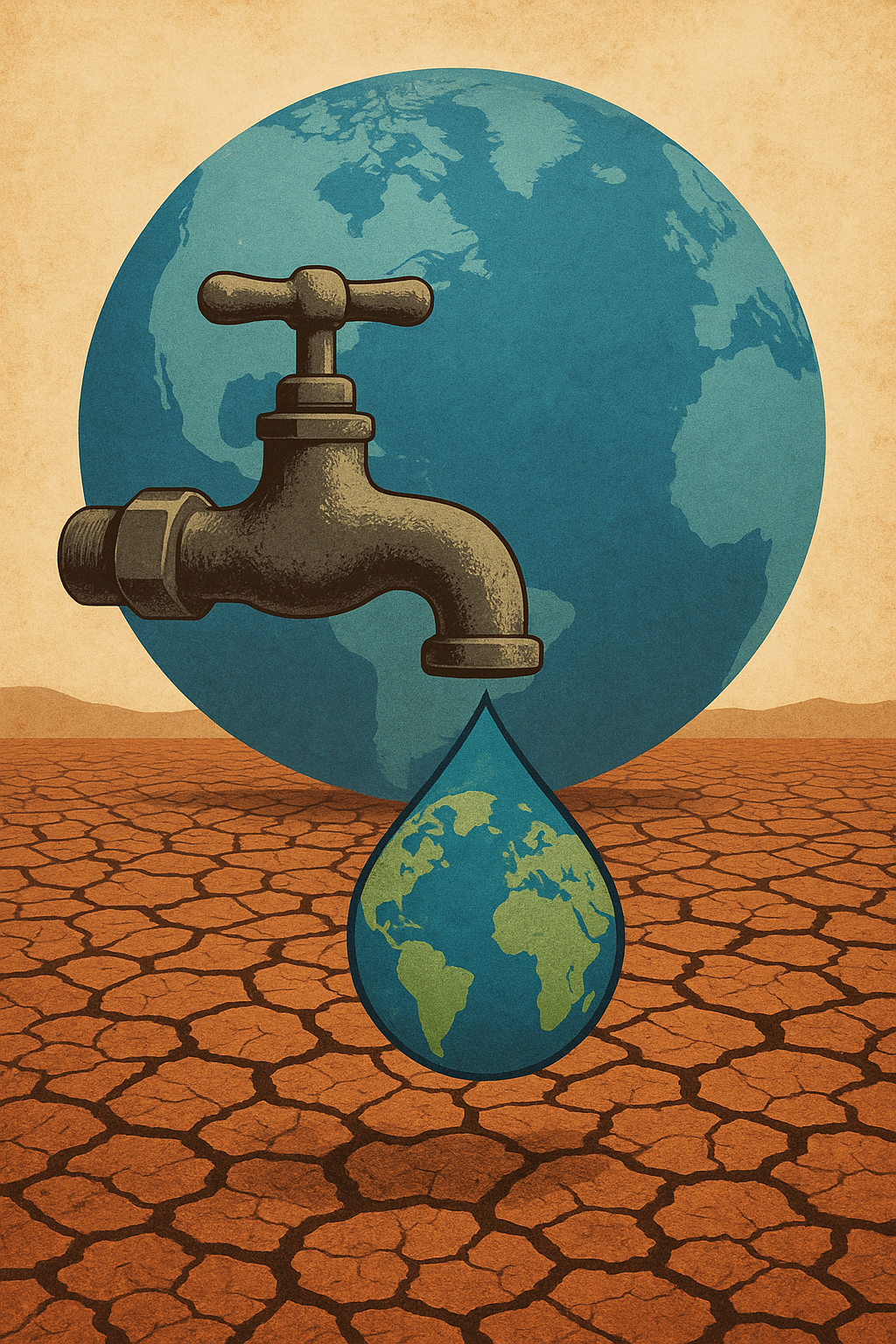
Freshwater is the world’s most vital resource — the foundation of civilization, agriculture, and life itself. Yet across the globe, rivers are running dry, aquifers are depleting, and climate change is pushing nations toward a new kind of conflict. In a world already divided by politics and inequality, the struggle over water is emerging as one of the 21st century’s most urgent geopolitical flashpoints.
The Looming Global Crisis
Only about 2.5% of Earth’s water is fresh, and less than 1% is easily accessible in lakes, rivers, and underground aquifers. But this limited supply must serve nearly 8 billion people — a population expected to reach 10 billion by mid-century. As urbanization and industrialization accelerate, the demand for water is surging even as climate patterns become more erratic.
According to the United Nations, more than 2 billion people currently live in water-stressed regions, and by 2050, that number could rise to 5 billion. Droughts are becoming more frequent and severe, and melting glaciers threaten the long-term supply for hundreds of millions. “Water is becoming the new oil,” warns Dr. Leila Hamadi, a hydrologist with the International Institute for Sustainable Development. “Except unlike oil, there is no substitute.”
When Rivers Cross Borders
Water doesn’t respect political boundaries. Around 60% of the world’s freshwater flows through transboundary rivers, shared by two or more countries. These include the Nile, Mekong, Indus, Euphrates, and Amazon — all lifelines for entire regions. As populations grow and rainfall declines, competition over these shared waters is intensifying.
Nowhere is this more evident than in Northeast Africa, where Egypt, Sudan, and Ethiopia are locked in a tense standoff over the Grand Ethiopian Renaissance Dam (GERD) on the Blue Nile. Ethiopia insists the dam is essential for its development and electricity generation, while Egypt fears it will reduce downstream water flows that sustain its population of over 100 million.
Diplomats have spent years trying to broker an agreement, but mutual distrust lingers. “It’s not just about water — it’s about sovereignty and survival,” says Ambassador Hani Mahmoud, a retired Egyptian negotiator. “For us, the Nile is life.”
Similar tensions are rising elsewhere. In South Asia, India and Pakistan continue to spar over water from the Indus River, despite a treaty that has survived wars. In Southeast Asia, the Mekong River — shared by six countries — is under strain from Chinese dams upstream, which critics say are choking the flow to downstream nations like Vietnam and Cambodia.
Climate Change as a Threat Multiplier
Climate change is reshaping the global water map. Prolonged droughts, erratic rainfall, and extreme weather are straining fragile ecosystems and political systems alike. The Middle East, already the world’s driest region, is becoming hotter and thirstier. In Iraq and Syria, declining flows from the Tigris and Euphrates — compounded by mismanagement and conflict — have devastated agriculture and forced thousands to migrate.
In Central Asia, the retreat of glaciers feeding the Amu Darya and Syr Darya rivers threatens the livelihoods of millions. Meanwhile, rising temperatures are accelerating evaporation from reservoirs and lakes, shrinking vital sources like the Aral Sea, once the world’s fourth-largest inland body of water.
“Climate change doesn’t create conflicts by itself,” explains Dr. Hamadi, “but it intensifies existing tensions. When rainfall drops and reservoirs dry up, every decision — who gets water and who doesn’t — becomes political.”
Water as a Weapon and a Diplomatic Tool
Access to water can be used as a geopolitical weapon. Control of dams and reservoirs gives upstream countries leverage over downstream neighbors. During conflicts, armed groups have targeted water infrastructure to gain power or terrorize civilians. In 2014, the so-called Islamic State seized control of dams along the Tigris River to cut water supplies and generate electricity for its operations.
Yet water can also serve as a tool for peace. Shared dependence on rivers and aquifers often forces cooperation. The Indus Waters Treaty between India and Pakistan, signed in 1960, has endured even during times of war. Similarly, the Senegal River Basin Organization has fostered collaboration among four West African nations, turning potential disputes into joint development projects.
“In a divided world, water diplomacy remains one of the few areas where cooperation is not just possible, but essential,” says Professor David Sun, a water policy expert at the University of Oxford. “It’s a shared interest that transcends ideology.”
The Hidden Crisis Beneath Our Feet
While river disputes make headlines, an even larger crisis is unfolding underground. Groundwater aquifers, which supply drinking water and irrigation for billions, are being drained faster than they can recharge. Satellite data from NASA shows significant declines in key aquifers from India to California. In parts of the Middle East, aquifers are collapsing, leading to land subsidence and saltwater intrusion.
The Ogallala Aquifer in the United States, which supports nearly one-fifth of the country’s wheat and corn production, is drying up. Scientists warn that once depleted, many of these underground reserves could take thousands of years to recover. “We are literally mining our water,” says Dr. Hamadi. “And unlike fossil fuels, this resource doesn’t come back.”
The Economics of Scarcity
Water scarcity is already reshaping economies. In agriculture — the largest consumer of freshwater — farmers are being forced to adapt by shifting to drought-resistant crops and more efficient irrigation systems. But for poorer nations, these transitions are costly. Global competition for water-intensive products such as cotton, rice, and beef is also pushing prices up, adding stress to global food systems.
Industries from manufacturing to tech are also vulnerable. Semiconductor production, for instance, requires massive amounts of ultrapure water. When Taiwan experienced severe droughts in 2021, chipmakers were forced to truck in water to keep operations running — a stark reminder that even high-tech economies are at the mercy of natural cycles.
Searching for Solutions
The good news is that innovation and cooperation are offering glimpses of hope. Desalination technology, once prohibitively expensive, has become more efficient thanks to advances in reverse osmosis membranes. Countries like Saudi Arabia, Israel, and the UAE now derive much of their freshwater from the sea. However, desalination remains energy-intensive and produces brine waste that harms marine ecosystems.
Another emerging solution is water recycling — purifying wastewater for reuse. Singapore’s “NEWater” program has become a global model, turning sewage into drinking-quality water. Meanwhile, smart irrigation systems and satellite monitoring are helping farmers use water more efficiently.
On the diplomatic front, international organizations are urging countries to establish water-sharing frameworks that emphasize collaboration over competition. The UN Water Convention, though not universally ratified, provides guidelines for equitable management of transboundary resources.
A Future of Shared Stewardship
The struggle for water is not inevitable. Experts argue that with better governance, investment, and technology, the world has enough water to meet everyone’s needs. But that will require treating water not as a commodity, but as a shared human right.
“The coming decades will test our capacity for cooperation,” says Professor Sun. “Every drop of water carries political, economic, and moral weight. How we manage it will define our collective future.”
As climate change accelerates and populations grow, the politics of water will shape global security as profoundly as oil once did. Whether it becomes a source of conflict or a catalyst for unity will depend on the choices made today — in boardrooms, in parliaments, and along the banks of the world’s great rivers.
700 701 702 703 704 705 706 707 708 709 710 711 712 713 714 715 716 717 718 719 720 721 722 723 724 725 726 727 728 729 730 731 732 733 734 735 736 737 738 739 740 741 742 743 744 745 746 747 748 749 750 751 752 753 754 755 756 757 758 759 760 761 762 763 764 765 766 767 768 769 770 771 772 773 774 775 776 777 778 779 780 781 782 783 784 785 786 787 788 789 790 791 792 793 794 795 796 797 798 799 800 801 802 803 804 805 806 807 808 809 810 811 812 813 814 815 816 817 818 819 820 821 822