NEW YORK / LONDON / TOKYO – January 26, 2026 – The invisible war for the future of global finance officially began today. Following a stern, mandatory directive issued by the U.S. National Institute of Standards and Technology (NIST) and echoed by central banks worldwide, the planet’s major financial institutions have commenced an urgent, all-hands-on-deck migration to Post-Quantum Cryptography (PQC).
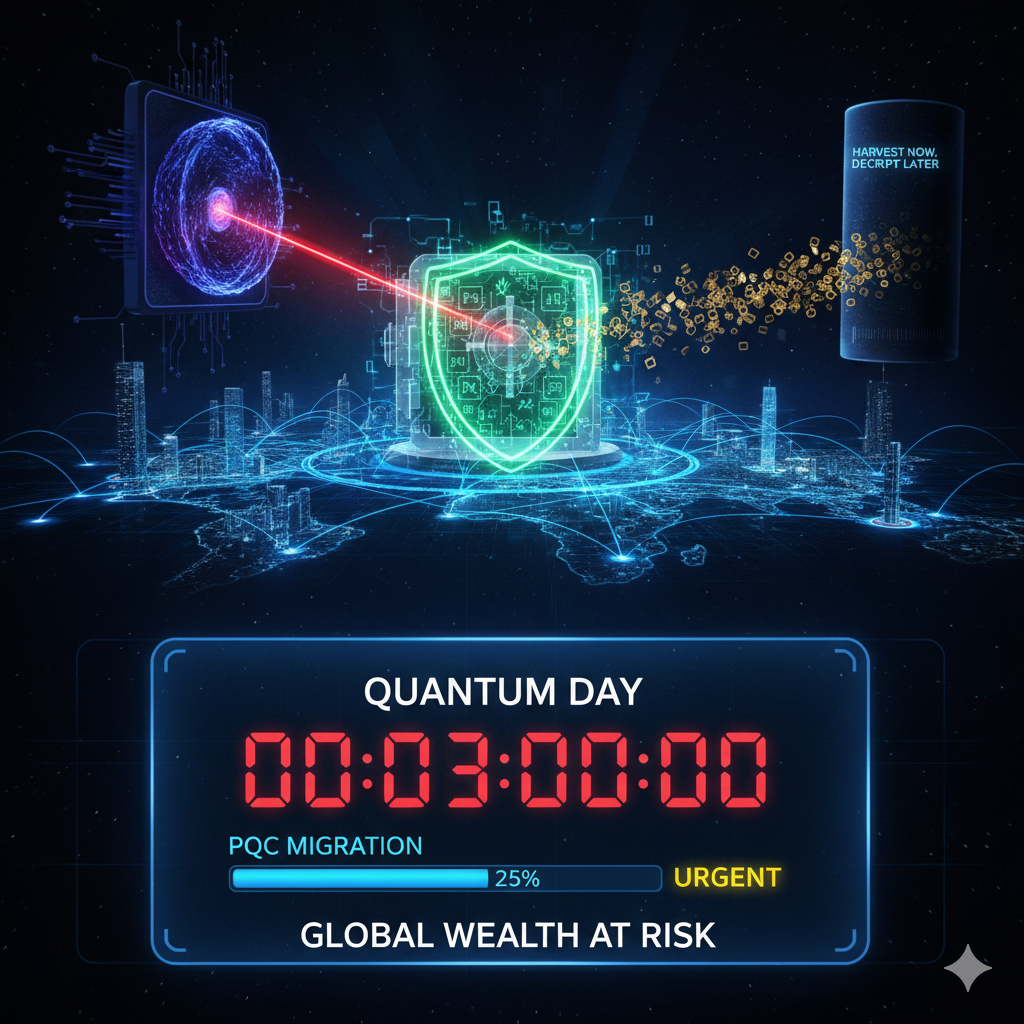
With “Quantum-Day”—the theoretical point at which fault-tolerant quantum computers could break today’s standard encryption protocols—estimated to arrive as early as 2029, the 2026 mandate is being seen as a desperate, multi-trillion-dollar race against the clock to secure global wealth before it becomes vulnerable to the most powerful computing threat in history.
The Looming Threat: Shor’s Algorithm and the “Harvest Now, Decrypt Later” Attack
For decades, the security of digital transactions, from credit card payments to international wire transfers, has rested on the mathematical impossibility of factoring large prime numbers or solving elliptic curve problems. These are the foundations of RSA and ECC encryption.
However, quantum computers, leveraging phenomena like superposition and entanglement, can theoretically execute Shor’s Algorithm, which can crack these cryptographic puzzles in minutes—a task that would take classical supercomputers billions of years.
The most immediate threat isn’t just future attacks. Experts warn of a “Harvest Now, Decrypt Later” scenario. Malicious actors, including nation-states, are already actively collecting vast amounts of encrypted financial data, intending to store it until a sufficiently powerful quantum computer becomes available. Once Quantum-Day arrives, this historical data could be decrypted, exposing decades of sensitive transactions, intellectual property, and personal financial information.
“This isn’t just about tomorrow’s transactions; it’s about the entire digital history of our financial system,” warns Dr. Anya Sharma, lead cryptographer at the World Economic Forum’s Quantum Security Initiative. “Every single encrypted communication, every bank transfer, every stock trade from the past several years, if captured, could be laid bare.”
NIST’s Mandate: A Unified Front Against an Invisible Enemy
NIST’s directive, building on its multi-year standardization process, specifies a suite of new PQC algorithms deemed “quantum-resistant.” These algorithms—including CRYSTALS-Kyber for key establishment and CRYSTALS-Dilithium for digital signatures—rely on different mathematical problems (e.g., lattice-based cryptography) that are believed to be hard even for quantum computers to solve.
Key Aspects of the Mandatory Migration:
-
System-Wide Overhaul: Not just customer-facing applications, but backend databases, interbank communication networks (like SWIFT), ATM networks, and internal corporate systems must be re-encrypted.
-
Firm Deadlines: Financial institutions have been given staggered deadlines, with core infrastructure required to be PQC-compliant by Q4 2027 and all public-facing services by Q2 2028.
-
International Harmonization: Major central banks (ECB, BoE, BoJ) have issued parallel directives, ensuring a coordinated global response to avoid fragmented security.
The Staggering Cost and the Talent Scarcity
The scale of this migration is unprecedented. Industry estimates place the global cost of quantum-proofing the financial sector at over $500 billion by 2030. This includes:
-
Software Upgrades: Implementing new cryptographic libraries across every application.
-
Hardware Replacement: Upgrading firewalls, network devices, and data centers to support new PQC standards.
-
Talent Acquisition: A severe global shortage of quantum cryptographers and PQC implementation specialists, driving up consulting fees and salaries.
Companies like IBM, Google, and a new wave of quantum security startups are seeing a massive surge in demand for their PQC solutions and expertise.
The Race Against Time: Will We Be Ready?
While the banking sector has a reputation for cautious, slow-moving change, the quantum threat is forcing an agility rarely seen. The next few years will define whether the global financial system can adapt quickly enough to protect the trillions of dollars that flow through its digital veins every day.
The stakes could not be higher. Failure to implement PQC could lead to widespread data breaches, financial chaos, and a complete erosion of trust in the digital economy. The countdown to Quantum-Day has begun, and the world’s bankers are now playing for the highest possible stakes.
700 701 702 703 704 705 706 707 708 709 710 711 712 713 714 715 716 717 718 719 720 721 722 723 724 725 726 727 728 729 730 731 732 733 734 735 736 737 738 739 740 741 742 743 744 745 746 747 748 749 750 751 752 753 754 755 756 757 758 759 760 761 762 763 764 765 766 767 768 769 770 771 772 773 774 775 776 777 778 779 780 781 782 783 784 785 786 787 788 789 790 791 792 793 794 795 796 797 798 799 800 801 802 803 804 805 806 807 808 809 810 811 812 813 814 815 816 817 818 819 820 821 822